30 High Dividend-Paying Euro Zone Stocks

In order to identify some of the high dividend paying stocks in the Euro Zone countries I referred to the EURO STOXX® Select Dividend 30 Index. This index “offers exposure to the 30 highest dividend-paying stocks from Euro Zone countries. Only companies are included that have a non-negative historical five-year dividend-per-share growth rate and a dividend to earnings-per-share ratio of less than or equal to 60%. The index is weighted according to net dividend yield.”

The table below lists the components of the  EURO STOXX® Select Dividend 30 Index and the current yield of the ADRs if available:

[TABLE=889]

Disclosure: Long EONGY, LFRGY, ENLAY, AXAHY, STD
5-Year Performance: Top Chilean vs. U.S. Bank Stocks

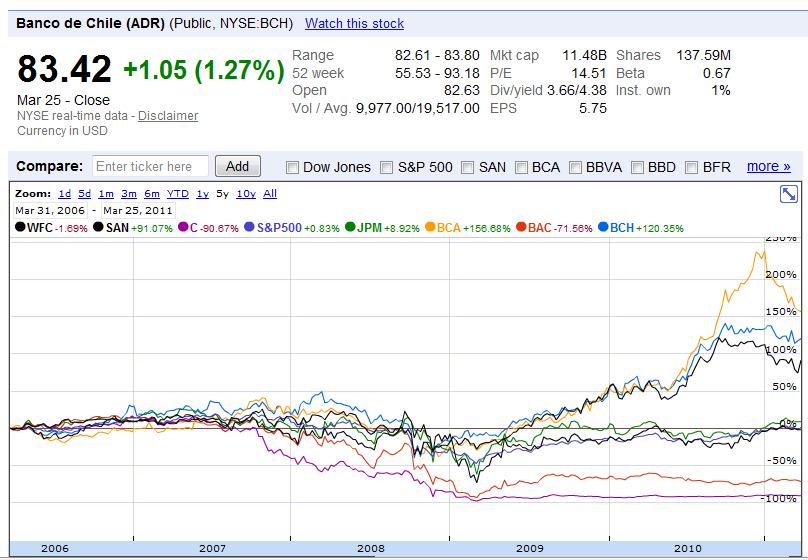
The chart below shows the 5-year performance comparison of top three Chilean banks and the four largest banks in the U.S:

Click to enlarge

chile-us-banks-compare.png

Banco Santander Chile (SAN) and Banco de Chile(BCH) are the first and second largest Chilean banks based on assets. And CorpBanca(BCA) is one of the top 10 banks by assets.

[TABLE=887]

In the past 5 years, the S&P 500 has been flat at 0.83%. Among the four largest U.S. banks only JPMorgan Chase(JPM) has been a decent performer.This week the Federal Reserve rejected Bank of America’s proposal to increase its dividend payments.. JPMorgan Chase has announced plans to buy back stock worth $15 billion and raise its dividend in the second quarter to 25 cents a share up from 5 cents now. Wells Fargo(WFC) has increased the quarterly dividend rate to $0.12 a share and announced the repurchase of its common stock by an additional 200 million shares. Citigroup (C) plans to reinstate a one-cent dividend and implement a reverse stock split in the ratio of 1 for 10 after the market close on May 6. Citi’s total outstanding shares stands at a massive 29 billion and in the last 50 days an average of 509 million shares were traded on the NYSE. As a result of the reverse split, the daily trading volume on the NYSE is projected to fall by an incredible 11% according to a Reuters report.

Disclosure: Long BCH

Six Foreign Stock Splits

Despite the volatility in equity markets for a few months now, some foreign companies are implementing stock splits to increase liquidity. The following are some of the foreign stocks that recently had stock splits:

1.Telefonica SA (TEF)
Sector: Telecom
Country: Spain
Split Ratio: 3:1
Split Date: 1/21/11
Current Dividend Yield: 7.17%
Current Stock Price: $25.10

2.Potash Corp Of Saskatchewan Inc (POT)
Sector: Non-Metallic Mining
Country: Canada
Split Ratio: 3:1
Split Date: 2/25/11
Current Dividend Yield: 0.49%
Current Stock Price: $57.23

3.Ultrapar Participacoes SA(UGP)
Sector: Oil & Gas Operations
Country: Brazil
Split Ratio: 4:1
Split Date: 2/25/11
Current Dividend Yield: 3.34%
Current Stock Price: $16.69

4.Technip SA (TKPPY)
Sector: Oil Well Services & Equipment
Country: France
Split Ratio: 4:1
Split Date: 3/22/11
Current Dividend Yield: 1.66%
Current Stock Price: $25.75

5.Cemex SAB De CV (CX)
Sector: Construction – Raw Materials
Country: Mexico
Split Ratio: 1.040:1
Split Date: 3/25/11
Current Dividend Yield: N/A
Current Stock Price: $8.81

Update:

7. Nedbank Group Ltd (NDBKY)
Sector: Banking
Country: South Africa
Split Ratio: 2:1
Split Date: 1/31/11
Current Dividend Yield: 3.74%
Current Stock Price: $19.93

8. CorpBanca (BCA)
Sector: Banking
Country: Chile
Split Ratio: 3.3333:1
Split Date: 2/23/11
Current Dividend Yield: 7.85%
Current Stock Price: $21.10

NedBank changed the ratio on the Depositary Receipt program from 1 Depositary Share  representing 2 Ordinary shares to 1 DS representing 1 Ordinary share. Hence all ADR holders received an additional DR share.

Canada-based oil services provider Enbridge Inc (ENB) has proposed a 2-for-1 split with a split date of 5/25/11.The current yield of ENB is 3.26% and the stock price is $60.89.

Disclosure: No Positions

Note: Stock price and dividend yield noted above are as of Mar 25, 2011.

A Look At China’s Dazzling Economic Growth

China has become the driver of global economic growth for many years now. As a communist country following a “Market Socialism” philosophy China continues to grow despite slowdown in developed economies and other emerging markets.

The following is brief overview of few of the statistics on China’s incredible growth. From a recent OECD report:

Ten years ago, on the eve of the 2001 slowdown, the world economy was expanding at a rate of close to 5% and China accounted for just over one tenth of that growth. Last year, as the world bounced back from the worst recession since the Great Depression, and growth was once again close to 5%, China contributed almost one third of global growth. In the meantime, it had become the world’s second-largest economy.

Ten years ago, China’s current account surplus stood at less than 2% of GDP, and its foreign exchange reserves at $166 billion, or 14% of GDP. Last year, China’s current account surplus exceeded 5% of GDP, down sharply from its 2007 double-digit peak, but still too high for comfort, while foreign exchange reserves towered at $2.85 trillion, or half of China’s GDP.

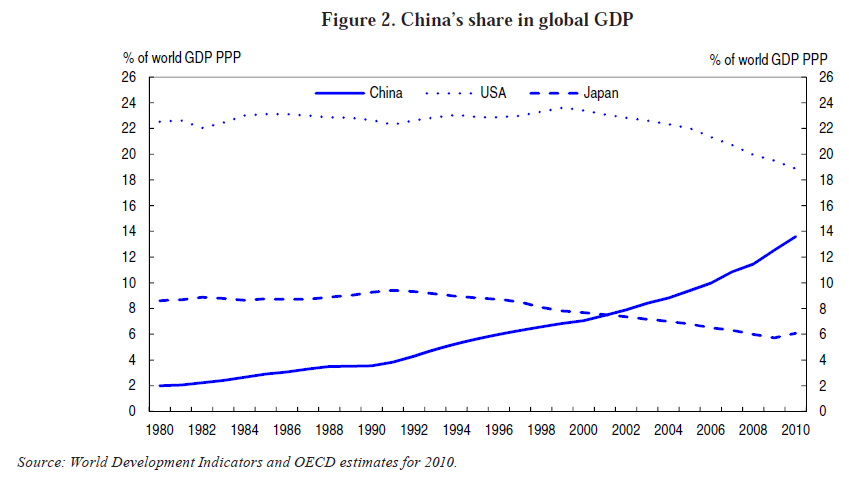
Two decades ago China accounted for less than 4% of global GDP at PPP exchange rates. Since then China’s sustained and rapid economic growth has pushed the share to 13% by 2010 as shown in the graph below. Meanwhile from 2000, the U.S. share of global GDP has decreased at a consistent pace.

china-share-of-global-gdp.png

China’s 12th Five Year Plan runs from 2011 to 2015. This plan outlines policies to changing the country from being the factor-floor of the world to more of a technology-based economic power. A an example of China’s successful transformation to a high-tech economy is the buildup of high-speed rail lines across the country.The stark contrast between this initiative and that of the situation in the U.S. couldn’t be more shocking.

From an article in Yale Environment 360:

China has committed to investing $360 billion to vastly expand its showcase network of high-speed trains, which already carry passengers at more than 200 miles per hour between some of the country’s largest cities.

Spain, despite its economic woes, is investing $170 billion to extend its acclaimed high-speed rail system, which now makes the 386-mile Madrid-Barcelona run in just 2 hours, 38 minutes — compared to six hours by car. A similar boom in high-speed rail construction is taking place throughout Europe, from the boot of Italy to the Baltic Sea.

Worldwide, nations not normally associated with the bullet train revolution — India, Brazil, Argentina, and Morocco, among others — are making plans to build high-speed rail networks. They understand that rapid, inter-city rail systems will be essential to developing competitive 21st-century economies as oil supplies dwindle, highways and airports face increasing congestion, and pressure to reduce carbon emissions rises.

And the United States? For the past several months the news on the high-speed rail front has been dominated by several governors, swept into power by the Tea Party movement, proudly proclaiming that they will have nothing to do with high-speed rail projects, which they contend are boondoggles. Indeed, the governors of Florida, Wisconsin, and Ohio have collectively rejected $3.6 billion in federal funds that would have covered nearly all of the cost of building rail lines on such routes as Orlando to Tampa, Milwaukee to Madison, and Cleveland to Columbus.

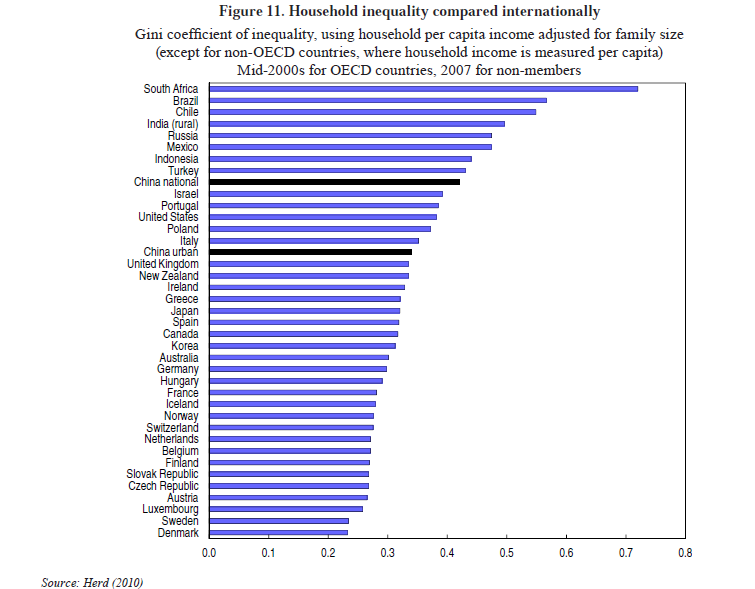
Unlike other emerging countries China’s economic growth does not seem to benefit only a small section of the population. Income inequality as measured by the Gini coefficient is not very high relative to other countries such as Brazil, India and Russia.

china-world-gini-coefficient.png

Source: China’s Emergence as a Market Economy: Achievements and Challenges, OECD contribution to the China Development Forum, 20-21 March 2011, Beijing.

The World’s Best Emerging Market Banks in Latin America 2011

The Global Finance magazine has published the list of Best Banks in Latin America for 2011. The winners were selected based on factors such as growth in assets, profitability, strategic relationships, customer service, competitive pricing, innovative products, etc.

The World’s Best Emerging Market Banks in Latin America 2011

[TABLE=886]

Source: Global Finance

Canadian banking group Bank of NovoScotia’s(BNS) subsidiaries are the winners in five Latin American countries including Costa Rica. Chile’s Banco Santander Chile (SAN) currently has a 3.17% dividend yield. The Bank proposes to payout 60% of its 2010 earnings as dividends to shareholders. Some of the notable winners of large Latin American economies include Itau-Unibanco(ITUB) of Brazil, Banamex of Mexico and Banco Santander Rio of Aregentina. Banamex is the Mexican unit of Citigroup(C).

Disclosure: Long BNS, ITUB