Portugal: A Nation of Dropouts

Portugal used to be called The Sick Man of Europe before the economy recovered in the 1990s. However in 2007 The Economist magazine dubbed the country as the “new sick man of Europe”. More recently traders made it a member of the PIGS group of countries. Despite being part of the EU and appearance of prosperity Portugal is still dominated by agriculture and industrial development lags behind. Illiteracy remains a major issue and the high school dropout rate is too high. A recent article in the Journal noted that lack of educated professionals remains a major stumbling block to economic recovery.

From the article:

The state of Portuguese education says a lot about why a rescue is likely to be needed, and why one would be costly and difficult. Put simply, Portugal must generate enough long-term economic growth to pay off its large debts. An unskilled work force makes that hard.

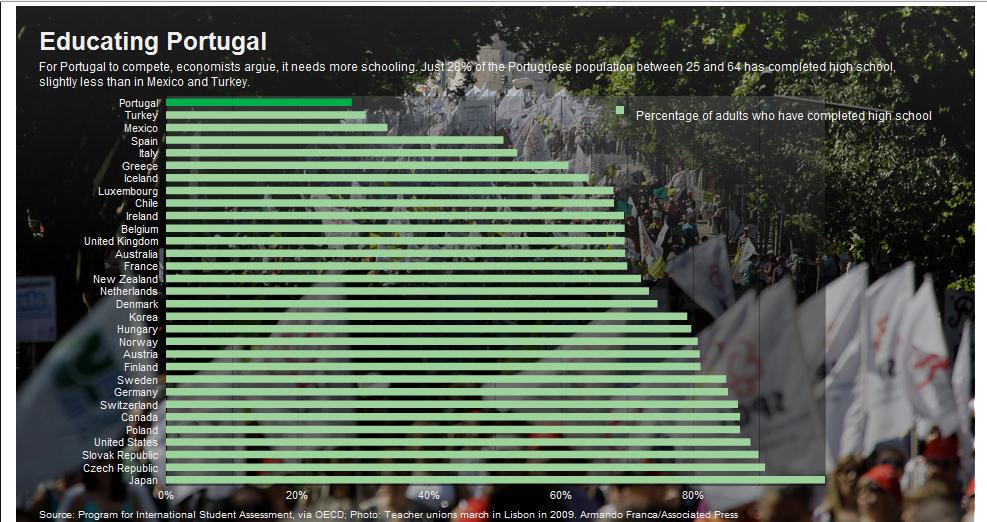
Cheap rote labor that once sustained Portugal’s textile industry has vanished to Asia. The former Eastern Bloc countries that joined the European Union en masse in 2004 offer lower wages and workers with more schooling. They have sucked skilled jobs away.Just 28% of the Portuguese population between 25 and 64 has completed high school. The figure is 85% in Germany, 91% in the Czech Republic and 89% in the U.S.

“I don’t see how it is going to grow without educating its work force,” says Pedro Carneiro, an economist at University College London who left Portugal to do his postgraduate studies in the U.S. The education woes in Portugal show the extent of Europe’s challenge as it tries to right itself amid the sovereign-debt crisis.

Click to enlarge
best-portugla-education.jpg

Ireland has an educated workforce but the economy crashed due to the work of greedy bankers and incompetent regulators. Greece has a chronic corruption problem and has been the poorest country in Europe for many decades now.

Among the Portuguese ADRs trading on the US markets, electric utility Energias de Portugal (EDPFY) has a 4.91% dividend yield and telecom services provider Portugal Telecom(PT) pays a 6.02% dividend.

Disclosure: No Positions
ADR Review: Metering Device Maker Elster Group

Elster Group ADR – Terminated Effective 12/6/13. Details here.

Essen, Germany-based Elster Group(ELT) is a world leader in Advanced Metering Infrastructure (AMI) and integrated metering and utilization solutions to the gas, electricity and water industries. The company’s products and solutions are used to accurately and reliably measure gas, electricity and water consumption as well as enable energy efficiency and conservation. Elster has operations in 38 countries.

In the fourth quarter of 2010, Elster had revenues of $476.8 million, up 5.9% year-over-year and the GAAP earnings was $0.30 per ADS. For the full year, total revenues came in at $1,759.3 million.

The ADS started trading on the NYSE in October of last year. Currently the stock does not pay a dividend. The Friday’s closing price of $16.30 is just a dollar shy of the 52-week high of $17.44.

In the last 10 years Elster has installed over 200 million metering devices in more than 130 countries for both residential and industrial customers. With energy conservation and the green movement gaining more acceptance among the general population in recent years, the future looks promising for Elster.Investors may want to keep an eye on this interesting German company operating in one of the most-promising industries.

Disclosure: No Positions

Why is College Tuition Increasing Consistently in the U.S.?

College tuition rates are increasing year-after-year in the U.S. making more students carry heavier debt-loads by the time they graduate. Last year for the first time, student-loan debt surpassed credit-card debt.From an article in The Wall Street Journal:

Consumers now owe more on their student loans than their credit cards.

Americans owe some $826.5 billion in revolving credit, according to June 2010 figures from the Federal Reserve. (Most of revolving credit is credit-card debt.) Student loans outstanding today both federal and private total some $829.785 billion, according to Mark Kantrowitz, publisher of FinAid.org and FastWeb.com.

The growth in education debt outstanding is like cooking a lobster, Mr. Kantrowitz says. “The increase in total student debt occurs slowly but steadily, so by the time you notice that the water is boiling, you are already cooked.

By his math, there is $605.6 billion in federal student loans outstanding and $167.8 billion in private student loans outstanding. He estimates that $300 billion in federal student loan debts have been incurred in the last four years.

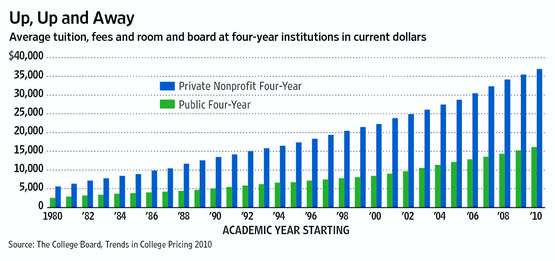
The chart below shows the consistent pace at which college tuition is increasing since 1980:

US-Tuition-Fees

Source: The Wall Street Journal

It must be noted that most of the U.S. schools offer mediocre education despite charging high tuition and accordingly churn out average or functionally illiterate students. One question that many in the main stream media fail to ask is why college college tuition is rising year-after-year.

I believe one of the reasons for the rising costs of tuition is the liberal granting of student loans by Uncle Sam and private lenders. When the U.S. government offers loans easily it provides an incentive for students to take on huge debts in the pursuit of gaining higher education and more importantly it creates a strong incentive for school boards to raise tuition and other fees. As students are hit with higher fees college presidents, professors and instructors give themselves high salaries and raises year after year. It is not unheard of for some top college presidents to make more than a million dollars in compensation similar to executives in private sector. In addition, average tenured-professors make in excess of $100K in pay and benefits for a few hours of teaching each week.

Whenever Uncle Sam gets involved in an industry in the false belief that everyone should be able to afford something it leads to a bubble. For example, the U.S. real estate bubble became so huge and ultimately crashed due in part by the easy approval of home loans which were in turn backed by US-sponsored agencies such as Fannie Mae and Freddie Mac. Unlike other countries, the U.S. government believes that owing a home is a right and not a privilege. The same thinking is applied to higher education as well leading to inflation of tuition.If lending standards are tightened and loans made more difficult to obtain for students who cannot repay then the runaway gray-train tor those in the college business can be stopped and tuition will return to fair and affordable levels.Until that happens college tuition will continue to soar irrespective of unemployment rates, recession and other factors.

Also checkout:

      1. On the Continuous Rise of College Tuition in the U.S., April 19, 2015 (TFS)
      2. Where Public College Tuition Is Growing the Fastest, Bloomberg, Nov 2015
      3. Foreign Students In U.S. Universities and Colleges, April 19, 2015 (TFS)
      4. Three Reasons for Those Hefty College Tuition Bills, NY Times, Dec 19, 2015
      5.  US College Tuition Costs in 2014:  

Click to enlarge           

US college tuition costs 2014
Source: Questions Families Need to Ask About Paying for College, WSJ, Sept 21, 2015

6. College tuition rising at slowest rate ever, MarketWatch, Feb 19, 2016

30 High Dividend-Paying Euro Zone Stocks

In order to identify some of the high dividend paying stocks in the Euro Zone countries I referred to the EURO STOXX® Select Dividend 30 Index. This index “offers exposure to the 30 highest dividend-paying stocks from Euro Zone countries. Only companies are included that have a non-negative historical five-year dividend-per-share growth rate and a dividend to earnings-per-share ratio of less than or equal to 60%. The index is weighted according to net dividend yield.”

The table below lists the components of the  EURO STOXX® Select Dividend 30 Index and the current yield of the ADRs if available:

[TABLE=889]

Disclosure: Long EONGY, LFRGY, ENLAY, AXAHY, STD

5-Year Performance: Top Chilean vs. U.S. Bank Stocks

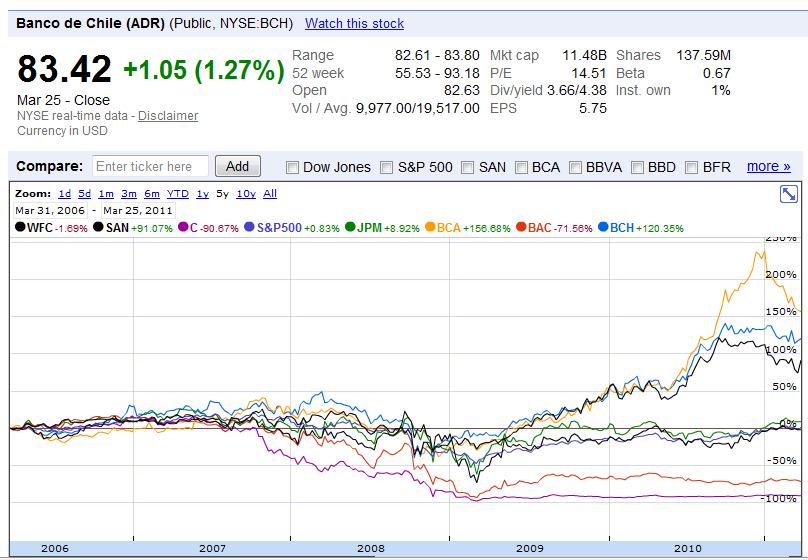
The chart below shows the 5-year performance comparison of top three Chilean banks and the four largest banks in the U.S:

Click to enlarge

chile-us-banks-compare.png

Banco Santander Chile (SAN) and Banco de Chile(BCH) are the first and second largest Chilean banks based on assets. And CorpBanca(BCA) is one of the top 10 banks by assets.

[TABLE=887]

In the past 5 years, the S&P 500 has been flat at 0.83%. Among the four largest U.S. banks only JPMorgan Chase(JPM) has been a decent performer.This week the Federal Reserve rejected Bank of America’s proposal to increase its dividend payments.. JPMorgan Chase has announced plans to buy back stock worth $15 billion and raise its dividend in the second quarter to 25 cents a share up from 5 cents now. Wells Fargo(WFC) has increased the quarterly dividend rate to $0.12 a share and announced the repurchase of its common stock by an additional 200 million shares. Citigroup (C) plans to reinstate a one-cent dividend and implement a reverse stock split in the ratio of 1 for 10 after the market close on May 6. Citi’s total outstanding shares stands at a massive 29 billion and in the last 50 days an average of 509 million shares were traded on the NYSE. As a result of the reverse split, the daily trading volume on the NYSE is projected to fall by an incredible 11% according to a Reuters report.

Disclosure: Long BCH