Another Take on Why Diversification is Important

In an earlier post we reviewed about why diversification matters in building a portfolio. In this post let us take another look at a two charts that show the importance of diversification across various asset classes and sectors.

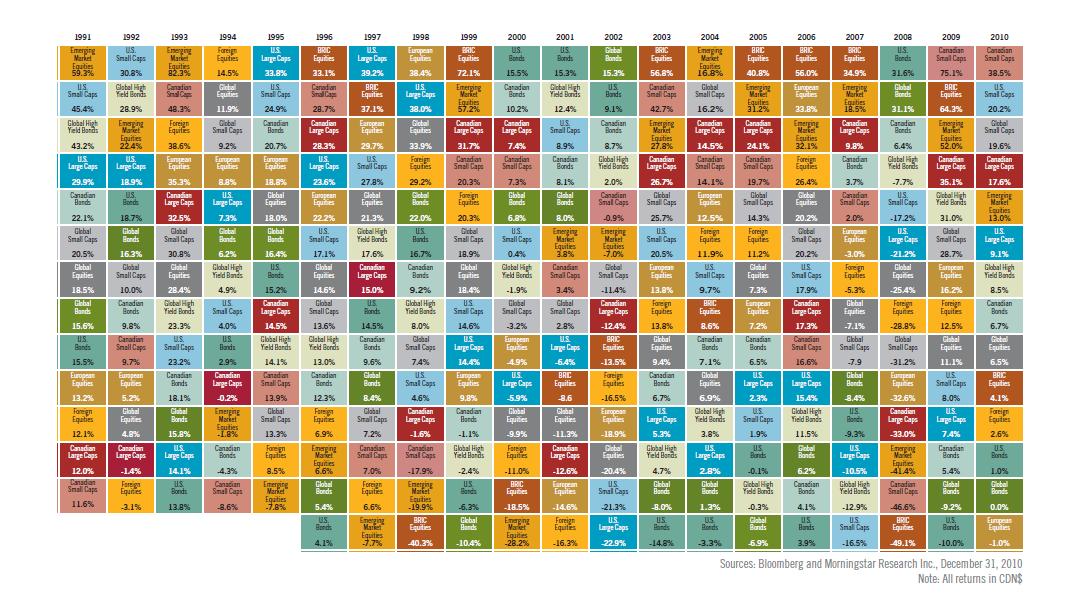
The period table of investment return below shows the performance of various asset classes from 1991 to 2010:

Click to enlarge
Asset-Class-Returns-1991-2010

asset-class-defns.jpg

At the depth of the Global Financial Crisis(GFC) in 2008, emerging markets fell 41.4% and BRIC equities crashed almost by 50%. However U.S. large caps fell just 21.4% and U.S. bonds were the best performers with a return of 31.6%. In four out of the five prior to 2008, BRIC equities were the top asset class earning high double digit returns each year.

Note: All returns noted in the above chart are in Canadian $ terms.

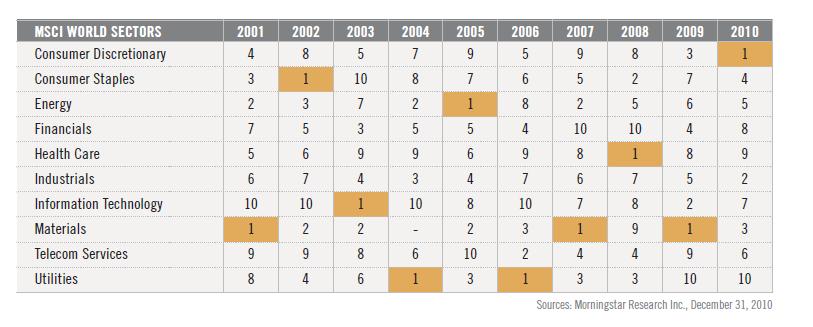
In addition to diversifying across various asset classes as noted above, it is also essential to diversify across sectors. Since top performing sectors rotate in and out of favor, this strategy will help an investor to avoid predicting which sector will be the winner each year.
annual-sector-performance.jpg

Source: Why Diversify?, Franklin Templeton Investments

Related ETFs:
Vanguard Emerging Markets ETF (VWO)
SPDR S&P 500 ETF (SPY)
SPDR STOXX Europe 50 ETF (FEU)

Disclosure: No Positions
Foreign Chemical Makers Offer Investment Opportunities

chemicals.jpgIn the most recent M&A deal in the chemical industry, Belgian chemical and plastics maker Solvay (SVYZY) agreed to buy French speciality chemical maker Rhodia(RHAYY) for 3.3 billion Euros. This represents premium of 50% to Rhodia’s closing price on April 1, 2011.  This is an all-cash deal with Solvay offering 31.60 Euros for each Rhodia share.

Solvay’s footprint in the emerging markets of China, Brazil and India is set to increase with this deal. In addition it will beef up its R&D capabilities and innovation of new products. Solvay’s OTC-listed ADR closed at $12.80 today. While Solvay has paid a rich premium for Rhodia, the deal should benefit Solvay tremendously in the long run since demand for chemicals continues to rise in emerging markets. Investors looking to gain some exposure to the chemical sector may want to add Solvay at current levels.

Unlike other industries, acquirers in chemical sector usually pay a nice premium for their targets. Some of the past notable takeovers include the acquisition of UK’s paint maker ICI by Dutuch chemical giant Akzo Noble (AKZOY) in 2007, Dow Chemical’s(DOW) acquisition of Rohm and Haas in 2008, BASF’s (BASFY) $5B acquisition of Engelhard in 2006 and Swiss specialty chemical maker Ciba in 2008. Dow Chemicals paid a 74% premium to buy Rohm and Haas. Some of the foreign chemical stocks that are available on the U.S. market include Bayer (BYERF),Yara International (YARIY),L’Air Liquide (AIQUY), Braskem (BAK), Syngenta (SYT),Arkema (ARKAY),Nova Chemicals Corp.(NCX),K+S AG (KPLUY) and Linde AG (LNEGY)

Disclosure: No Positions

Knowledge is Power: China, Amsterdam, Tech Bubble Edition

Up to our eyes


Amsterdam canals10 fun things to do in Amsterdam

How to Avoid the Pitfalls of a New Tech Bubble: Matthew Lynn

Is Osborne fit to run economy – or ruin it?

REITs Outpace S&P 500 In 1st Quarter

5 Ways the Government Screws Up Housing Finance

Canada’s demographic time bomb

China becoming the Pacific’s ‘banker’: think tank

Why China’s economy needs some quality time

The World’s Best Developed Market Banks 2011

The Global Finance magazine has published the winners for the Best Developed Market Banks awards for this year. The winning banks were selected in 25 countries with the exclusion of Ireland and Iceland. From the news report:

The winners of this year’s awards are those banks that attended carefully to their customers’ needs in difficult markets and accomplished better results while laying the foundations for future success.

All selections were made by the editors of Global Finance, after extensive consultations with bankers, corporate financial executives and analysts throughout the world. In selecting these top banks, we considered factors that range from the quantitative objective to the informed subjective. Banks were invited to submit entries supporting their selection. Amid nominally objective criteria were growth in assets, profitability, geographic reach, strategic relationships, new business development and innovation in products. Subjective criteria included the opinions of equity analysts, credit rating analysts, banking consultants and others involved in the industry. The mix of these factors yields leading banks that may not be the largest, the oldest or the most diversified in a given country, but rather the best — the banks with which corporations around the world would most likely want to do business.

The World’s Best Developed Market Banks 2011:

[TABLE=891]

JPMorgan Chase(JPM) is the best bank in the U.S. The bank survived the financial crisis well and has announced plans to raise its dividend. Due to the current uncertainty with European banks it is a better to avoid them altogether for most investors until the dust settles. However investors willing to take a long-term view may nibble at some of the bank stocks at current levels. For Finland’s Nordea Bank (NRBAY) and Austria’s Raiffeisen Bank(RAIFY) have the potential for strong growth since they are well capitalized and have written off most of the losses from their books. Australia’s Commonwealth bank(CMWAY) and Singapore’s United Overseas Bank(UOVEY) should benefit from emerging Asia’s growth.

Disclosure: Long RY, DNSKY, STD

The World’s Best Emerging Market Banks in Asia 2011

In an earlier post we looked at the Best Banks in Latin America based on rankings by the Global Finance magazine. The table below lists the Best Banks in Asia for 2011:

[TABLE=890]

Source: Global Finance

China’s Industrial And Commercial Bank Of China Ltd aka ICBC trades on the OTC market under the ticker IDCBY and has a dividend yield of 2.92%. India’s HDFC Bank (HDB) has a yield of 0.44% but has a high P/E of over 31. Malayan Banking (MLYBY) of Malaysia closed at $6.15 and pays a  juicy dividend of 9.09%. South Korea’s Shinhan Financial Group Co (SHG) has a yield of just 0.77%.

Disclosure: No Positions