The table below lists 16 foreign stocks yielding more than 7% in dividends as of May 3, 2011:
[TABLE=947]
Disclosure: Long SAN
The table below lists 16 foreign stocks yielding more than 7% in dividends as of May 3, 2011:
[TABLE=947]
Disclosure: Long SAN
After the recent financial crisis many banks have shored up their balance sheets and are now raising dividends due to increasing earnings. However some investors are still avoiding bank stocks according to a piece in the Journal yesterday. From the article:
Nearly 300 banks had reduced or discontinued their dividends since 2008, saving the industry nearly $100 billion in shareholder payouts, according to boutique investment bank Keefe, Bruyette & Woods Inc.
Now, more than a dozen banks have raised dividends so far in the second quarter, on top of the 39 financial institutions that raised payouts earlier this year, according to KBW research.
After passing regulatory tests to probe banks’ readiness to withstand financial shocks, 10 of the nation’s largest banks are poised to return more than $10 billion to shareholders this year, according to RBC Capital Markets.
Still, some investors who were badly burned by the financial crisis are steering clear of bank stocks.
Despite the improved earnings that many banks reported last month, shareholders worry the fragile economy could crimp nascent demand for new loans. Rising regulatory costs and more-stringent capital requirements may slow revenue and profit growth for the next few years, they fear. At the same time, regional and smaller banks continue to grapple with piles of bad precrisis loans.
“My clients, especially the retired ones, are still scared,” said Frank Shull, vice president at Lara, Shull & May LLC, a money-management firm in Falls Church, Va., that invests on behalf of wealthy individuals.
“Obviously, the resumption of dividends is good, but we would rather not be early” investors in the stocks, he said. “There are still a lot of banks that we are unsure of.”
Rising earnings suggest more dividend increases on the horizon.
The rate of the industry’s earnings recovery is outpacing the amount of capital being returned to shareholders. The banking industry’s dividend ratio—as measured by dividing the payouts by earnings—stood at 25.7% in the first quarter, the lowest first-quarter level since 1993, according to Sandler O’Neill + Partners.
As mentioned in the article above for some investors avoiding bank stocks may be the best option. But those that are willing to make a long-term investment and stomach some risk can nibble at a few of these bank stocks. With hundreds of banks trading on the markets it is a challenge to filter and identify candidates for potential investment.
I have listed ten mid-size bank stocks below with their current dividend yields. These were the top ranked banks from last year’s Top 150 Performers list published by the Bank Director magazine.
1.First Financial Bankshares Inc (NASDAQ:FFIN)
Current Dividend Yield: 1.73%
2.Bank Of The Ozarks Inc (NASDAQ:OZRK)
Current Dividend Yield: 1.62%
3.Glacier Bancorp Inc (NASDAQ:GBCI)
Current Dividend Yield: 3.46%
4.Westamerica BanCorp (NASDAQ:WABC)
Current Dividend Yield: 2.84%
5.Republic Bancorp Inc (NASDAQ:RBCAA)
Current Dividend Yield: 2.63%
6.Bank Of Hawaii Corp (NYSE:BOH)
Current Dividend Yield: 3.69%
7.International Bancshares Corp (NASDAQ:IBOC)
Current Dividend Yield: 2.16%
8.1St Source Corp (NASDAQ:SRCE)
Current Dividend Yield:3.02%
9.CVB Financial Corp (NASDAQ:CVBF)
Current Dividend Yield: 3.49%
10.Northern Trust Corp (NASDAQ:NTRS)
Current Dividend Yield: 2.24%
Disclosure: Long GBCI
The list of the most customer friendly banks in India based on a study by the Outlook Money magazine is shown below:
Click to enlarge
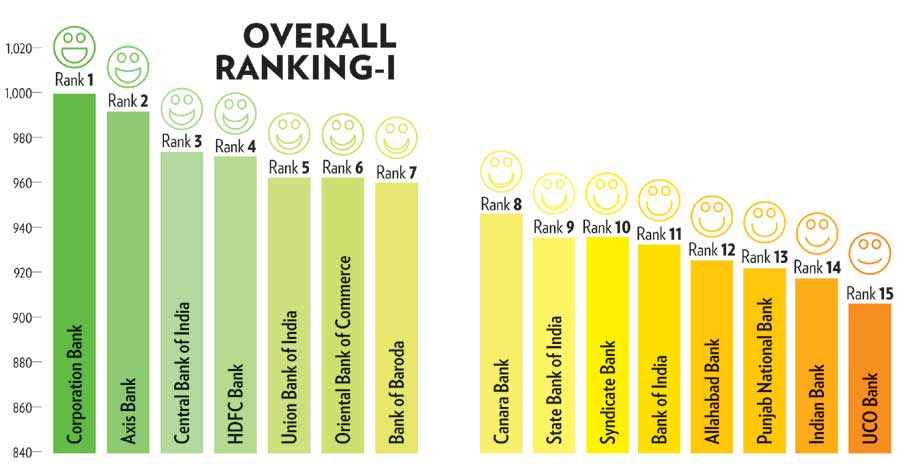
Source: India’s Most Customer Friendly Banks
HDFC Bank(HDB) currently has a 0.45% dividend yield.
Disclosure: No positions
The U.S. dollar has been on a downward spiral for many years now. The following chart makes it clear the severity of the dollar’s plunge against major currencies since 2002:
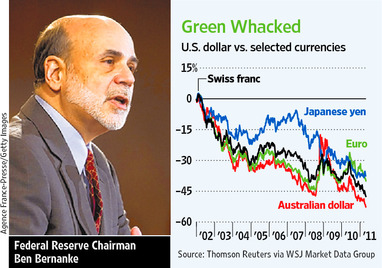
Source: The Wall Street Journal
As the dollar continues to fall many investors seek the shelter in gold which has driven the price of gold to record levels. From a journal article titled How to Profit From the Shrinking Dollar:
A slumping dollar historically has been good for stocks. The classic stock play during periods of dollar weakness is large-cap companies that export heavily: Companies in the S&P 500 index derive nearly half of their revenues from abroad, notes Howard Silverblatt, senior index analyst at Standard & Poor’s.
Such companies benefit from a weaker dollar in two ways. In the shorter term, profits rise as companies convert their foreign sales into dollars. In the longer term, their products become more competitive in overseas markets, boosting revenue as well.
Barry Knapp, U.S. equity portfolio strategist at Barclays Capital, says big stocks are poised to outperform. He points to the fourth quarter of 2003, when the Federal funds rate hovered at 1%, triggering inflation fears that sent the dollar down 5.8%. The large-cap S&P 500-stock index surged 11.6%.
Large-cap technology companies usually see an uptick in their stock price when the dollar flails, says Emily Sanders, chief investment officer at Norcross, Ga.-based Sanders Financial Management Inc. Of the 10 sectors in the S&P 500, information technology generates the highest proportion of revenues outside the U.S.—an average of 57%, notes Ms. Sanders.
She says she especially likes International Business Machines Corp., whose sales increased 8% during the first quarter, with more than one-third of the gain coming from a weakening dollar. Most of her clients own the company in their portfolios.
The surprise lately has been the performance of small and midcap companies—those with market valuations of less than $5 billion. During the past 120 days, midcaps have seen their “correlation” with the ICE US Dollar Index—the degree to which the two trade together—fall to minus-0.76 from minus-0.55. (A correlation of 1.0 means two assets trade in perfect lockstep; a correlation of minus-1.0 means they trade in perfect opposition.)
Small caps—companies with an average market value of less than $1 billion or so—have seen their dollar correlations fall to minus-0.68 from minus-0.53. Large caps’ correlation fell only slightly to minus-0.69 from minus-0.64.
In other words, as the dollar has weakened, midcaps have risen the most: The S&P Midcap 400 index has jumped 12% during the period, while the S&P Small Cap 600 has gained 10% and the S&P 500 is up 8.2%.
In a declining dollar environment which sectors of the equity market offer the best opportunities?
Stocks in the Technology and Materials sectors are the most attractive in the current situation as they have the highest overseas revenues as shown in the graphic below:
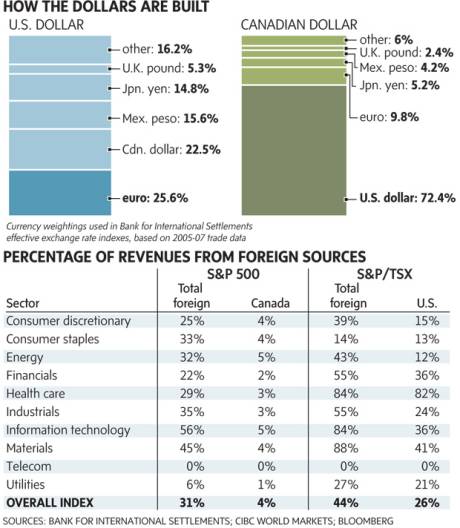
Source: The Globe and Mail
Related ETFs:
Disclosure: No positions
Rising food prices heavily affects low-income countries than developed markets. The following chart shows the food expenses share of the Consumer Price Index (CPI) for a few countries:
Click to enlarge
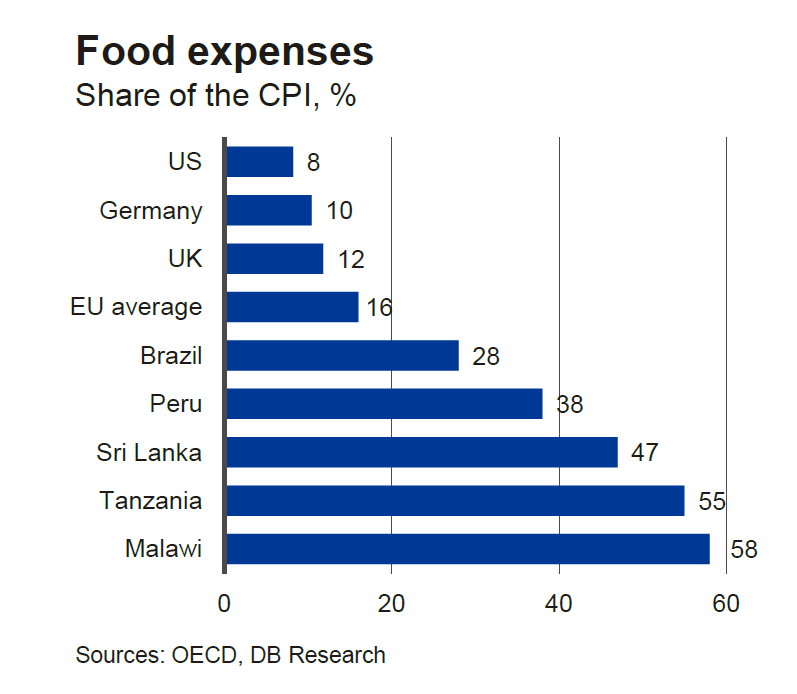
Source: Rising food prices – Short-term drivers, trends, implications, Deutsche Bank Research
From an article titled Asia Price Rises Imperil Growth in The Wall Street Journal:
Unchecked increases in oil and food prices could shave growth across Asia over the next two years, according to a report by the Asian Development Bank, imperiling economic gains among the poor in the globe’s fastest expanding region.
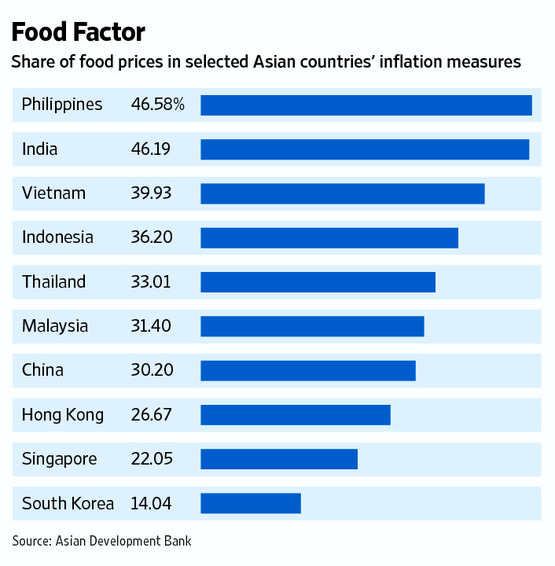
The ADB report warned Tuesday that if fuel and food prices continue to rise at their current pace, inflation could shave between 0.4 and 1.5 percentage points off gross domestic product in each of Asia’s largest developing economies this year and next, including in China and India. Barring such price rises, the intergovernmental bank expects growth in the region overall to be 7.8% this year. Inflation has become the dominant economic challenge in the region, prompting widespread monetary tightening and other measures, such as price caps, fuel subsidies and tariff reductions. Several countries, including China, Indonesia and South Korea have allowed their currencies to strengthen recently, making imported goods, especially commodities, more affordable.
Inflation continues to accelerate despite these measures. This week, Vietnam announced its April inflation rate hit 17.5% compared with a year earlier, the fastest rate in over two years, as increased supplies and attempts by the government to cool lending failed to halt the rise in food and fuel prices.
Food prices, which account for 40% of Vietnam’s inflation measure, rose 4.5% in April alone.
The takeaway for investors is that governments in emerging markets will try to rein in on inflation by raising interest rates which will adversely affect equity markets