Why Small and Mid Caps Are Better Investments Than Large Caps

Smaller companies in general tend to yield better returns than larger companies despite their higher risk and other perceived negative factors. I came across two articles that confirms that stocks of small companies are better investments than most large companies.

From “Why So Many Blue-Chip Investors Are Still Singing the Blues” by Jason Zweig in The Wall Street Journal:

Over the past decade, the Dow Jones Industrial Average and the Standard & Poor’s 100 index—selected baskets of the biggest stocks—produced an annual average total return of 4.7% and 2.1%, respectively. Small and midsize companies provided an annualized total return of roughly 9% over the same span.

Jason added:

Leslie Hannah, a business historian at the London School of Economics, analyzed what happened to the world’s largest companies (as measured by stock-market value) between 1912 and 1995.

The winners more than made up for the losers, but most didn’t win. By 1995, only half the 100 largest concerns survived in their original form; fewer than one in five stayed among the 100 biggest; and only a third finished larger than they began. The rest shrank, died or got digested by other companies. Adjusted for inflation, the typical blue chip finished the period at only 40% of its original market value.

Almost no one invests on an eight-decade time horizon, but over shorter periods the story is the same—as the sluggish stock prices of many of today’s giants suggest.

A research study on 1000 largest non-financial U.S. companies by Fortuna Advisors LLC found that small cap stocks with market caps of less than $2.0 billion returned the highest return to shareholders in 10 years than large cap stocks. From the study titled “Too Big to Succeed?“:

Our capital-market research on the 1,000 largest nonfinancial U.S. companies, excluding those that were not public for the full decade of the 2000s (net sample size: 748 companies), indicates that size does indeed matter — but more as a shortcoming than an advantage.

We separated the companies into four categories based on their total size in terms of earnings before interest, taxes, depreciation, and amortization (EBITDA) for the full decade. Then we assessed various measures of share-price performance, valuation, and operating performance. Since executives in large companies indicate that it becomes more and more difficult to reinvest a large percentage of cash flow back into the business as cash flow grows, reinvestment rate seems to be one very useful categorization of size.

As shown in the table below, the largest companies delivered median annualized total shareholder returns (TSR) of 2.7%, including both dividends and capital gains, versus 9.7% for the smallest group. Although the results for individual companies varied, investors were typically much better off investing in smaller companies rather than large companies.

The results also held when we assessed the valuation multiples. We examined the average forward price-earnings (PE) ratio based on the share price at the end of each of the 10 years, divided by the consensus research analysts’ estimates for earnings per share over the next 12 months. The median of the smallest companies has an average forward PE ratio of 20.9x, in contrast to 16.6x for the largest group.

Our analysis indicates these substantial share-price performance gaps can be at least partially explained by differences in operating performance. The largest companies generated 15.8% cash-on-cash returns on capital versus 19.5% for the smallest companies, notwithstanding the “scale” advantage of the biggest players. Despite the ability to spread fixed cost across a larger base of business, they are actually less profitable.
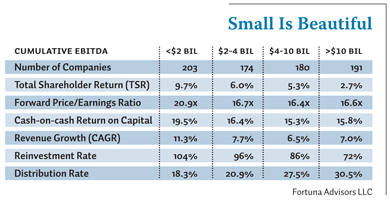
The above study shows that the difference in total shareholder return between large companies and small companies is indeed substantial. So diversification among large, medium and small caps is extremely important in a building portfolio.

What are some of the U.S. medium and small cap stocks that investors can consider now for potential investment?

Unlike large caps, the universe of small and mid cap stocks is huge. The challenge for investors is to research and identify some of the winners. For small caps, the best option for most investors is to go with an ETF. Some of the small cap ETFs are listed below:

  • iShares Russell 2000 Index Fund (IWM)
  • Vanguard Small-Cap ETF  (VB)
  • iShares S&P SmallCap 600 (IJR)

The following is a list of 20 randomly selected mid-cap U.S. stocks:

1.Company: Gardner Denver Inc (GDI)
Sector: Capital Goods
Current Stock Price: $81.95

2.Company: The Greenbrier Companies Inc (GBX)
Sector: Railroads
Current Stock Price: $25.23

3.Company:Church And Dwight Co Inc (CHD)
Sector:Personal & Household Prods.
Current Stock Price: $78.90

4.Company:Ametek Inc (AME)
Sector:Scientific & Technical Instruments
Current Stock Price:$44.62

5.Company: Applied Industrial Technologies Inc (AIT)
Sector: Capital Goods
Current Stock Price: $34.44

6.Company:Msc Industrial Direct Co Inc (MSM)
Sector: Capital Goods
Current Stock Price: $70.62

7.Company:Mettler Toledo International Inc (MTD)
Sector:Scientific & Technical Instruments
Current Stock Price: $173.30

8.Company:Kansas City Southern (KSU)
Sector: Railroads
Current Stock Price: $56.44

9.Company: Curtiss-Wright Corp (CW)
Sector: Misc. Fabricated Products
Current Stock Price: $32.99

10.Company:Global Payments Inc (GPN)
Sector:Consumer Financial Services
Current Stock Price: $51.65

11.Company:Equifax Inc (EFX)
Sector:Business Services
Current Stock Price: $38.44

12.Company:Genesee & Wyoming Inc (GWR)
Sector:Railroads
Current Stock Price: $59.57

13.Company:Donaldson Co Inc (DCI)
Sector:Capital Goods
Current Stock Price: $60.21

14.Company: Timken Co (TKR)
Sector:Misc. Fabricated Products
Current Stock Price: $52.48

15.Company:Smurfit Stone Container Corp (SSCC)
Sector:Containers & Packaging
Current Stock Price: $38.02

16.Company: Pitney Bowes Inc (PBI)
Sector:Office Equipment
Current Stock Price: $24.63

17.Company:Legg Mason Inc (LM)
Sector: Investment Services
Current Stock Price: $34.37

18.Company:Sealed Air Corp (SEE)
Sector:Containers & Packaging
Current Stock Price: $25.71

19.Company:Eaton Vance Corp (EV)
Sector:Investment Services
Current Stock Price: $32.94

20.Company:Mcdermott International Inc (MDR)
Sector:Oil Well Services & Equipment
Current Stock Price: $21.85

Note: Prices noted above are as of market close May 6, 2011

For investors who would rather prefer to play it safe or do not have the time to research and analyze mid-size companies, the easy and simple way to invest in them is to select an ETF. Some of the ETFs available for mid-caps are listed below:

  • MidCap SPDRs (MDY)
  • iShares S&P MidCap 400 Index Fund (IJH)
  • iShares Russell Midcap Index Fund (IWR)
  • iShares Morningstar Mid Core Index Fund (JKG)
  • SPDR DJ Wilshire Mid Cap ETF (EMM)
  • Vanguard Mid-Cap ETF (VO)

The list of mid-cap ETFs can be found here.

Disclosure: No Positions
The Horrendous Decline in U.S. Labor Income for the Past Four Decades

The official unemployment rate in the U.S. stood at 9.0% in April. 13.7 million Americans are out of work. Even the lucky ones who hold a job are finding it difficult to make a decent living due to rising cost of living and stagnant to down wages. While equity markets have soared from the depths of the recent financial crisis in the developed world, the majority of workers have not benefited. Most of the spoils of this recovery has not gone to average workers.

From an article titled “The tipping point in labour’s share of the spoils looms” by Shaun Le Roux of PSG Asset management of South Africa:

The fact is, the benefits of the global economic recovery have accrued to the wealthy.  As The Economist put it in a recent article, “the benefits of recovery seem to have been distributed almost entirely to the owners of capital rather than workers. In America total real wages have risen by $168 billion since the recovery began, but that has been far outstripped by a $528 billion jump in profits. Dhaval Joshi of BCA Research reckons that this is the first time profits have outperformed wages in absolute terms in 50 years.

In Germany profits have increased by €113 billion since the start of the recovery, and employee pay has risen by just €36 billion. Things look even worse for workers in Britain, where profits have risen by £14 billion but aggregate real wages have fallen by £2 billion. A study by the Institute for Fiscal Studies, a think-tank, found that the median British household had suffered the biggest three-year fall in real living standards since the early 1980s.” (¹)

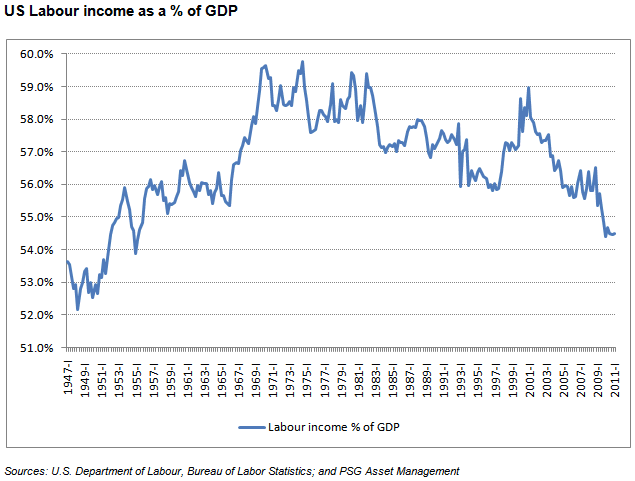
As the chart below demonstrates, labour’s share of income in the US (represented as a % of GDP) has been in a steady decline for forty years.  Now, some of this decline can be attributed to productivity gains and structural changes in the US’s drivers of output, but, at the same time that labour’s share has been declining, profit margins have been widening.  This trend cannot be sustained indefinitely and the catalyst for a change in this state of affairs is likely to be inflationary pressure spilling over into demand for higher wages.  The West has enjoyed three decades of remarkably benign inflation; globalization and the entry of cheaper emerging markets (amongst other things) have helped constrain cost pressures.  But, this status quo looks about to change.  As discussed above, wage pressures are building in the developing world, raw material costs have been rising and the world is no longer awash with cheap goods from the East.  Inflation is coming.

us-labor-income-gdp.gif

Meanwhile U.S. companies hoard billions of dollars in cash. According to a Bloomberg report last October, U.S. firm held almost $1 Trillion in cash and other equivalents on their balance sheets. Another factor to consider in evaluating why U.S. workers are not enjoying the benefits of economic growth in recent decades is that firms are getting rid of workers in the U.S. and moving those jobs abroad where wages are cheap and  government regulations lax. Globalization pits U.S. workers against third-workers who can work for $2 per day easily making U.S. workers unable to compete in the global market. As more and more workers find their jobs offshore-able any day, companies are able to squeeze more productivity and generate higher profits for their owners. The threat of losing their jobs in the current depressed labor market keeps the U.S. workforce docile and unable to demand higher wages.

From “Big U.S. Firms Shift Hiring Abroad” in The Wall Street Journal:

U.S. multinational corporations, the big brand-name companies that employ a fifth of all American workers, have been hiring abroad while cutting back at home, sharpening the debate over globalization’s effect on the U.S. economy.

The companies cut their work forces in the U.S. by 2.9 million during the 2000s while increasing employment overseas by 2.4 million, new data from the U.S. Commerce Department show. That’s a big switch from the 1990s, when they added jobs everywhere: 4.4 million in the U.S. and 2.7 million abroad. (emphasis added)

In all, U.S. multinationals employed 21.1 million people at home in 2009 and 10.3 million elsewhere, including increasing numbers of higher-skilled foreign workers.

The trend highlights the growing importance of other economies, particularly in rapidly growing Asia, to big U.S. businesses such as General Electric Co., Caterpillar Inc., Microsoft Corp. and Wal-Mart Stores Inc.

The data also underscore the vulnerability of the U.S. economy, particularly at a time when unemployment is high and wages aren’t rising. Jobs at multinationals tend to pay above-average wages and, for decades, sustained the American middle class.

As of today the above article has generated 678 comments on the Journal’s site. So unless structural changes are made by bold and responsible politicians, high unemployment and stagnant wages will continue to strangle the U.S. economy. For investors this gives another reason to invest abroad.

Top 10 Brazilian Banks by Assets

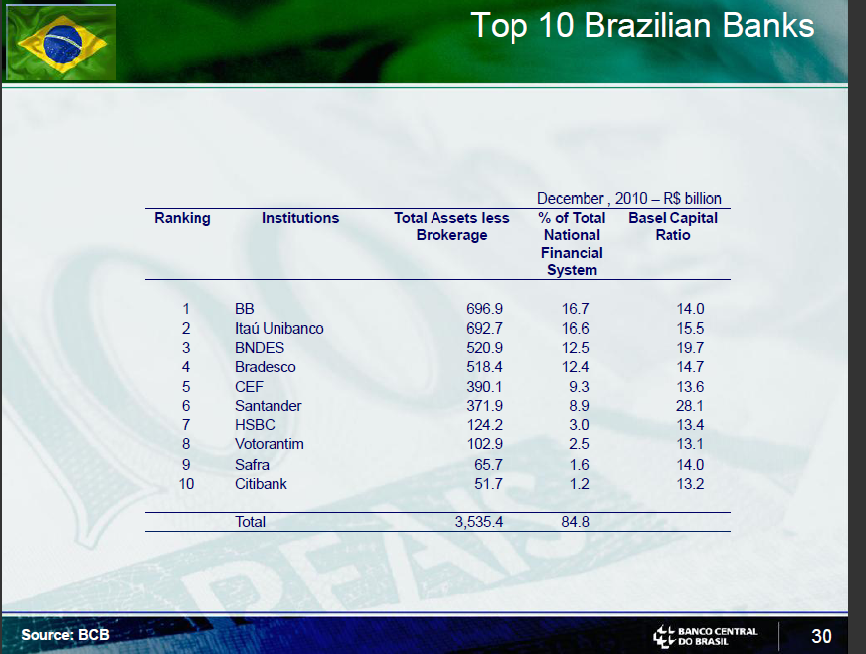
The Top 10 Brazilian Banks based on Assets held as of December 2010 are listed below:

Click to enlarge

Top-10-Brazil-Banks

Source: Banco Central Do Brasil

The top bank in this list is the state-owned Banco Do Brasil (BDORY). Its ADR currently pays a 1.12% dividend yield. The second largest bank is Itaú Unibanco Holding S.A. (ITUB) which is the largest private-sector bank in Brazil and has a 1.61% yield. A $10K investment 5 years ago would have grown to $21,878 as of May 1st, 2011 according to a S&P research report. For the first quarter the bank announced higher net earnings relative to the same period last year as its credit portfolio continues to expand.

Banco Bradesco (BBD) is the second largest private sector Brazilian bank. Like it rival Itau Unibanco, Bradesco also reported strong earnings for 1Q, 2011. Among the foreign bank subsidiaries in the above list Spain’s Santander (STD), UK-based HSBC (HBC) and US-based Citibank (C). Of these three banks Santander has the largest asset base in Brazil.

Disclosure: Long STD, BBD, ITUB

8 Economic Charts of BRICs

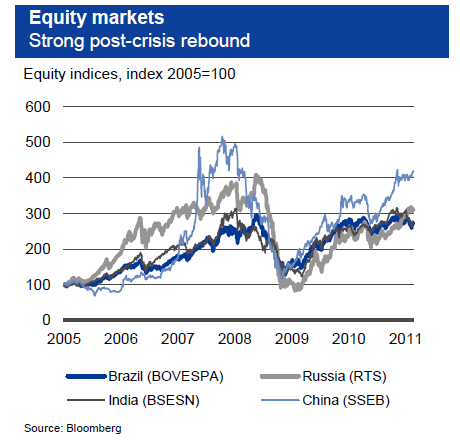
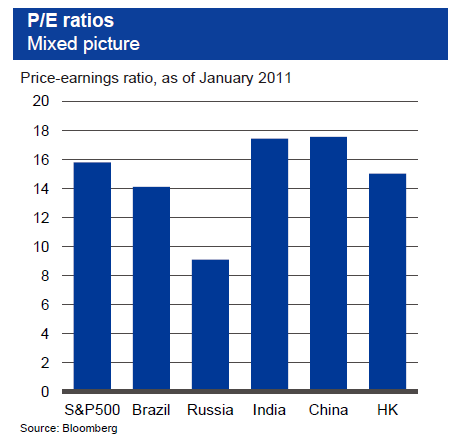
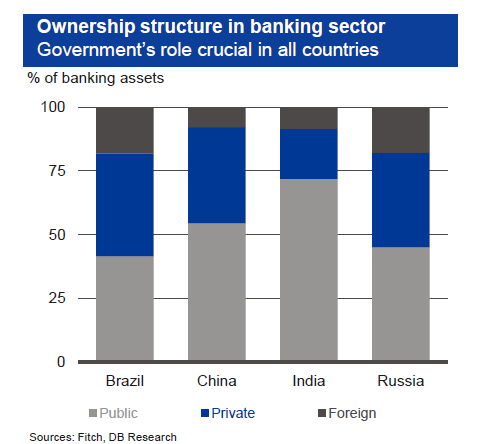
The equity markets markets of BRIC countries are not soaring this year.Brazil and India are down while China and Russia are up YTD compared to S&P’s fall of 1.90%. However the economies of BRICs continues to be strong and their growth is projected to outpace that of developed countries this year as well.

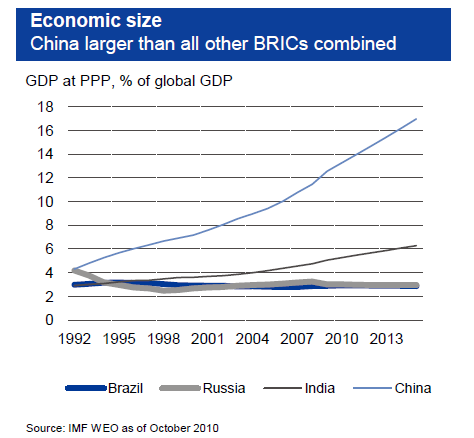
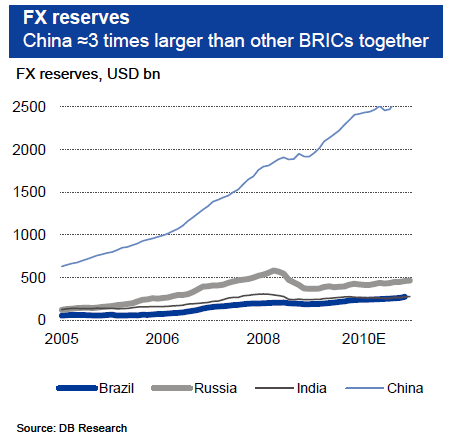
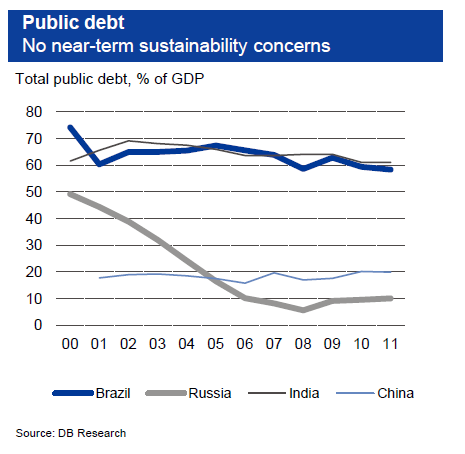
Deutsche Bank’s Research projects real GDP growth of 4.5%, 5.5%, 8.2% and 9% for Brazil, Russia, India and China respectively for 2011.The current weakness in BRIC equities offers an opportunity for investors looking to gain exposure to these countries. Some of the positive factors of the BRIC countries include strong Foreign Direct Investment (FDI) flows, low government debt, large balance-of-payments surpluses, lower labor costs, rising middle class, high foreign exchange reserves, etc.

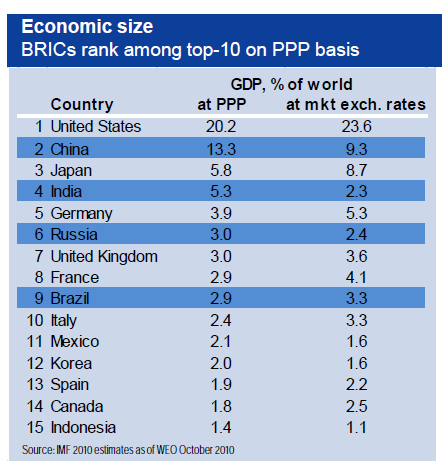
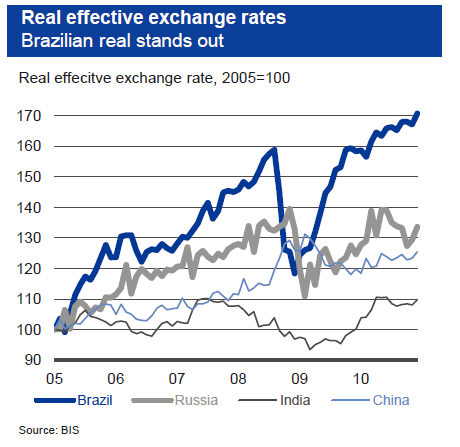
The following eight charts offer some insight into the BRIC economies:

1-bric-chart.png

2-bric-chart.png

3-bric-chart.png

4-bric-chart.png

5-bric-chart.png

6-bric-chart.png

7-bric-chart.png

8-bric-chart.png

Source: BRIC Capital Markets Monitor, February 2011, Deutsche Bank Research

Related ETFs:

WisdomTree India Earnings (EPI)
PowerShares India (PIN)
iShares S&P India Nifty 50 (INDY)
iShares MSCI Emerging Markets Indx (EEM)
EGShares Brazil Infrastructure ETF (BRXX)
iShares MSCI Brazil Index (EWZ)
Market Vectors Russia ETF (RSX)
iShares FTSE/Xinhua China 25 Index Fund (FXI)

Disclosure: No Positions