Five Latin American Stocks Yielding More Than 5% Dividends

The S&P 500 is up 6.3% YTD. Most emerging markets are down so far this year. The following are the YTD performance of select Latin American country indices:

  • Brazil Bovsepa: -13.5%
  • Mexico IPC All-Share: -8.0%
  • Chile IPSA: -6.2%


At current prices some Latin American stocks have high dividend yields. Five Latin American equities with current dividend yields of more than 5% are listed below:

1.Company: AFP Provida SA (PVD)
Current Dividend Yield: 9.03%
Sector:Investment Services
Country: Chile

2.Company: YPF Sociedad Anonima (YPF)
Current Dividend Yield: 7.47%
Sector:Oil & Gas – Integrated
Country: Argentina

3.Company: Empresa Nacional de Electricidad SA (EOC)
Current Dividend Yield: 5.96%
Sector: Electric Utilities
Country: Chile

4.Company: Telecomunicacoes de Sao Paulo SA Telesp (VIV)
Current Dividend Yield: 11.62%
Sector: Telecom
Country: Brazil

5.Company: Bbva French Bank SA  (BFR)
Current Dividend Yield: 11.32%
Sector: Banking
Country: Argentina

Note: Prices noted are as of market close July 26, 2011

Disclosure: No Positions
10 Not-So-Popular German ADRs

The fall of European equities in the past few weeks due to the sovereign debt crisis has made some of the equities cheap. Many German companies especially are worth a look at current levels. The export-driven German economy is weathering the crisis well and is poised to expand further once the dust settles.

According to the BNY Mellon DR site, only six German ADRs trade on the organized exchanges. 27 other German firms trade as sponsored ADRs on the OTC markets. In addition, 42 more firms trade as unsponsored ADRs on the OTC exchanges.

Trading in unsponsored ADRs can get tricky since daily trading volumes may be very thin and some stocks may not trade at all for days. Hence investing in such stocks may not for some investors.

The following are 10 unsponsored ADRs from Germany that investors can review for potential investment opportunities:

1.Company: Bayerische Motoren Werke (BAMXY)
Sector:Automobiles & Parts
Current Share Price: $35.18
maker of BMW, Mini and Rolls-Royce brands of cars and also motobikes

2.Company: Wacker Chemie (WKCMY)
Sector: Speciality Chemicals
Current Share Price: $20.10

3.Company: ThyssenKrupp (TYEKY)
Sector:General Industrials
Current Share Price: $11.49

4.Company: Munich Re Group (MURGY)
Sector:Insurance and reinsurance services
Current Share Price: $15.25

5.Company: Metro (MTTRY)
Sector: Retail
Current Share Price: $11.20

6.Company: Man (MAGOY)
Sector:    Industrial Transports
Current Share Price: $12.33

7.Company: Rheinmetall (RNMBY)
Sector:Automobiles & Parts
Current Share Price: $18.24

8.Company: Hamburger Hafen Und Logistik (HHULY)
Sector:Logistics
Current Share Price: $20.56

9.Company: Fraport AG (FPRUY)
Sector: Frankfurt Airport Operator
Current Share Price: $41.23

10.Company: Bilfinger Berger (BFLBY)
Sector:Construction & Materials
Current Share Price: $19.81

Note: Price noted are as of market close July 25, 2011

Disclosure: No Positions

China Projected To Accumulate More Wealth Than The U.S.

China’s savings rate is one of the largest in the world even in dollar terms. Chinese tend to save a higher proportion of their incomes due to the lack of social safety nets such as healthcare, social security and other state-provided benefits.

From a recent IMF report on China:

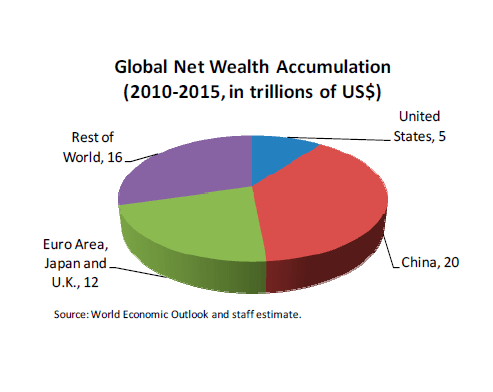
On account of its large annual saving, China is projected to contribute more than 1/3rd of global net wealth accumulation between 2010 and 2015 (measured as net investment plus increase in net foreign assets). China’s allocation of this new wealth should have increasingly important, if gradual, implications for domestic and global financial markets.

What will the impact of this saving on asset prices?

Due to capital controls and an undervalued currency, among other factors one of the major impact of China’s large savings would be asset price inflation both in the domestic economy and in foreign markets.

As of May this year China holds $1.1 Trillion of U.S. debt according to U.S. Department of the Treasury, making China the largest holder of U.S. debt.

U.S. Debt position:

As the world’s largest debtor country, the U.S. currently owes $14.3 Trillion in debt to both Americans and foreigners. However despite $4.5 Trillion held by foreign countries including the $1.1 Trillion held by China, the vast majority of the U.S. debt held is the American public.

The U.S. Congress is trying to reach a deal to raise the $14.3 trillion debt ceiling before the government runs out of cash by August 2. From an article on Debt Limit by the U.S. Department of the Treasury:

The debt limit is the total amount of money that the United States government is authorized to borrow to meet its existing legal obligations, including Social Security and Medicare benefits, military salaries, interest on the national debt, tax refunds, and other payments. The debt limit does not authorize new spending commitments. It simply allows the government to finance existing legal obligations that Congresses and presidents of both parties have made in the past.

Failing to increase the debt limit would have catastrophic economic consequences. It would cause the government to default on its legal obligations – an unprecedented event in American history. That would precipitate another financial crisis and threaten the jobs and savings of everyday Americans – putting the United States right back in a deep economic hole, just as the country is recovering from the recent recession.

Congress has always acted when called upon to raise the debt limit. Since 1960, Congress has acted 78 separate times to permanently raise, temporarily extend, or revise the definition of the debt limit – 49 times under Republican presidents and 29 times under Democratic presidents.  In the coming weeks, Congress must act to increase the debt limit. Congressional leaders in both parties have recognized that this is necessary.

Sources:

The Spillover Report and Selected Issues, July 2011, IMF

U.S. Department of the Treasury


Comparison of Public Debt: U.S. vs. Canada

The Canadian economy is one-tenth of the size of the U.S. economy. The Canadian banking system was largely unaffected by the global credit crisis and the country is in a relatively strong fiscal position than the U.S.

The outstanding public debt of Canada stood at$563,068,532,455.00 CDN (or) C$563.0 billion as of July 22, 2011.

The total outstanding U.S. public debt  stood at 14,342,884,944,996.28 (or) $14.3 Trillion as of July 21, 2011.

The Canadian government spent $33.3 billion dollars or 2.2% of the GDP in 2007-08 to service its debt. Only about 15% of Canada’s public debt is held by non-residents. Along with the US, France, UK and Germany, Canada also maintains the coveted AAA rating by S&P.  While the debt-to-GDP ratio for Canada is projected to increase to 84% this year it is expected to jump from 62% in 2007 to 100% this year in the U.S.

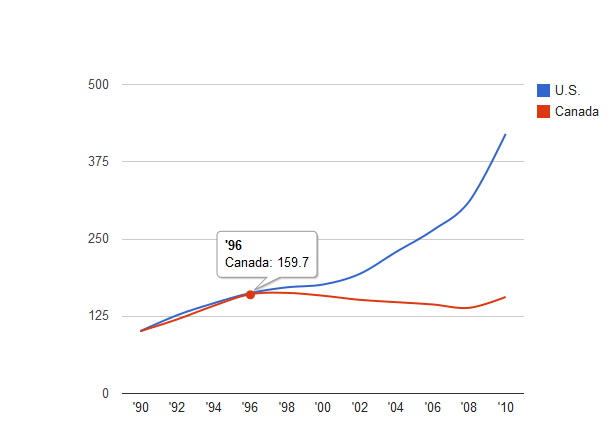
The chart below shows the growth of debt for US and Canada from 1009 thru 2010:

Note: Numbers noted represent percentages with 100% as the base in 1990.

Source: Canadian Business

From an article in Canadian Business:

Since 1990, U.S. federal debt has more than quadrupled while Canada’s debt rose by about 55%. In the 10 years ended in 2010, Canada’s debt showed a moderate decline and U.S. debt doubled. Why the differences? Statistics show that Canada has made an effort to reduce debt and paid off over $90 billion from 1997 through 2008. The recent increase was entirely due to the global recession. U.S. debt has consistently risen, especially in the last 10 years. Major drivers of the increase over that last decade according to the PEW Center were: recession related revenue declines (28%), defence spending (13%; cost of the wars on terror alone were over $2.4 trillion to the end of 2009 according to Homeland Security Research), Bush tax cuts (13%), increases in net interest (11%), and other non-defence spending (10%).

What Are The Options To Invest In Foreign Stocks?

Investing in a foreign stock is not as easy as selecting a company and placing a buy order as one would with a US stock. After an investor has decided to invest in a foreign stock, there are usually three different options to trade the stock.

For example, lets say an investors has decided to invest in Diageo plc, the UK-based global liquor maker. The company’s equity is traded as ordinary stock on the LSE (DGE.L), as ADR on the NYSE (DEO) and also as foreign ordinary on the OTC market (DGEAF) in the U.S. So the investor has to consider various factors to determine the best option suitable to invest in Diageo stock.

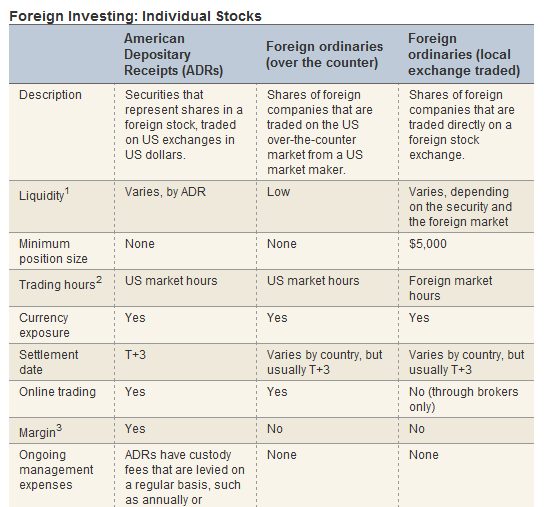
The following table lists the advantages and disadvantages of the three options:

Source: Going Global: Selecting ADRs or Foreign Stocks, Schwab Center for Financial Research

Key points

1.ADRs are suitable for smaller positions, have decent liquidity, can be traded online during US market hours, and are generally marginable.
2.Foreign stocks listed in the US OTC market are an alternative for smaller positions, however costs tend to be higher than ADRs and the liquidity may not be as strong.
3.Foreign stocks listed in the local market are often the best alternative for orders greater than $5,000, due to their superior liquidity and costs.

It must be noted that not all foreign stocks may have all the three options. Some foreign companies may trade only on the OTC markets (either as an ADR or as an ordinary) since listing on the NYSE is expensive and places many regulatory burden on these companies. Foreign companies trading on the OTC market are not just small and unknown firms. In fact, many large foreign multinationals such as Nestle (NSRGY) trade on the OTC market for the reasons noted above. So though the OTC market may not be very liquid for small and long-term investors it may not be an issue.

More information on foreign stocks can be found in the following sites:

Note: Investing in foreign equities via ETFs, mutual funds, etc. are beyond the scope of this article.

Disclosure: No Positions