Three Charts on U.S. Corporate Taxes

In an earlier article I discussed about the total tax revenues as a percentage of GDP.In this post lets a look at three charts about corporate taxes in the U.S.

Chart 1:

Click to enlarge

Chart 2:

Chart 3:

Source: Ten Charts that Prove the United States Is a Low-Tax Country, Center for American Progress.

U.S. corporate profits are at historic levels as companies experience strong growth overseas and cut costs in the domestic market. Booming profits and low tax rates have benefited companies tremendously with an estimate putting the cash pile they hold at over a $1 Trillion. Despite the huge cash pile, most companies have a low dividend payout ratio. The average yield on the S&P 500 is just around 2%. Due to lack of growth in the local market most companies avoid investing at home. As a result, the unemployment rate continues to be high and most government policies have failed to to stimulate economic growth.

The World’s Oil and Natural Gas Reserves by Country

The following table shows the World’s Natural Gas Reserves by Country:

Russia, Iran and Qatar account for over 50% of the world’s reserves with Russia alone holding over 25% of the world’s reserves.

The following table shows the World’s Oil Reserves by Country:

The top three oil-rich countries are Saudi Arabia, Venezuela and Canada. The U.S. holds less than 2% of the world’s total reserves but depends on oil more than any other country.This also forces the U.S. economy permanently addicted to foreign oil.

Source: International Energy Outlook 2011, U.S. Energy Information Administration

Related ETFs:

United States Natural Gas Fund (UNG)
United States Oil Fund (USO)

Disclosure: No Positions

Relationship Between Oil Prices and Stock Markets

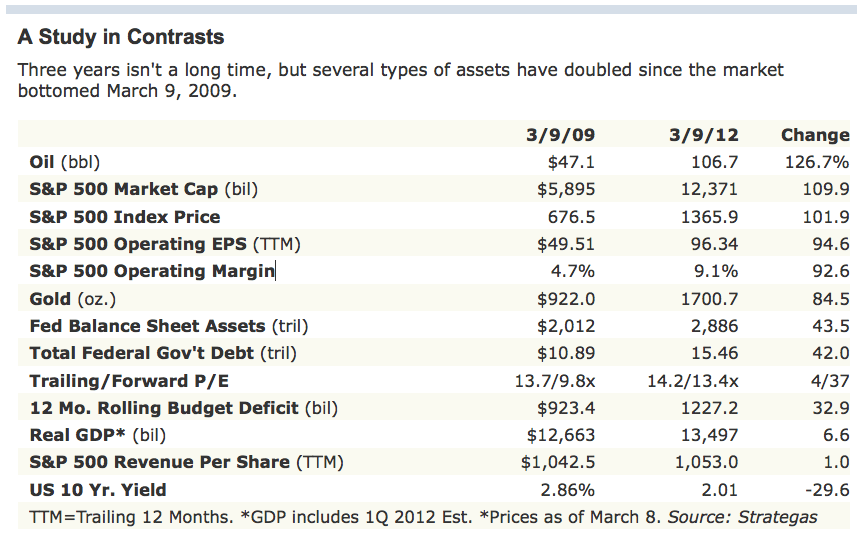
Crude oil prices have risen in the past few months on fears of war on Iran, global supply disruptions and a multitude of other factors. From $96.0 a barrel last month oil rose over $110 recently but closed down $2.24 at $106.60 for April delivery on the New York Mercantile Exchange.

Despite the rise in oil prices equity markets across the world have soared since late last year.The S&P 500 is up 8.9% YTD. Germany’s DAX has shot up over 17% YTD. Many of the emerging markets are also up by digit digit percentages so far this year.

Based on conventional wisdom one would assume that stock prices would fall when the price of oil increases since higher oil prices translates into higher gasoline prices and other costs which may drive consumers to reduce consumption. However that is not true. The relationship between oil prices and stock markets is actually positive as shown in the chart below. Hence stocks markets will not fall heavily due to higher oil prices alone.

Chart showing the relationship between oil prices and S&P 500:

Source: Black: Swans and Crude, Liz Ann Sonders, Charles Schwab & Co., Inc.

Related ETFs;

iShares MSCI Emerging Markets Indx (EEM)
Vanguard Emerging Markets ETF (VWO)
SPDR S&P 500 ETF (SPY)
United States Oil Fund (USO)

Disclosure: No Positions

Performance of Foreign Oil Stocks YTD

In the past few months global equity markets rose on the hopes of an economic recovery. During that time crude oil prices also steadily increased. However in recent weeks crude oil prices have shot up strongly with the Greek economic crisis and the war on Iran taking center stage again. While an attack on Iran is highly unlikely this year the fear of disruptions to the global oil supply is causing oil prices to rise.

From an article titled Analysis: Oil price rise raises specter of global recession by Reuters:

(Reuters) – A jump in energy prices is jamming the slow-turning cogs of an economic recovery in the West, but that may be nothing compared to the economic shock an Israeli attack on Iran would cause.

Oil rose to a 10-month high above $125 a barrel Friday, prompting responses from policymakers around the world including U.S. President Barack Obama, watching U.S. gasoline prices follow crude to push toward $4 a gallon in an election year.

Europe may have more to fear as its fragile economic growth falters and Greece, Italy and Spain look for alternative sources to the crude they currently import from Iran, where an EU oil embargo, intended to make Iran abandon what the West fears are efforts to develop nuclear weapons, comes into force in June.

Oil stocks are performing well this year with the rise in gasoline prices. The following table lists the exchange-listed foreign oil industry-related ADRs with their year-to-date returns and current dividend yields:

[TABLE=1056]

Disclosure: Long PBR

Total Tax Revenue as a Percentage of GDP Among OECD Countries

This week President Obama reduce the corporate tax rate from 35% to 28% in order to stimulate economic growth. Naturally this has kicked off a political firestorm as some consider this to a classic political ploy in an election year while others strongly support the plan.

From an article in the New York Times:

WASHINGTON — President Obama will ask Congress to scrub the corporate tax code of dozens of loopholes and subsidies to reduce the top rate to 28 percent, down from 35 percent, while giving preferences to manufacturers that would set their maximum effective rate at 25 percent, a senior administration official said on Tuesday.

Mr. Obama also would establish a minimum tax on multinational corporations’ foreign earnings, the official said, to discourage “accounting games to shift profits abroad” or actual relocation of production overseas.

While reduction of any form of taxes would be welcomed by the public, in general, should the US reduce taxes? One way to answer this question is to look at a country’s total tax revenues as a percentage of a its GDP. Based on this measure for 2009, the U.S. has already one of the lowest figures among the OECD countries and hence corporate taxes need not be reduced. Skyrocketing government expenditures with low tax revenues also leads to higher deficits. It must be noted that most of the taxes collected by the U.S. is from individuals and not corporations. Over the past few decades the U.S. has slowly shifted the burden of taxes from corporations to individuals with some companies paying no taxes while earning billions in profits.

Comparison of Total Tax Revenues as a Percentage of GDP among OECD countries:

Click to enlarge

The U.S. has the third lowest tax revenues at 24.1% of the GDP (based on 2009 data) with Mexico having the lowest among the developed countries.

Source: OECD