Click to enlarge
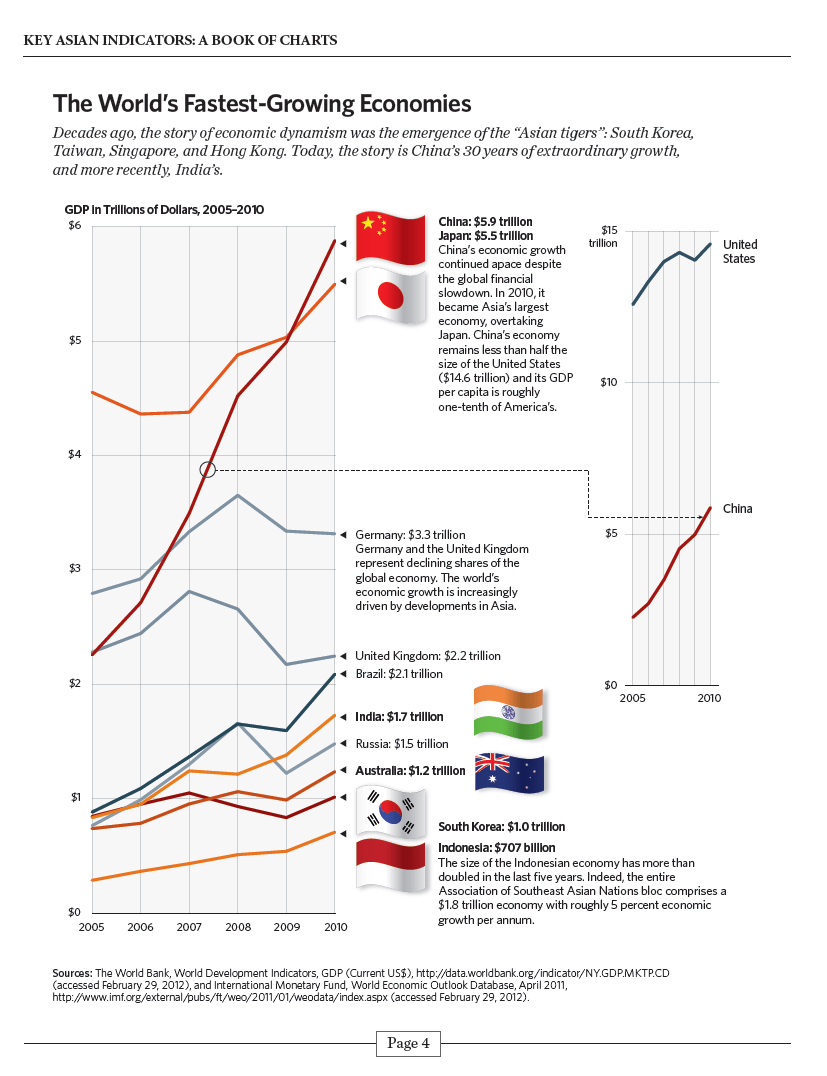
Source: Key Asian Indicators: A Book of Charts, Asian Studies Center, The Heritage Foundation, July 2012
Click to enlarge
Source: Key Asian Indicators: A Book of Charts, Asian Studies Center, The Heritage Foundation, July 2012
As an emerging market economy Brazil has a lower unemployment rate than the U.S. In May, the unemployment rate in Brazil stood at a seasonally adjusted rate of 5.4%. Unemployment has been trending downwards since the peak of over 13% in 2002 as shown in the chart below:
Click to enlarge
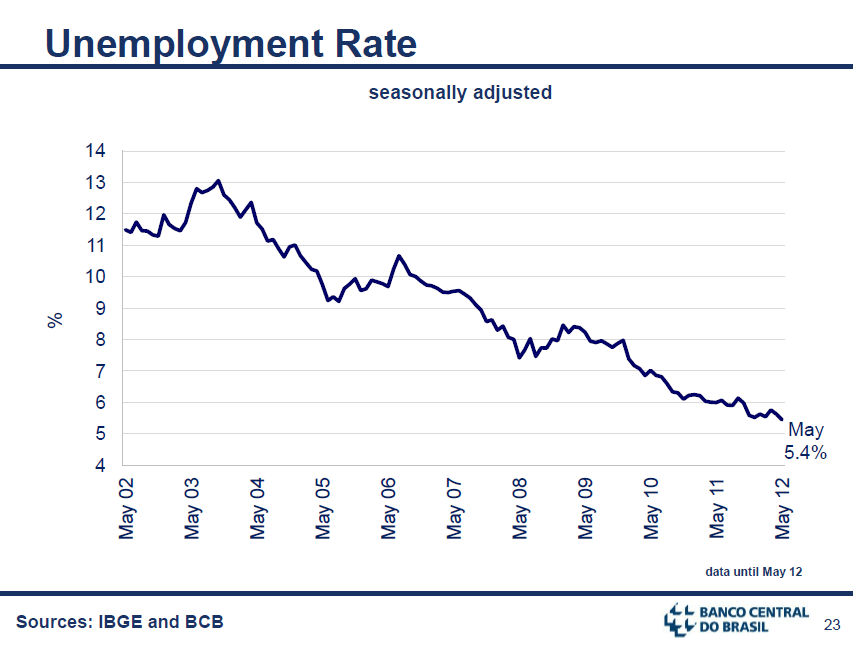
Source: Brazil’s Economic Chart Pack, August 2012, Banco Central Do Brasil
Compared to the Brazilian unemployment rate of 5.4%, the U.S. unemployment rate was 8.2% in May this year. Unemployment peaked during the recession and is slowly declining in the U.S.
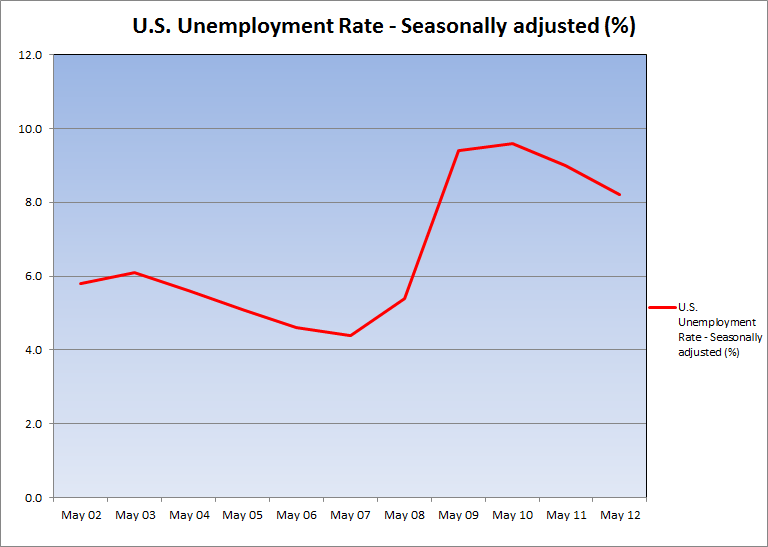
Source: Bureau of Labor Statistics, U.S. Department of Labor
Interesting chart on how to improve the U.S. healthcare system:
Click to Enlarge

Source: Best Care at Lower Cost: The Path to Continuously Learning Health Care in America, Institute of Medicine, National Academy of Sciences
Forbes magazine recently published its latest list of the World’s Most Innovative Companies. These companies were selected based on a factor called “The Innovation Premium”.
Definition of The Innovation Premium:
“The Innovation Premium is a measure of how much investors have bid up the stock price of a company above the value of its existing business based on expectations of future innovative results (new products, services and markets) . Members of the list must have $10 billion in market capitalization, spend at least 1% of their asset base on R&D and have seven years of public data.”
The Top 10 Companies in the ranking are listed below:
[TABLE=1067]
The rest of the list can be found here.
Source: The World’s Most Innovative Companies, Forbes
On a related note, from a Bloomberg article on the lack of innovation at Procter & Gamble:
For much of its history, Procter & Gamble Co. (PG) didn’t just roll out new products, it created new product categories, from the first mass-produced disposable diapers to Crest teeth-whitening kits. That’s one reason P&G has more than 1,000 Ph.D.’s among the 8,000 employees at its 26 innovation facilities around the world.
“P&G is largely a branded science company,” said Larry Huston, former innovation officer at P&G who’s now managing director of 4inno, a consulting firm.
Lately, though, there’s been a dearth of pioneering brands emerging from the world’s largest consumer-products company. Spending on research and development in fiscal 2012 ended June 30 was $2.03 billion, or 2.4 percent of sales, the same as the prior year and down from 3 percent of sales in 2006.
P&G’s most recent homegrown blockbusters — Swiffer cleaning devices, Crest Whitestrips, and Febreze odor fresheners — all went on sale at least a decade ago.
“P&G is built on creating new categories, and innovation is in its DNA, but they need to rediscover it,” said Peter Golder, a professor at the Tuck School of Business at Dartmouth College.
P&G ranked 24th in the Forbes list.
Disclosure: No Positions
The Asian airline industry has experienced tremendous growth in the past few years in tandem with strong economic growth. Rising middle class with higher disposable income and eager to explore air travel has been the major driver of growth.Countries such as Indonesia, China, India, etc. with large populations have invested heavily in airport and related infrastructure upgrades in recent years.
Catering to the demand of the growing air travellers, many small discount airlines have propped up driving down the cost of air fares.These airlines are also competing fiercely with the traditionally dominant state or national carriers.In 2011, Asia Pacific Carriers accounted for 27% of global passenger traffic and 41%% of global passenger traffic according to Association of Asia Pacific Airlines.
Most of the airlines in the developed world are money-losing operations and their stocks should be avoided like the plague.However this is not the case with airlines in emerging countries.Many of them offer not only offer excellent service but are also profitable.
The following are nine of the Asian airline stocks traded on the US markets:
1.Company: Air China Ltd (AIRYY)
Current Dividend Yield: 2.92%
Country: China
2.Company: China Eastern Airlines Corp Ltd (CEA)
Current Dividend Yield: N/A
Country: China
3.Company: China Southern Airlines Co(ZNH)
Current Dividend Yield: 15.12%
Country: China
4.Company: All Nippon Airways Co Ltd (ALNPY)
Current Dividend Yield: 2.35%
Country: Japan
5.Company: Garuda Indonesia TBK PT (PSEOY)
Current Dividend Yield: N/A
Country: Indonesia
6.Company: Singapore Airlines Ltd (SINGY)
Current Dividend Yield: 1.87%
Country:Singapore
7.Company: Thai Airways International Ltd (TAWNY)
Current Dividend Yield: N/A
Country: Thailand
8.Company: Cathay Pacific Airways Ltd (CPCAY)
Current Dividend Yield: 4.33%
Country: Hong Kong
9.Company: Virgin Australia Holdings Ltd (VBHLY)
Current Dividend Yield: N/A
Country: Australia
Disclosure: No Positions