Are Emerging Market Stocks Worth The Trouble?

Emerging equity markets are lagging the performance of developed markets this year. The year-to-date price returns as of May 31st of some of the major emerging and developed indices are listed below:

  • S&P 500: 14.3%
  • UK’s FTSE 100: 11.6%
  • France’s CAC 40: 8.4%
  • Germany’s DAX: 9.7%
  • China’s Shanghai Composite: 1.4%
  • India’s Bombay Sensex: 1.7%
  • Brzail’s Sao Paulo Bovespa: -12.2%
  • Chile’s Santiago IPSA: -4.8%
  • Mexico’s IPC All-Share: -4.0%

As economic growth in China slowed and the demand for commodities decreased in the past few months,  emerging markets which are dependent on commodity exports were deeply affected. Other factors such as high inflation, fiscal issues, political instability, slow progress of economic reforms, lackluster economic growth, labor issues, etc. have negatively impacted the performance of  emerging markets such as India, Russia, Mexico, South Africa, etc.

More recently the currencies of emerging countries have experienced sharp declines with rising fear of a meltdown in the equity markets. So far the plunge in currency prices has not severely hit the equity markets of these countries.

From a May 31st article by Ambrose Evans-Pritchard in The Telegraph:

South Africa’s rand punched through the psychological barrier of 10 to the dollar as investors flee countries with big current account deficits, deemed most at risk. The country’s central bank said it would take action to stem the fall in the rand if moves became “abrupt and disorderly”.

The Johannesburg Stock Exchange says foreigners have withdrawn €1.1bn (£940m) from South African bonds over the past 10 days. The Turkish lira fell to the lowest in 17 months against the dollar, though it has just been upgraded to “investment” quality by Moody’s. The Thai baht fell to a one-year low, a pattern seen in much of emerging Asia.

Bond yields have spiked sharply in Turkey, South Africa, Mexico and Hungary, rippling through down corporate spreads. Yields on 10-year Polish bonds have jumped 60 basis points to 3.60pc in May as even the strongest are drawn into the turmoil. “This is the end of the bull market,” said Benoit Anne from Societe Generale. “I am now throwing in the towel. We are out of virtually all our emerging market bonds.”

Mr.Ambrose noted that of the $8.0 Trillion foreign capital invested in these markets outflows have been tiny so far.

Source: South African rand leads emerging market rout, The Telegraph, May 31, 2013

An article in Bloomberg today echoed similar sentiment on the state of emerging markets. From the article:

The worst month in a year for emerging-market currencies will prove to be more than a momentary bout of weakness to strategists at firms from UBS AG to Societe Generale SA who see the Federal Reserve weaning investors off its extraordinary stimulus.

South Africa’s rand led declines among the 24 developing-nation currencies tracked by Bloomberg last month, tumbling 11.3 percent. JPMorgan Chase & Co.’s Emerging MarketsCurrency Index (FXJPEMCI) fell 3.3 percent, the most since it slipped 7 percent in May 2012. Only China’s yuan gained, rising 0.51 percent.

“For these emerging-market currencies, this is the beginning of a trend that perhaps is going to be longer and deeper in terms of a correction,” Tom Levinson, a currency strategist in Londonat ING Groep NV, the largest Dutch financial-services firm, said in a May 31 phone interview.

Source: Emerging Market Dominoes to Fall as SocGen Sees Rout, Bloomberg

I recently came across an interesting article by emerging markets guru Mark Mobius of Franklin Templeton Investments. He discussed the results of a 2013 Global Investor Sentiment Survey (GISS) conducted by his firm and the case for emerging markets. The key findings of the survey:

According to the GISS, 58% of investors residing in developed markets believe their local stock market will be up this year, but investors in emerging markets were even more upbeat – 66% believed their local stock market would post a bullish performance in 2013.  Similarly, investors residing in emerging markets expected higher returns on their investments, with an average return expectation of 12% this year and 18% over the next 10 years. Those in developed markets expected a 7% average return in 2013, and 10% over the next 10 years.

Supporting his theory on emerging markets, he quoted three important factors:

  • Developed countries are projected to grow by just 1.2% this year compared to emerging market’s growth of  5.3% according to the IMF. Mark anticipates this trend to continue in the coming years also.
  • Emerging markets have foreign reserves higher developed markets.
  • The ratio of public debt to GDP has been declining in emerging markets while it has been increasing in the developed world.

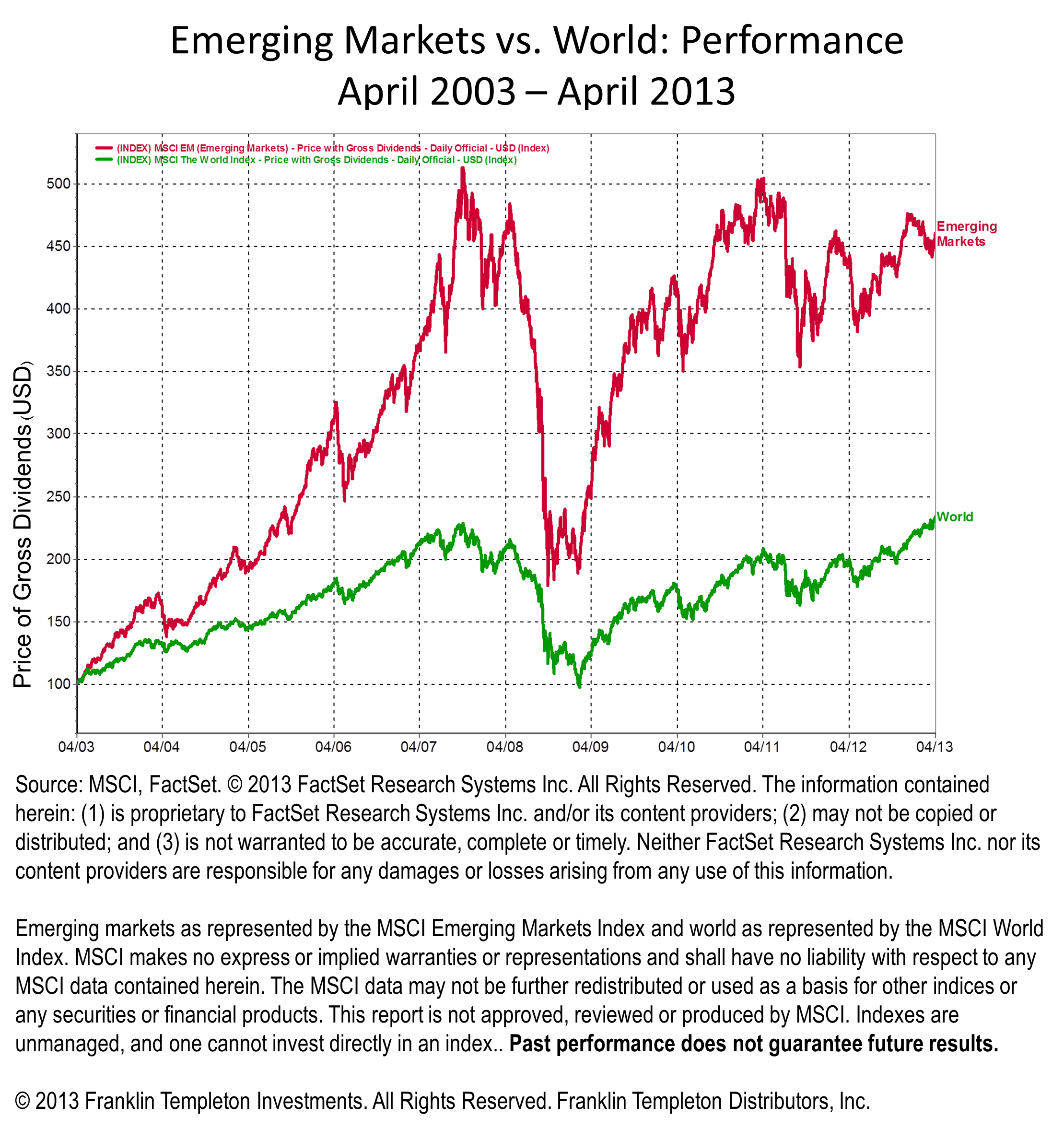
The following chart compares the performance of Emerging Markets against Developed Markets using the respective MSCI indices (Price with Gross Dividends in US $ terms):

Click to enlarge
Emerging-Developed-World-Return-Chart

Source:  Investors Living in Emerging Markets are a Bullish Bunch!, Investment Adventures in Emerging Markets, Franklin Templeton Investments

Though their equity markets have soared, most countries in the Europe and even the U.S. are not completely out of the woods yet. For example, though unemployment rate is declining in the U.S. the pace of job growth is not robust yet as employers are still reluctant to take risks. Similarly most governments across the pond seem to be mired in policy paralysis unable to find meaningful solutions to the problems plaguing their economies. Though outside of the Euro zone, the British government has not fixed the banking system despite giving billions in bailouts at the depth of the financial crisis.

Developing countries have many positive factors including the rise of middle class, growing consumption of goods and services, rising wages, etc. in addition to the ones mentioned by Mr.Mark Mobius above. Hence investors need not completely avoid these countries despite the current turmoil. Investments in the mining sector can be avoided. However sectors closely tied to the domestic economy such as banking, consumer goods, utilities, oil, etc. can be considered for potential opportunities.

To get started, ten emerging market stocks from ten different countries with their current dividend yields are shown below:

1.Company: Vina Concha y Toro (VCO)
Current Dividend Yield: 1.78%
Sector: Beverages
Country: Chile

2.Company: Ultrapar Participacoes SA (UGP)
Current Dividend Yield: 2.33%
Sector: Oil, Gas & Consumable Fuels
Country: Brazil

3.Company: Sanlam Limited (SLLDY)
Current Dividend Yield: 5.05%
Sector: Insurance
Country: South Africa

4.Company: HDFC Bank (HDB)
Current Dividend Yield: 0.70%
Sector: Banking
Country: India

5.Company: Telekomunikasi Indonesia (TLK)
Current Dividend Yield: 2.49%
Sector: Telecom
Country: Indonesia

6.Company: China Petroleum & Chemical (SNP)
Current Dividend Yield: 4.21%
Sector: Oil and Gas Producers
Country: China

7.Company:Coca-Cola FEMSA S.A.B de C.V. (KOF)
Current Dividend Yield: 0.82%
Sector:Beverages
Country: Mexico

8.Company: Ecopetrol SA (EC)
Current Dividend Yield: 6.36%
Sector: Oil and Gas Producers
Country: Colombia

9.Company: Malayan Banking Berhad (MLYBY)
Current Dividend Yield: 3.20%
Sector: Banking
Country: Malaysia

10.Company: Gazprom (OGZPY)
Current Dividend Yield: 7.39%
Sector: Oil and Gas Producers
Country: Russia

Note: Dividend yields noted are as of May 31, 2013. Data is known to be accurate from
sources used.Please use your own due diligence before making any investment decisions.

Disclosure: No Positions
Are U.S. Stocks Overvalued Now?

The U.S. equity market is one of the best performing market among developed countries so far this year. For example, the S&P 500 is up by 14.35% on price return basis and 15.37% on total return basis year-to-date. Financials have skyrocketed with the sector in the index up by over 20%. Healthcare and Consumer Discretionary sectors also have had a great with a return of 20% or closer to that. Telecoms and Utilities, usually considered as income plays for their slow and steady growth with high dividend payouts, are lagging the overall performance of the market.

Financials were the hardest hit during the global financial crisis. Less than a few years later their strong performance is surprising. As the market sentiment has improved stocks are continuing to soar higher confounding skeptics by ignoring negative news and focusing more on positive news and company-specific events. As a result many investors are wondering if U.S. stocks are overvalued now after the double digit gains in less than six months.

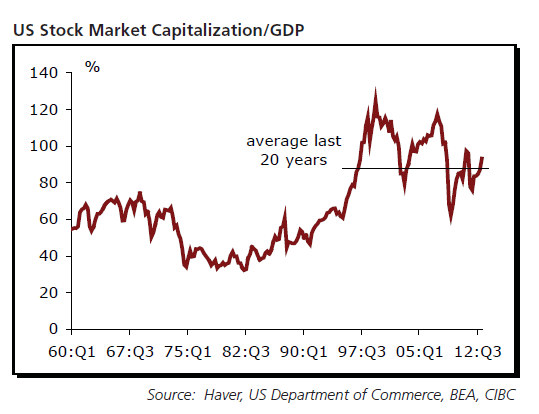
According to a report by Peter Buchanan of CIBC World Markets, U.S. stocks are not yet overvalued at least based on one measure. He states that the the ratio of stock market capitalization to GDP is still lower relative to two earlier highs.

This ratio shows the percentage of GDP that represents stock market value. It can be used to identify if a  market is overvalued or undervalued. Any figure over 100% is considered as U.S. market being overvalued and a figure of around 50% is said to show that the market is undervalued. It should be noted however that this metric does not always work perfectly. For example, in 2000 it stood at 153% implying that the market was overvalued. Later the markets crashed. But in 2003 it was at around 130% and instead of falling, stocks went to reach all-time highs. So this measure must be used with caution.

From the CIBC report:

Click to enlarge

US-Stock-Market-Cap-to-GDP-Ratio

Beyond the raft of conventional metrics trotted out by analysts, like forward and Shiller trailing PEs, one interesting metric is the ratio of stock market capitalization to GDP. Publicly listed corporations play a greater role in the economy than they once did. Many listed corporations do more of their business overseas than in the past, and interest rates are also lower. While that complicates longer term comparisons, data for shorter intervals can still convey useful information. At 97%, that ratio today is still some ways from its highpoint of the last two cycles.

Source: Are Abenomics Benefits in Abeyance?, The Week Ahead, June 3-7, 2013, CIBC World Markets

Investors willing to bet on further rise in U.S. stock prices can consider some of the companies listed below:

1.Company: Cullen/Frost Bankers Inc (CFR)
Current Dividend Yield: 3.11%
Sector: Banking

2.Company: T. Rowe Price Group Inc (TROW)
Current Dividend Yield: 2.00%
Sector:Capital Markets

3.Company:Consolidated Edison Inc (ED)
Current Dividend Yield: 4.31%
Sector:Multi-Utilities

4.Company:Airgas Inc (ARG)
Current Dividend Yield: 1.87%
Sector: Chemicals

5.Company:The Clorox Co (CLX)
Current Dividend Yield: 3.42%
Sector:Household Products

6.Company:PPG Industries Inc (PPG)
Current Dividend Yield: 1.59%
Sector: Chemicals

7.Company: Kellogg Co (K)
Current Dividend Yield: 2.84%
Sector:Food Products

8.Company: Quest Diagnostics Inc (DGX)
Current Dividend Yield: 1.94%
Sector:Health Care Providers & Services

9.Company:Ametek Inc (AME)
Current Dividend Yield: 0.56%
Sector:Electrical Equipment

10.Company: Church & Dwight Co Inc (CHD)
Current Dividend Yield: 1.84%
Sector:Household Products

Note: Dividend yields noted are as of May 31, 2013. Data is known to be accurate from sources used.Please use your own due diligence before making any investment decisions.

Disclosure: No Positions
A Comparison of S&P 500 and S&P/TSX Composite Indices

The S&P 500 Index is the best representation of large cap U.S. companies. The index was first published in 1957  and the components in the index capture 75% coverage of all U.S. stocks. The S&P 500 is the widely followed barometer of the U.S. equity markets.

The S&P/TSX Composite Index is the benchmark index of the Canadian equity market.This index provides coverage for 95% of the Canadian market.A total of 239 companies are in the index.

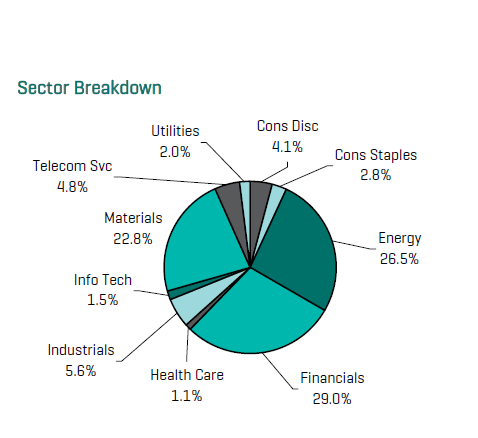
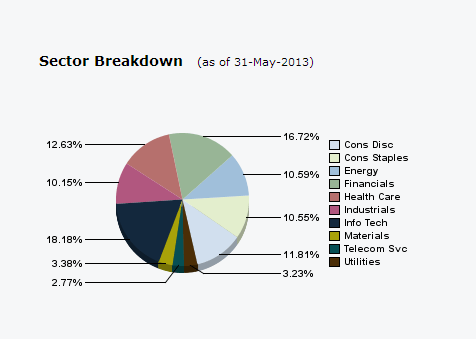
The following charts show the composition of the indices:

1) S&P 500 Index (as of May 31, 2013):

Click to enlarge

SP500-Index-Composition-may-2013

2) S&P/TSX Composite Index (as of October 31, 2011):

SPTSX-Composite-Index-Composition

The Top 10 Constituents of S&P 500 Index:

S.No.ConstiuentTickerSector
1Apple Inc.AAPLInformation Technology
2Exxon Mobil CorpXOMEnergy
3Microsoft CorpMSFTInformation Technology
4General Electric CoGEIndustrials
5Chevron CorpCVXEnergy
6Johnson & JohnsonJNJHealth Care
7Google IncGOOGInformation Technology
8International Business Machines CorpIBMInformation Technology
9Procter & GamblePGConsumer Staples
10JP Morgan Chase & CoJPMFinancials

The Top 10 Constituents of S&P/TSX Composite Index:

S.No.ConstiuentTickerSector
1Royal Bank of CanadaRYFinancials
2Toronto-Dominion BankTDFinancials
3Bank of Nova Scotia HalifaxBNSFinancials
4Suncor Energy IncSUEnergy
5Canadian National RailwaysCNIIndustrials
6Barrick Gold CorpABXMaterials
7Bank of MontrealBMOFinancials
8Potash Corp of SaskatchewanPOTMaterials
9Canadian Natural ResourcesCNQEnergy
10BCE IncBCETelecommunication Services


Source: Standard & Poor’s

As a resource-based economy, Canada’s benchmark index is concentrated with financials, energy and materials. These three sectors account for about 79% of the index with energy and materials alone having a weightage of about 50%. In the S&P 500, financials account for about 17% while materials and energy make up less than 15% of the index.

Among the top 10 constituents, the TSX Composite is dominated by companies in the above three sectors with the exception of one firm (Canadian National) from the industrial sector. In the S&P 500, just two companies from the energy sector are in the top 10. The presence of four IT firms shows the importance of the industry for the U.S. economy.

Related ETFs:

  • SPDR S&P 500 ETF (SPY)
  • iShares MSCI Canada Index (EWC)

Disclosure: Long BMO, BNS, CNI, TD and RY

The Digital Revolution is Destroying Jobs

Technological advancements made possible by computer is destroying jobs faster than creating them according to a study by economists Andrew McAfee and Erik Brynjolfsso of MIT. Many scholars are now warning that this revolution is different unlike past warnings of destruction of jobs due to technological innovations that have proved exaggerated.

From Man vs. Machine: Are Any Jobs Safe from Innovation? by Thomas Schultz in Der Spiegel:

The worldwide application of computer technology has become so much more cost-effective and efficient that people are no longer only replaceable in certain sectors — autoworkers on assembly lines, for instance — but in entire occupational areas. Cashiers are being replaced by self-service check-out lines, airline employees by self check-in kiosks, financial traders by algorithms and travel agencies by online travel sites.

This development has been apparent for roughly a decade. But, says McAfee: “You ain’t seen nothing yet. Looking ahead to what technology is going to do over the next five to 10 years, I’m really concerned.”

In addition to the ongoing turmoil from the financial crisis, Western economies may have to face “tectonic shifts in employment,” the economists warn — and Asian countries won’t be able to escape this development, either. In the battle between man and machine, many workers in Chinese production plants will also lose out.

Fresh Causes for Concern

Fears of the impact of technical progress are nothing new. Back in 1930, renowned British economist John Maynard Keynes warned of a “new disease” that he dubbed “technological unemployment.” Nonetheless, the world’s economies and their labor markets have always managed to swiftly adapt to even major changes and, ultimately, more jobs were created in new industries than were lost in obsolete ones.

Why should this be any different for the digital revolution, which has produced global technology giants, such as Microsoft and Google, over the past couple of decades and created countless new jobs around the world?

It goes without saying that advances in computer technology have generated millions of new jobs around the globe, more than any other economic sector, says McAfee. But he hastens to add that, at the same time, this very progress could wipe out even more jobs in other areas of the economy.

The two MIT professors are not the only ones issuing such warnings. Politicians and economists of all ideological stripes have similar concerns, and current unemployment figures from early April appear to confirm these fears. Despite the current positive economic climate and rising consumer confidence, far fewer jobs have been created than expected.

“Can innovation and progress really hurt large numbers of workers, maybe even workers in general?” asked Nobel laureate and economist Paul Krugman, for example, in his column for the New York Times last December. “I often encounter assertions that this can’t happen,” Krugman wrote. “But the truth is that it can.”

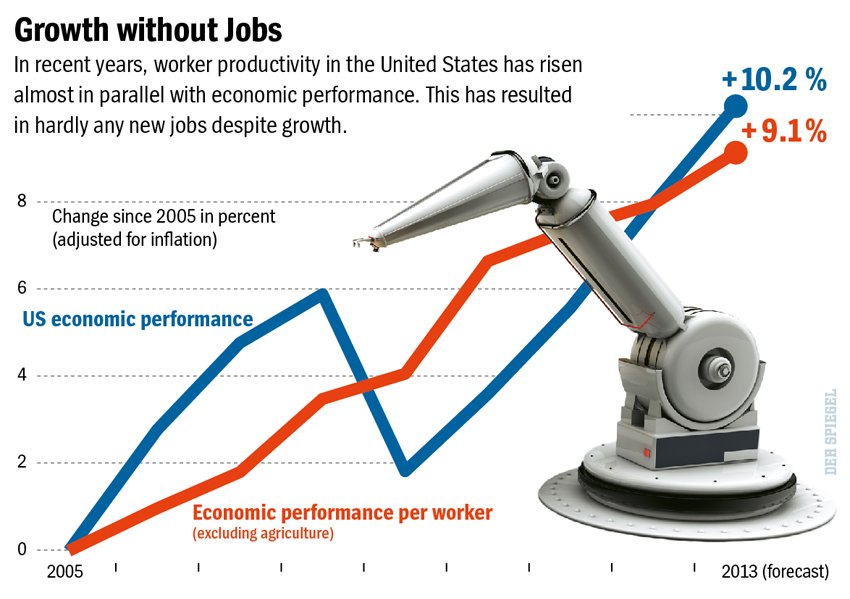
US-Econ-Performance-vs-Worker-productivty

The 2000s were the first decade since the Great Depression to end with a net loss in jobs despite the fact that per capita gross domestic product (GDP) in the US is one-third higher than it was 20 years ago — and the country produces 75 percent more goods than it did back then.

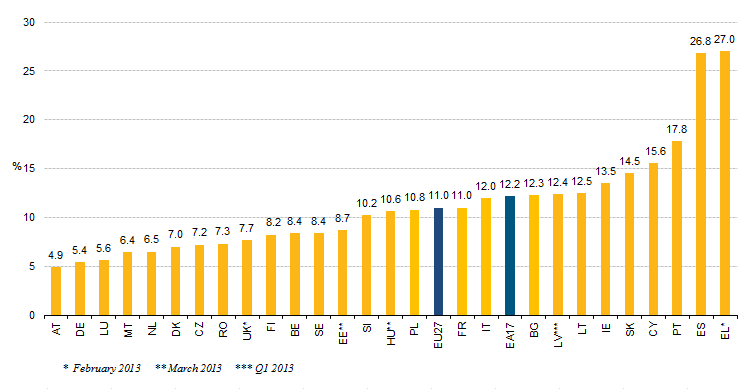
Automation is decimating jobs in developed economies. When outsourcing and offshoring of jobs are taken into account jobs are scarce in most of the developed world especially in the Eurozone countries. The chart below shows the latest seasonally-adjusted unemployment rates in the EU:

Click to enlarge

EU-Unemployment-rates-April-2013

Source: Eurostat

In Spain and Greece the unemployment rate now stands at over 25%. In the U.S. such high rates were last seen during the Great Depression. Countries such as France, Italy, Ireland and Portugal have unemployment rates in excess of 11%. In many European countries the rate for youth is much higher.

In the U.S, the unemployment rate stood at 7.5% in April down from 7.6 % in March. The employment situation has considerably improved from April 2012 when the rate was 8.1%. According to official figures, the total number of unemployed Americans was 11.7 million in April. The real numbers are much higher.

Unless policy makers implement effective policies to reinvigorate the job market, high unemployment rates will be the “new normal” in advanced countries for years to come.