Skanska ADR Conversion To Sponsored ADR

Sweden-based Skanska AB, the world’s leading project development and construction group,  converted its American Depositary Receipt (ADR) from an unsponsored program to Sponsored program on June 28,2013.  Previously the ADR used to trade under the ticker SKSBY. The new sponsored ADR ticker is SKBSY. The ratio of ADR to ordinary remains the same at 1:1.

Founded in 1887, Skanska operates in Europe, Americas and the Nordic region. Last year it had 57,000 employees.  The company focuses on construction of residential housing, commercial buildings, roads, and railways, as well as develops and carries out civil engineering projects or public private partnership (PPP) projects. The four major business units are: Construction, Residential Project Development, Commercial Project Development, and Infrastructure Development. The company’s single largest market is the U.S. followed by Sweden.

For more information, checkout Skanska’s Investor Relations site.

Disclosure: No Positions
New ADR: Skandinaviska Enskilda Banken AB

SEB_k_45mm150dpiSwedish bank Skandinaviska Enskilda Banken AB, also known as SEB, started trading on the US OTC markets as an unsponsored ADR effective Nov 12, 2013 under the ticker SVKEY. The ADR to Ordinary ratio is 1:1.

SEB mainly serves corporations in the Nordic and other areas. From the corporate website:

We are different from other Nordic banks in several ways, but mainly through our unique business mix with an emphasis on corporate banking and through deep and long-term relationships with our customers in the Nordic and Baltic countries and Germany.

We are also proud of our history – more than a century and a half of it. This gives us a firm tradition to stand on but has also taught us to be resilient and take a long-term perspective. Above all, it has given us an insight: close relationships with our customers are paramount.

A few interesting facts about SEB:

  • Was founded in 1856
  • Currently has operations in 20 countries
  • Home office is in Stockholm, Sweden
  • Has 16,000 employees

The bank serves 2,800 corporations and institutions, 400,000 small and medium enterprises and about 2 million private individuals. 

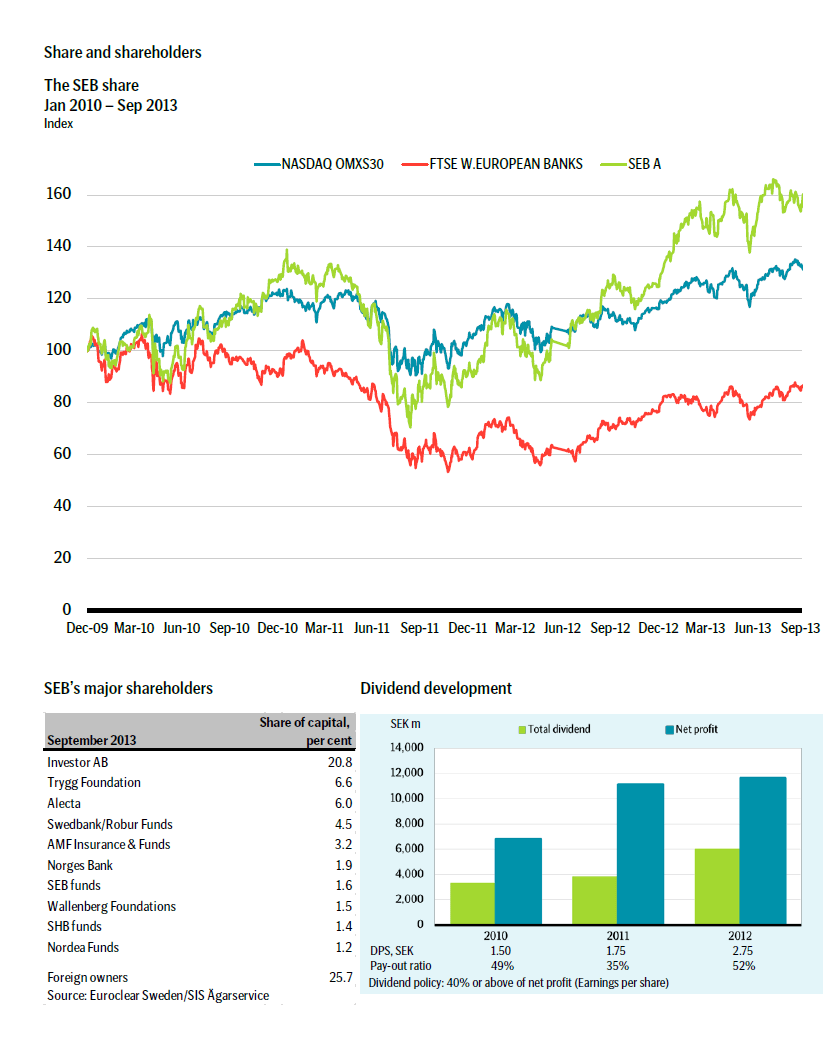
In the domestic market, SEB’s stock has handily beaten the NASDAQ OMX 30 and the FTSE W.European Banks index as shown in the chart below:

Click to enlarge

SEB-Stock-Price

Source: SEB

The total outstanding shares is about 2.2 billion and the major shareholders are shown in the above image. It should be noted that the largest shareholder with a stake of over 20% is the Swedish Wallenberg family through their investment company Investor AB.

In the US, the ADR opened for trading at $11.89 on Nov 15, 2013 and has traded in the $11 to $12 range since then closing at $12.28 on Friday. Daily trading volume is very light with a high of only 9,000 shares traded on one day only since Nov 15th.

You can download the 2013 3rd Quarter Factbook here (pdf).

For more info please visit SEB’s Investors Relations site.

Disclosure: No Positions
An Update On Little Bank

I first wrote about the small bank called Little bank Inc (OTC: LTLB) in Nov, 2011. This is a quick update on that article.

After strong performance since 2011, the stock split in the ratio of 21:20 on Nov 11, 2013. On Friday it closed at $11.25.  Currently the bank has a market capitalization of $33.0 million.

From the bank’s website:

the little bank was founded by a group of prominent Eastern North Carolina businessmen in November of 1998. The Bank’s guiding principal is that old fashion personal service is as valuable today as it was 100 years ago.

Today, the little bank has six branches in Kinston , LaGrange, Goldsboro , Jacksonville, New Bern and Greenville .

The bank announced solid earnings for 3Q, 2013. In addition to the 5% stock dividend noted above Little bank also increased its cash dividend. From the news release:

The Company’s Board of Directors has authorized the issuance of a 5% stock dividend to shareholders.The 5% stock dividend will be payable November 29, 2013 to shareholders of record as of November 15, 2013.Cash-in-lieu will be paid on fractional shares based on the stock’s market value at the close of business on November 15, 2013.

The Board has also approved an increase in the semi-annual cash dividend, payable December 31, 2013 to shareholders of record as of the close of business on December 16, 2013.The amount payable is at the rate of $0.0750 per common share.

Disclosure: No Positions


Ten European Stocks To Consider For 2014 and Beyond

The S&P 500 is up 26.62% YTD on price return basis. But the STOXX Europe 600 is up by only 20.07% YTD on US dollar price return terms. This index is composed of 600 companies across 18 counties of Europe including the UK and hence can be considered as a proxy for European markets similar to the S&P 500 for the US markets. The difference of over 600 basis points in returns is big and makes European equities relatively attractive based on this measure. European equities have plenty of room to play catchup with their US peers.

The European economy is improving and many positive developments have occurred in the past few weeks. Here are a few headlines from the media:

However investors should not be in a rush to get into European equities. Paul Wild of JOHCM Continental European Fund quoted the following in an article in FE Trustnet :

The manager says that although the European market is becoming more resilient, the current rally needs stronger earnings growth to come through to support the now relatively high equity valuations.

“The European market has been purely re-rating, so the question is ‘is the rally over?’ I think it will pause and a modicum of patience may be required over the next few months,” he said.

Wild adds that the reason this patience will be needed is because the market re-rating is largely complete, which is evident in the way P/E ratios are nearing their historic averages. However, he says this is nothing that long-term European equity investors should be concerned about.

“I am a believer that the European macro picture will improve,” he said.

Source: Wild: European rally to forge ahead in 2014, FE Trustnet

Ten European stocks to consider for 2014 and beyond are listed below with their current dividend yields:

1.Company: Banco Santander SA (SAN)
Current Dividend Yield: 7.16%
Sector: Commercial Banks
Country: Spain

2.Company: Diageo PLC (DEO)
Current Dividend Yield: 2.33%
Sector: Beverages
Country: UK

3.Company: Edp Energias De Portugal SA (EDPFY)
Current Dividend Yield: 4.12%
Sector: Electric Utilities
Country: Portugal

4.Company: Safran SA (SAFRY)
Current Dividend Yield: 1.92%
Sector:Aerospace & Defense
Country: France

5.Company: Barclays PLC (BCS)
Current Dividend Yield: 2.34%
Sector: Commercial Banks
Country: UK

6.Company:BASF SE (BASFY)
Current Dividend Yield: 2.34%
Sector: Chemicals
Country: Germany

7.Company: Technip (TKPPY)
Current Dividend Yield: 1.53%
Sector: Energy Equipment & Services
Country: France

8.Company: Novo Nordisk A/S (NVO)
Current Dividend Yield: 1.31%
Sector: Pharmaceuticals
Country: Denmark

9.Company:Telenor ASA (TELNY)
Current Dividend Yield: 3.46%
Sector: Telecom
Country: Norway

10.Company: ING Groep NV (ING)
Current Dividend Yield: No dividends paid
Sector: Commercial Banks
Country: The Netherlands

Note: Dividend yields noted are as of Nov 29, 2013. Data is known to be accurate from sources used.Please use your own due diligence before making any investment decisions.

Disclosure: Long TKPPY, ING, SAN

The Wisdom of Sir John Marks Templeton

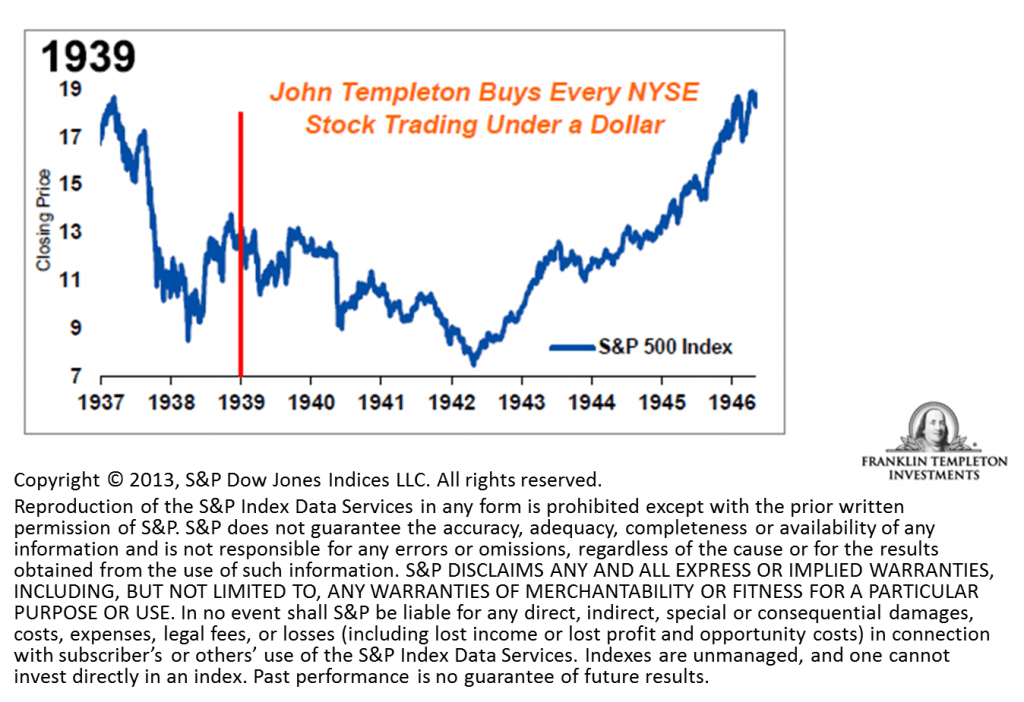
Sir John Marks Templeton was a pioneer global investor who founded the Templeton Mutual Funds. An extraordinary man he was very smart even in his early life. He was a superb stock picker. In 1939 when investors were fleeing the markets due to World War II  he bought 100 shares of each stock that was trading under a dollar on the New York Stock Exchange. When the US markets recovered and shot up strongly in the buildup to the war, he made many times over his original stock investments.

One of his famous quote on long-term contrarian investing:

The best bargains are not just stocks or assets whose prices are down the most, but rather those stocks having the lowest prices in relation to future potential earnings power.

Click to enlarge

Templeton-Investment

Source: Once-a-Generation European Opportunity?,  Franklin Templeton Investments