Which Sectors are Winners and Which are Losers from Lower Oil Prices ?

Crude oil (Brent)  closed at $48.23 a barrel yesterday on the NYMEX for March delivery. The fall in oil prices in recent months is benefiting some industries and hurting others. For example, convention wisdom says big consumers of oil such as chemical companies, transportation firms, etc. are bound to benefit while oil producers, oil distributors and other related-companies in the industry can be expected to suffer.

I wrote an article recently on how to profit from lower oil prices. I specifically noted that the consumer staples sector will benefit and mentioned a few firms like Kellogg(K), Kraft Foods Group(KFT), etc. as potential investment opportunities. In another post I discussed how lower prices is not a big boon to all chemical firms. A recent post on FT’s beyondbrics blog, discussed about the winners and losers of lower oil prices in Emerging Markets. From that post:

Click to enlarge
Low Oil price-Winners and Losers


Industry winners and losers
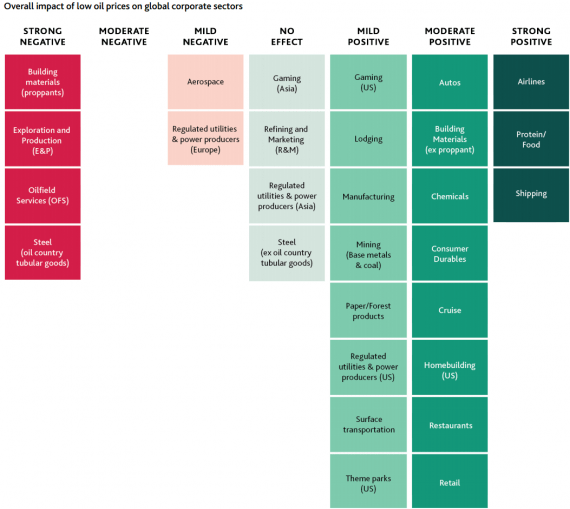
Moody’s, the rating agency, identifies airlines, food and shipping industries as the outright winners from lower oil prices (see chart). With fuel representing between about 30 per cent and 50 per cent of an airline’s operating expenses, the airlines that are set to benefit most are low-cost carriers which have pared back non-fuel costs. Airlines in the US, in particular American Airlines, Delta and United, are also particular beneficiaries because they have relatively low exposure to the strong US dollar, Moody’s said in a report.

In terms of food, a sustained period of low oil prices would boost household discretionary incomes – thus driving consumer spending. Thus Nestlé, Mondelez, International, Kellogg and Kraft Foods Group – among others – should benefit.

Global shipping companies, particularly container shipping companies, would benefit because fuel accounts for 20 per cent to 25 per cent of costs for container shipping companies, Moody’s said.

Source: Oil price slump cleaves divisions between EM winners and losers, Jan 15, 2015, FT beyondbrics blog

Investors looking to diversify their portfolio can consider adding some of the following ten foreign food and airline stocks:

1.Company: Copa Holdings SA (CPA)
Current Dividend Yield: 3.69%
Sector: Airlines
Country: Panama

2.Company: Avianca Holdings S.A. (AVH)
Current Dividend Yield: 2.61%
Sector: Airlines
Country: Colombia

3.Company: Singapore Airlines Limited (SINGY)
Current Dividend Yield: 3.58%
Sector: Airlines
Country: Singapore

4.Company: easyJet plc (ESYJY)
Current Dividend Yield: 4.97%
Sector: Airlines
Country: UK

5.Company: LATAM Airlines Group S.A. (LFL)
Current Dividend Yield: Not paid
Sector: Airlines
Country: Chile

6.Company: Unilever NV (UN)
Current Dividend Yield: 3.71%
Sector: Food Products
Country: The Netherlands

7.Company: Nestle SA (NSRGY)
Current Dividend Yield: 3.19%
Sector: Food Products
Country: Switzerland

8.Company: Danone SA (DANOY)
Current Dividend Yield: 3.03%
Sector:Food Products
Country: France

9.Company: Unilever PLC (UL)
Current Dividend Yield: 3.61%
Sector: Food Products
Country: UK

10.Company: Cathay Pacific Airways Limited (CPCAY)
Current Dividend Yield: 1.51%
Sector: Airlines
Country: Hong Kong

Note: Dividend yields noted above are as of Jan 20, 2015. Data is known to be accurate from sources used.Please use your own due diligence before making any investment decisions.

Disclosure: No Positions

The Periodic Table of Commodity Returns 2005 To 2014

Last week crude oil fell below $50 per barrel for the first time in over five years. The dramatic decline in oil prices since the middle of last year has been shocking to many investors.On Friday Brent for March delivery closed at $49.90 on the NYMEX.

This is not the first time that oil has plunged by over 50% in a year as the following table of periodic table of commodities shows:

Click to enlarge

Periodic Table of Commodities 2005 to 2014


Source: US Funds

In 2014 oil fell by over 45%. But in 2008  it fell even more with a loss of over 53%. This occurred after double digit gains in the previous year and following the collapse in 2008 it soared nearly 78% in 2009. Another highly volatile but closely watched commodity is copper. Copper collapsed by over 50% in 2008 but shot up 141% the next year.

Related ETF:

  • United States Oil ETF (USO)

Disclosure: No Positions

Why Panic Selling is Never a Good Strategy

Volatility is back with a vengeance in the US equity markets. In the first two weeks of this year stocks have been extremely volatile with the Dow taking investors on a wild ride.In times of such high volatility patience is a very important factor that differentiates successful investors from others. Panic selling and market timing does not work especially for retail investors.

Selling when the market plunges has a very high cost. Not only an investor ends up taking big losses by selling stocks are at their lows but also loses again when the market recovers strongly since that investor is usually fearful of getting back in. Moreover during panics markets plunge dramatically in a short period and during recoveries they soar violently. These types of moves are hard to predict or catch for any investor. In a collapsing market, even high quality stocks may get dumped along with others making the situation feel like that whole world is about to end. This scenario occurred during the Global Financial Crisis of 2008-2009. Since the lows from early 2009, the S&P 500 has more than doubled.

I recently came across a fascinating article by Ken Fisher of Fisher Investments on why staying calm and trusting one’s gut instincts is so important when markets are declining precipitously. He used the example of the market collapse and recovery in 1998. From the article:

Click to enlarge

Global Market Returns in 1998

In cooler moments, most investors with long-term growth goals agree they should think long term and ignore near-term wiggles. And they plan to.

But amidst volatility, more primal instincts take over – they want to take action to remove the threat of near-term pain, even if it costs them future returns. Again, investors articulate notions such as: ‘Don’t just sit there, do something’. It’s fight or flight. But sometimes doing nothing is best.

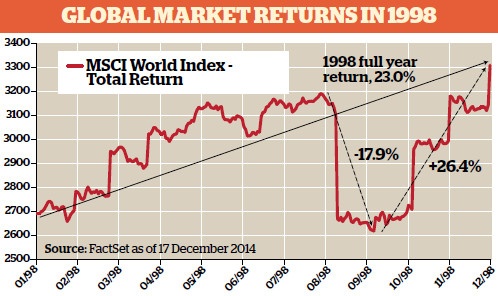
Here’s an example. 1998 was a terrific year for world stocks overall – but it was trying for investors. It started fine – world stocks rose 17 per cent by mid-July. But there was fear of contamination from the Asian financial crisis that had started in 1997 and led to Russian debt default.

Debt woes trickled west, pushing huge, super-leveraged US hedge fund Long-Term Capital Management (LTCM) to the brink of default. People feared that if LTCM failed, they could take down the US financial system, and world stocks dropped nearly 20 per cent in just 11 weeks.

But corrections move fast because they’re grounded in sentiment, not fundamentals – and sentiment changes swiftly. People got over their fears, and world stocks finished the year up a big 23 per cent overall.

Investors who ignored their gut and stayed invested were hugely rewarded. Investors who panicked and sold to stop the pain likely sold at a relative low, and probably didn’t buy back in time for the fast rebound. And they had to pay transaction fees and maybe taxes.

Source: Fisher’s financial myth-busters: you trust your gut feeling, Jan 16, 2015, Money Observer

Here is an excerpt from another article on this topic by Saket Mundra of McLean & Partners:

The mantra of ‘Doing Nothing’ stems from my belief in simplicity rather than a claim of its superiority over any other actions. ‘Doing Nothing’ marks a remarkable shift in one’s investment process from selection (finding the best stocks, forecasting the next recession etc.) to elimination (acting only on a small subset of opportunities or decisions). The decision to do nothing places the investor in a position to exploit some of the most powerful anomalies in the financial markets by:

1. Allowing only the best opportunities to make it to the portfolio
2. Lengthening the time horizon as one is not acting on short term noise
3. Minimizing the re-investment risk as the turnover is low
4. Reducing the odds of losses due to insolvency or bankruptcy4
5. Lowering the transaction costs and taxes

‘Doing Nothing’ does not imply, nor is it an excuse, for complacency or poor analysis. The foundation of the theory of ‘Doing Nothing’ lies in one’s ability to eliminate mediocre opportunities, or in other words, only acting on great opportunities. The approach does not reward investors for selecting a bad business (or even a good business at a bad price) to begin with. Provided that the bulk of the analytical effort is expended before a stock is even included in the portfolio, ‘Doing Nothing’ affords the investor the luxury of ignoring short-term gyrations and focusing only on the true underlying prospects for the business, which do not change each day/week/quarter. Identifying and sticking with great opportunities not only requires unbiased and factual analysis, but a great deal of behavioral restraint as well. The lesson here is simple – when a set of good businesses are allowed to compound for a long term without intervention, the winners significantly offset the losers resulting in above average returns.

4 Kay Giesecke, Francis A. Longstaff, Stephen Schaefer, Ilya Strebulaev (2011): Corporate bond default risk: A 150-year perspective. Journal of Financial Economics

Source: ‘Doing Nothing’ – The Unloved Alternative, Aug 2014, McLean & Partners

The key takeaway is that sometimes just doing nothing and sitting tight is the most important factor. Keeping one’s emotions in check and being focused on the long-term goal will lead to better investment returns. In today’s world of text alerts, email alerts, 24/7 internet connectivity, smartphones, 24/7 TV news, etc. it is very difficult to do nothing for most of us. But to be a successful investors requires sacrifices and one sacrifice that investors must do during times of market corrections is simply to became a spectator of all the actions and not become a participant.

Five Andean Stocks To Consider

When investors think of Latin American countries for investment they usually tend to gravitate towards Brazil and Mexico, two of the largest economies in the region. However Brazilian equities have been average to poor performers in the past few years and the Mexican economy is highly related to the performance of the U.S. economy.

Instead of focusing mainly on Brazil and Mexico, investors can consider some of the other countries in the region. Particularly they can expand their horizon to opportunities in the Andean countries of Chile, Colombia and Peru collectively known as the “Pumas”.

Some of the reasons to invest in “Pumas” are:

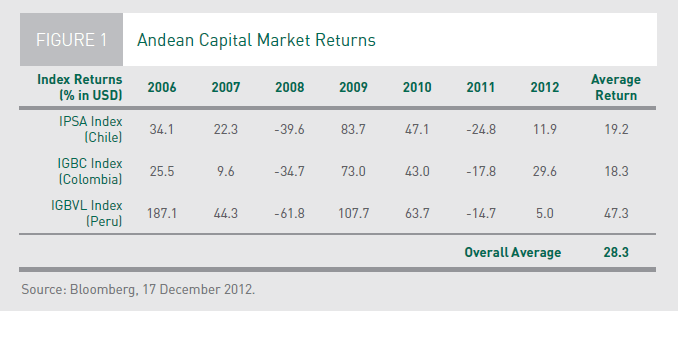
  1. The equity markets of these countries have performed well in the past few years. The table below shows their returns from 2006 to 2012:
  2. Puma ReturnsIn 2013 Chile was up by down by 14% and Colombia was down by 8%.
  3. The pumas have implemented private pension fund systems which offer a growing and captive local investor base.
  4. Andean markets are well diversified. For example, the benchmark indices of IPSA, COLCAP and IGBVL are diversified across the major sectors. In comparison, the Mexican IPC does not have representation from the utility and energy sectors.
  5. The three markets provide plenty of liquidity with over 600 companies listed on the exchanges.
  6. Political stability which has been an issue in the past is no longer a problem in these countries. For example, the FARC rebels and Colombia have agreed to a ceasefire and the country is slowly getting back to normality. Similarly Chile re-elected its leader recently and is largely a stable country for many years now.
  7. The average dividend yields in the Puma firms are attractive. For example, Chile is one of the few countries where companies are required by law to distribute a portion of their profits as dividends to their shareholders.

Source:Latin America Equity – Dispelling the Myths of the Andean Pumas, Pinebridge Investments

Five stocks from the three Andean countries are listed below for further research:

1.Company: Credicorp Ltd (BAP)
Current Dividend Yield: 1.31%
Sector: Banking
Country: Peru
Note: Credicorp is incorporated in Bermuda as a holding company.

2.Company: Ecopetrol SA (EC)
Current Dividend Yield: 14.49%
Sector: Oil
Country: Colombia

3.Company: Empresa Nacional de Electricidad SA (EOC)
Current Dividend Yield: 2.12%
Sector:Electric Utilities
Country: Chile

4.Company: Bancolombia SA (CIB)
Current Dividend Yield: 3.29%
Sector: Banking
Country: Colombia

5.Company: Banco de Chile (BCH)
Current Dividend Yield: 5.56%
Sector:Banking
Country: Chile

Note: Dividend yields noted above are as of Jan 16, 2015. Data is known to be accurate from sources used.Please use your own due diligence before making any investment decisions.

Disclosure: Long BCH

Knowledge is Power: Dividends, Top Energy Firms, Coal Edition

Reasons Target to Close Canadian Operations (Euromonitor International)

The importance of dividends (Invesco UK)

2020 Vision: Yield Scarcity and the Case for Dividends (Franklin Templeton Investments)

Causes of Wage Stagnation (EPI)

 (beyond brics)

2014 Top 250 Energy Companies (Platts)

Does Behavioral Investing Make Sense Anymore? (Alliance Bernstein Blog)

China’s long farewell to coal (Deutsche Welle)

Punta Cana Beach

Punta Cana Beach, Dominican Republic