Discretionary Federal Spending 2016: Chart

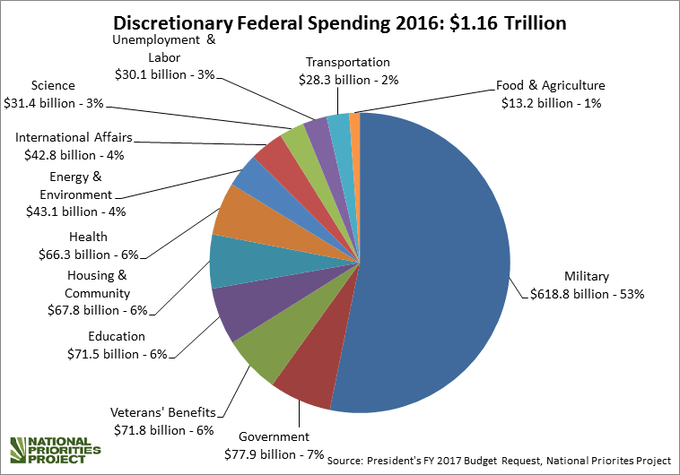
The US is the top country in terms of defense spending. None of the other countries in the world spend as much on military as the US does. According to a report by National Priorities Project, in 2016 more than half of the discretionary federal spending was spent on military. To put it another way, 53% or over $618.0 billion of the discretionary budget of $1.16 Trillion went to defense.

Click to enlarge

Source: The Militarized Budget 2017, National Priorities Project

Because more than of the spending is diverted to building weapons and other military stuff, other parts of the economy get smaller funding. For example, food and agriculture got 1%, health got 6% and transportation received 2%. High defense spending gives the country the world’s most powerful military. But lack of adequate spending in other areas leads to poor quality infrastructure, health, education, housing, etc. For example, transportation industry is a mess from roads to railroads to airports with some airports looking like third-world countries.

Percentage Share of Total Employment That Depend on Exports for Select Countries: Chart

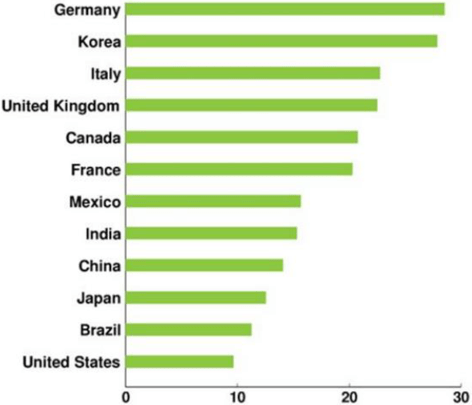
The economies of some countries are heavily dependent on exports while others do not. A higher percentage of jobs in export-driven countries depend on exports. For example, Germany is a classic export-based economy unlike the US which is a consumption-based economy. So 30% of total employment is attributed to exports. In the US, the figure is only 10%. Other countries like Korea, Mexico, Canada also have high number of jobs dependent on exports.

It is surprising that a lower percentage of jobs are dependent on exports in China than other countries like Mexico, Canada, India, UK, etc.


Click to enlarge


Source: The truth about Brexit, April 2017, The Absolute Return Letter, Absolute Return Partners

Valuation Metrics: U.S. vs. Foreign Stocks

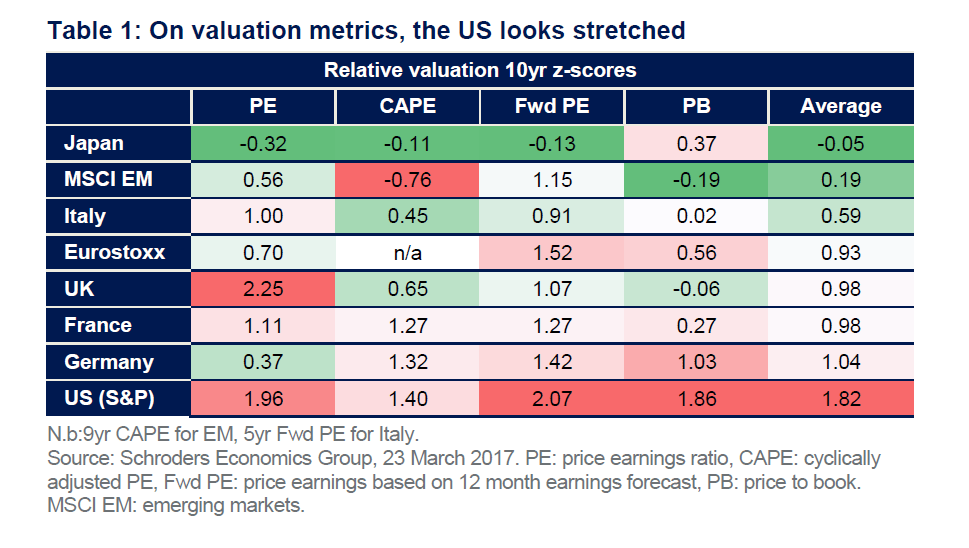
The U.S. equity market has performed well in recent months especially since the election in November. The S&P 500 is up by over 5.50% year-to-date on price only basis. The solid performance of US stocks has pushed valuations to high levels. When compared to other markets, US valuations look stretched according to a report by Schroders. From the report:

Markets are clearly putting a lot of faith in President Trump’s ability to deliver on his promises. Although valuation is not a good guide to near term performance, it does become a factor on longer time horizons. From our analysis, the US is trading well above normalised valuations for Price Earnings (historic, expected and cyclically adjusted PE) and on price-to-book. Easy money and low bond yields play a significant role in sustaining these valuations, so higher inflation which threatens to change Fed policy will be critical to the market outlook.

Source: Schroders Economic and Strategy Viewpoint, April 2017, Schroders

The key takeaway is that investors must not be complacent when markets continue to rise. U.S. stocks  could lag foreign stocks this year. Many of the developed European markets are ahead of US markets so far this year. So investors may want to consider diversifying their portfolio across markets and asset classes.