Valuation Ratio: US vs. International Developed and Emerging Market Stocks

U.S. stocks have outperformed international stocks in the past few years. Foreign stocks look attractive at current levels while their American peers look expensive. According to an article by Jurrien Timmer at Fidelity, since the Global Financial Crisis peak in March 2007 thru April 2017 the S&P 500 has returned 282% in total returns compared to 136% and 130% for international developed and emerging market stocks.

Most recently the MSCI US Index had a forward  P/E ratio of 17.7 while the MSCI EAFE Index (for international developed market) and MSCI EM Index had ratios of 14.8 and 12.2.  So investors looking to diversify their holdings may want to consider adding high-quality foreign stocks in a phased manner.

Click to enlarge
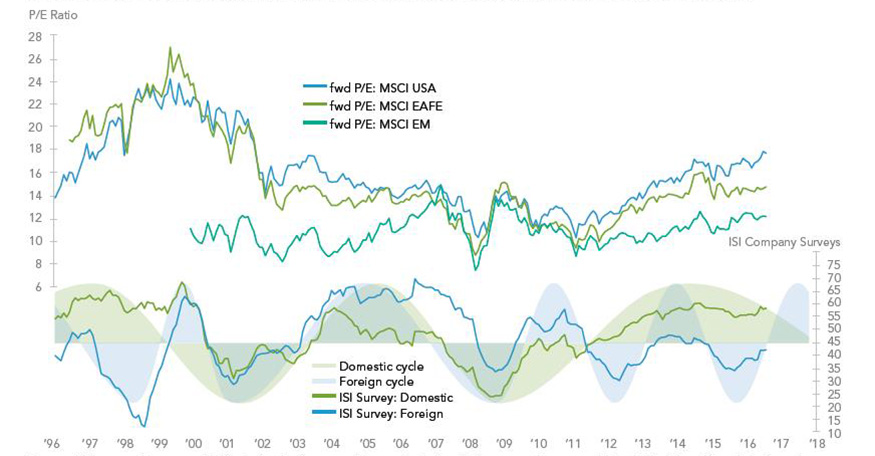
 

Source: Stock market check-in: Good and not-as-good news, Fidelity
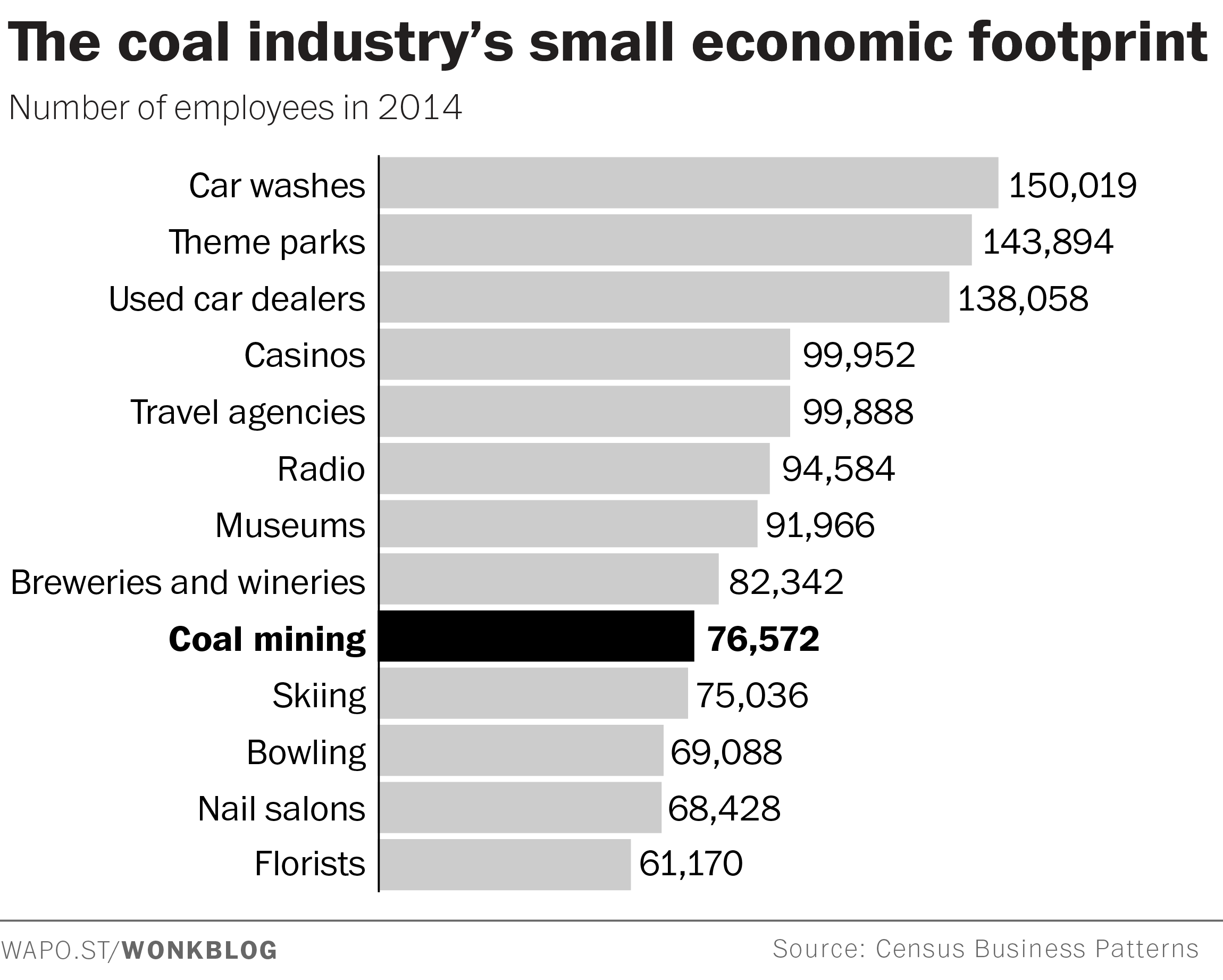
Coal Jobs Compared to Jobs in Other Industries: Chart

The number of workers employed in coal mining industry is less than the number of workers in than many other industries. For example, museums employed 91,966 compared to just 76,572 workers in the coal industry according an article I came across in The Washington Post. The 76K figure is not coal miners only but also includes office workers, sales people and others in the coal mining industry.


Click to enlarge


SourceThe entire coal industry employs fewer people than Arby’s, Washington Post

Related:

A Look At Leading Blue-Chip Companies From The Eurozone

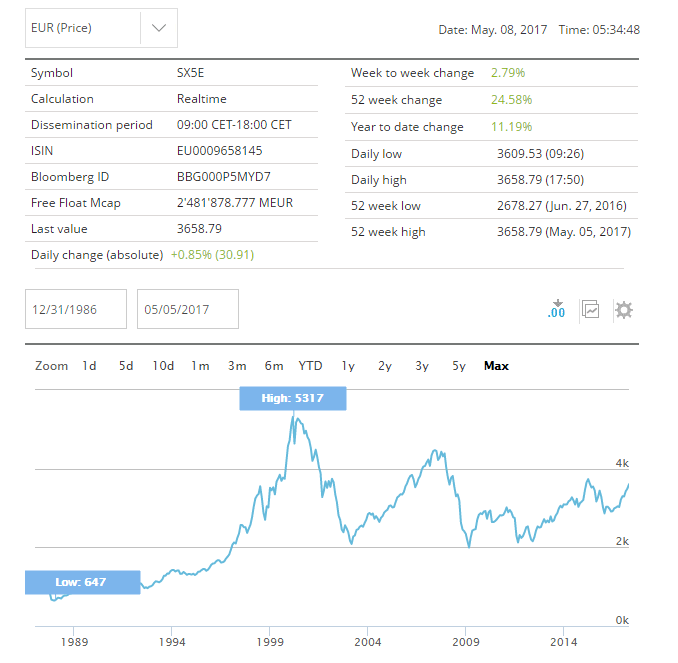
The Top 50 blue-chip companies in the Eurozone are represented in the Euro Stoxx 50 Index. The Eurozone countries covered by this index are Austria, Belgium, Finland, France, Germany, Ireland, Italy, Luxembourg, the Netherlands, Portugal and Spain. For investors looking to gain exposure to developed Europe this index offers an excellent starting point for identifying potential investment opportunities.

The Euro Stoxx Index is still below the long-term peak as shown in the chart below:

Click to enlarge

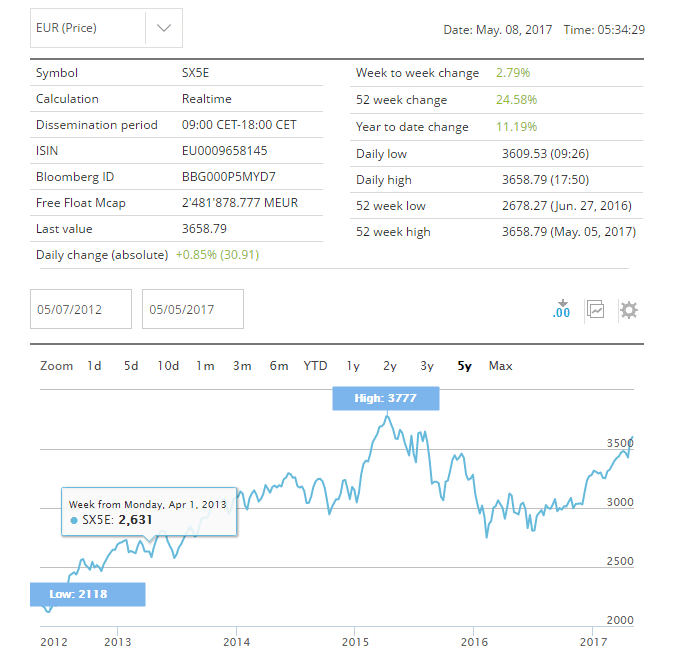
The following chart shows 5-Year performance of the index :

Note: Returns shown are for Euro-denominated price returns.

Source: Euro Stoxx

Ten stocks from the index are listed below with their current dividend yields for further research:

1.Company: Total SA (TOT)
Current Dividend Yield: 5.03%
Sector:Oil, Gas & Consumable Fuels
Country: France

2.Company: BASF SE (BASFY)
Current Dividend Yield: 3.21%
Sector: Chemicals
Country: Germany

3.Company: Siemens AG (SIEGY)
Current Dividend Yield: 2.64%
Sector:Industrial Conglomerates
Country: Germany

4.Company: Sanofi (SNY)
Current Dividend Yield: 3.21%
Sector: Pharmaceuticals
Country: France

5.Company: Banco Santander SA (SAN)
Current Dividend Yield: 3.41%
Sector: Commercial Banks
Country: Spain

6.Company: Unilever NV(UN)
Current Dividend Yield: 2.71%
Sector: Food Products
Country: The Netherlands

7.Company: Anheuser-Busch InBev SA/NV (BUD)
Current Dividend Yield: 3.17%
Sector: Beverages
Country: Belgium

8.Company: Allianz SE (AZSEY)
Current Dividend Yield: 4.16%
Sector:Insurance
Country: Germany

9.Company: Adidas AG (ADDYY)
Current Dividend Yield: 1.06%
Sector: Sportswear
Country: Germany

10.Company: Eni SpA (E)
Current Dividend :
Sector:Oil, Gas & Consumable Fuels
Country:Italy

Note: Dividend yields noted above are as of May 5, 2017. Data is known to be accurate from sources used.Please use your own due diligence before making any investment decisions.

Another simple way to gain exposure to the Eurozone blue-chips is via the SPDR® EURO STOXX 50® ETF (FEZ). Currently the fund has an asset base of over $3.4 billion and the expense ratio is 0.29%.

Disclosure: Long SAN

French Stocks in Focus

The French election is currently under-way. Tomorrow global investors may react based on the outcome of this divisive election. For US investors, only 11 French companies now trade on the organized exchanges. However those willing to go to the OTC markets have an additional 102 companies to choose from.

Among the major firms trading on the NYSE are Sanofi(SNY), Orange(ORAN) and oil major Total(TOT). Go to The full of French ADRs on the exchanges for all the stocks.

Many of the other top companies trade on the OTC market. Some of the options to consider include: Air Liquide(AIQUY), Arkema(ARKAY), AXA(AXAHY), BNP Paribas(BNPQY), Societe Generale(SCGLY), Danone(DANOY),Electricite de France(ECIFY) and Valeo(VLEEY). The complete list of stocks on the OTC market can he found here.

Related:

Disclosure: Long AXAHY

The Number of U.S. Stock Listings Continue To Decline

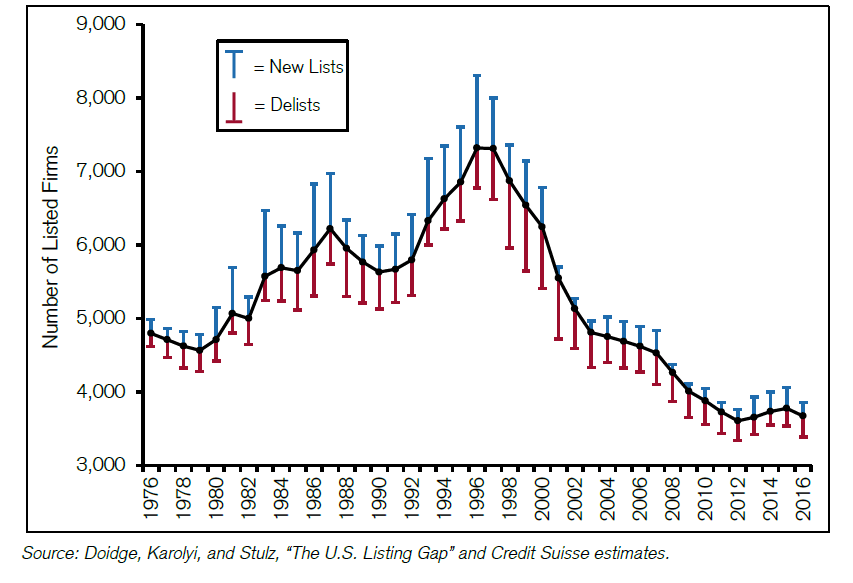
The total number of U.S. listed companies has continued to fall since the 1990s. From 1980 thru 1996 the number of listed companies rose steadily. But since then the number has declined year-after-after. The consequences of the low number of listed companies available for investors is huge. According to a research report from Credit Suisse, the number of listed US companies has fallen from 7,322 in 1996 to just 3,671 in 2016.

Click to enlarge

Sources:

The Causes and Consequences of Fewer U.S. Equities, Credit Suisse

The Case of the Missing U.S. Stocks by Frank Holmes, U.S. Funds

Some of the consequences of the low number of listed companies are:

  • Billions and billions of capital chasing investment opportunities find very options in the US market. This leads to a stampede in popular names like Amazon(AMZN), Facebook(FB), Alphabet(GOOG), Netflix(NFLX), Apple(AAPL), etc. and also some traditional  large-cap companies leading to sky-high valuations.
  • According to Frank Holmes of US Funds, since the US is the world’s largest equity market, low listed companies has huge implications.
  • From 1996 thru 2016, the number of listings has declined by 50%.
  • Private-equity investors are reaping incredible profits as public investors scramble to find opportunities in the markets. This is because private equity can keep companies private and earn profits to themselves or take public firms private leading to the continued decline in listings.
  • M&A activity has also contributed to the issue since large caps gobble up smaller companies at an alarming rate without worrying about things like anti-trust regulations as regulators and politicians look the other way.
  • Another impact is the scary ride that investors are subjected to in most US IPOs. Companies going public reach astronomical stock prices only to crash to fair levels in a few months as investors exit their positions looking for other investments. Firms with low to no profits and questionable products or businesses are also taken public. They hype surrounding the rare companies that go public are also awful.

Download Report: Listed US companies Report by Credit Suisse (in pdf format)