Review: The MSCI Emerging Markets Index

One of the easiest and simplest ways to gain exposure to emerging market equities is via an ETF. Some of the world’s top emerging market ETFs benchmark to the MSCI Emerging Markets Index offered by the index provider MSCI. In fact, according to MSCI over $1.5 Trillion in assets are benchmarked to this index.

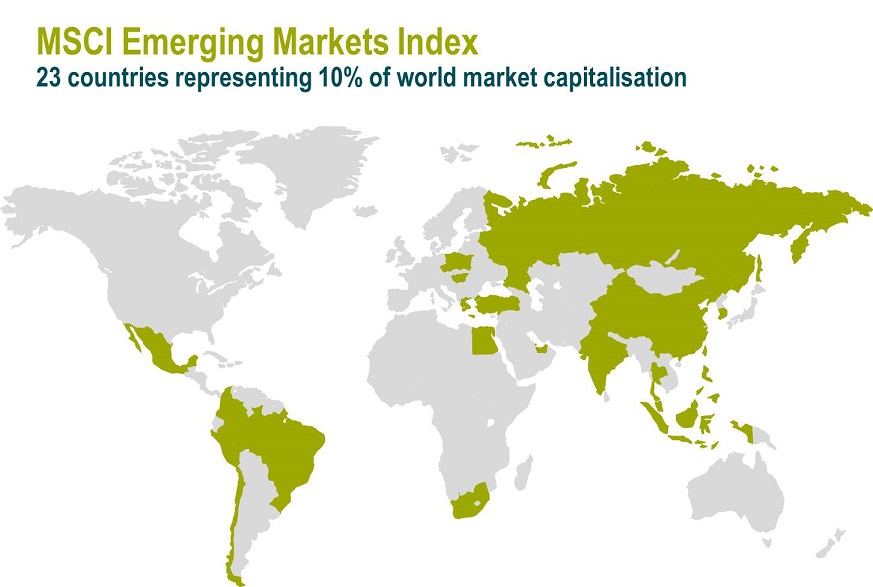
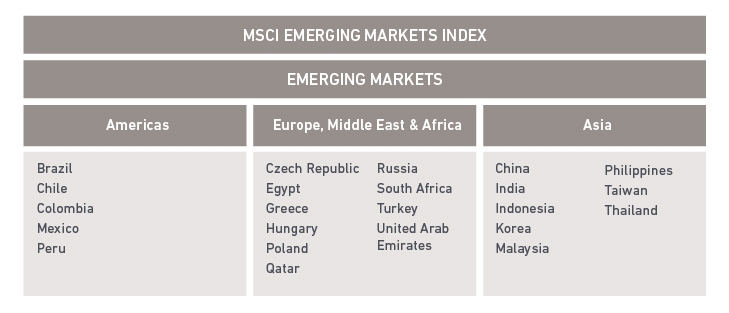
The MSCI Emerging Markets Index is comprised of equities from 23 emerging markets representing 10% of the world market capitalization.

Click to enlarge
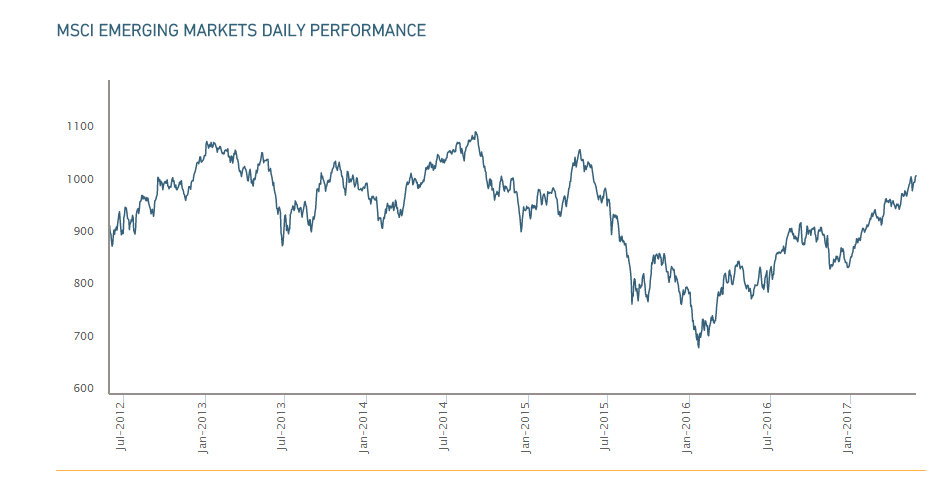
The long-term daily return of the MSCI Emerging Markets Index since 2012 is shown below:
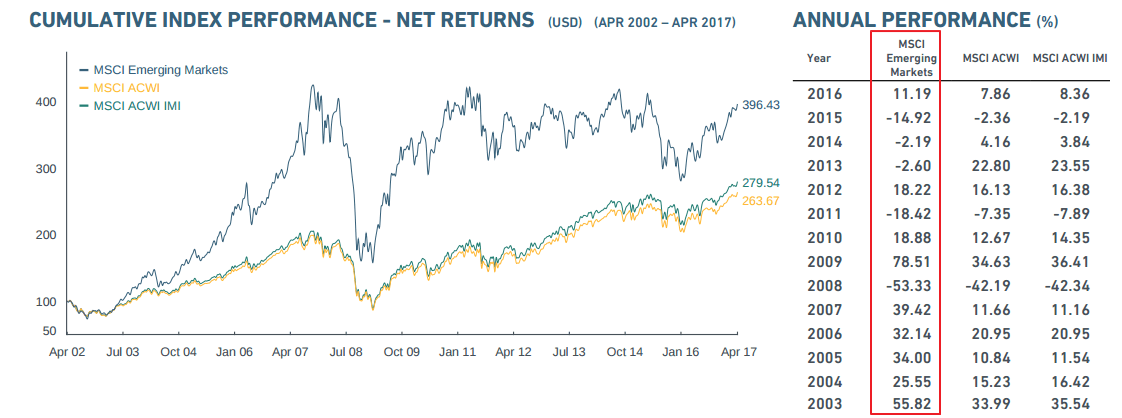
The long-term return of MSCI Emerging Markets Index vs. MSCI World Index is shown below. The MSCI World Index represents the developed world markets:

The table below shows the annual return of the MSCI Emerging Markets Index vs. MSCI World Index:
Download: The MSCI Emerging Markets Index Factsheet (in pdf)

Sources:

Earlier:

Related ETFs:

  • iShares MSCI Emerging Markets ETF (EEM)

The iShares ETF has an asset base of over $31 billion. The Vanguard MSCI Emerging Markets ETF (VWO) is benchmarked to the FTSE Emerging Markets Index and not the MSCI Index. A few years ago Vanguard switched their benchmark to the other index provider FTSE. The fund has over $72 billion in assets.

Disclosure: No Positions
World Equity Market Highlights 2016 In Three Charts

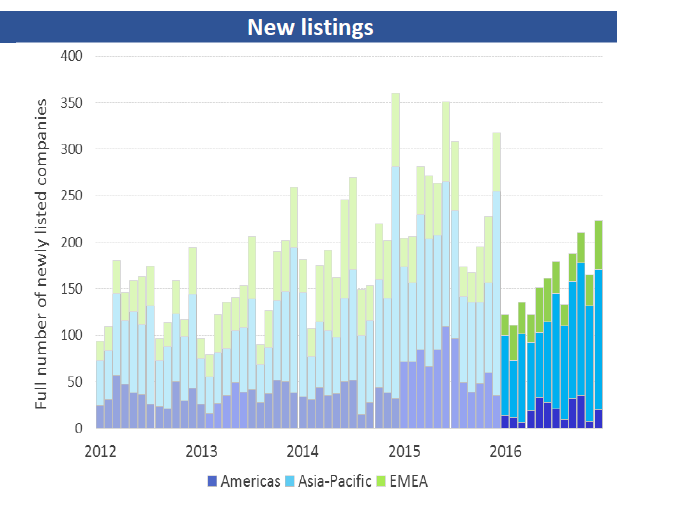
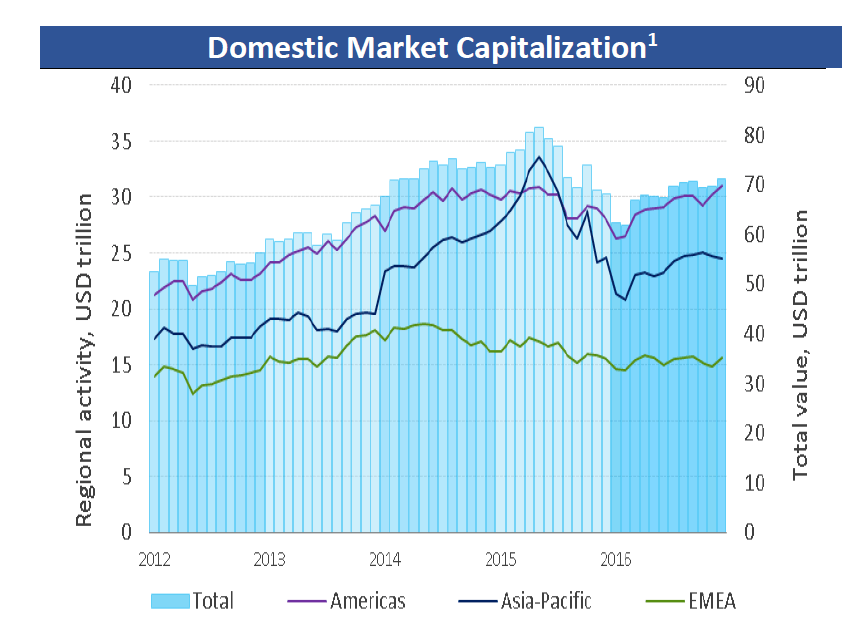
Global equity markets had a subdued growth in 2016 according to a report by The World Federation of Exchanges. The global market capitalization increased by 4.4% and value of stocks traded declined by 27%. Much of this fall can be attributed to sharp sell-off on Chinese exchanges and restricted trading there. Number of newly listed companies were also down by 36%.

The following are three charts from the 2016 WFE Market Highlights report.

1.Domestic market Capitalization by region:

Click to enlarge

2.Number of new listings by region:

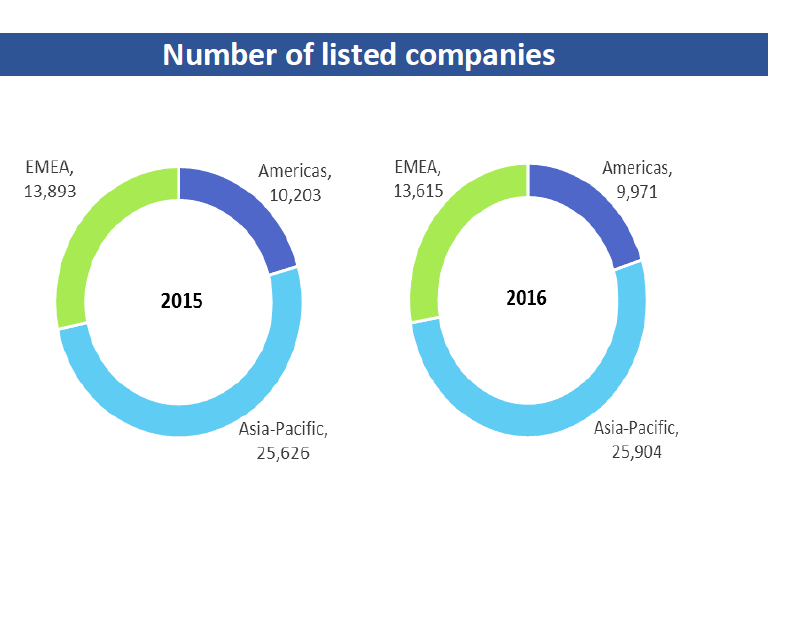
3.Number of listed companies by region:

Source: WFE

Four Economic Drivers of Different Emerging Market Equities: Infographic

Emerging market stocks are in vogue again in recent months. After abandoning these markets in the past few years global investors are slowly returning back to them in order to profit from higher growth potential than in developed markets.

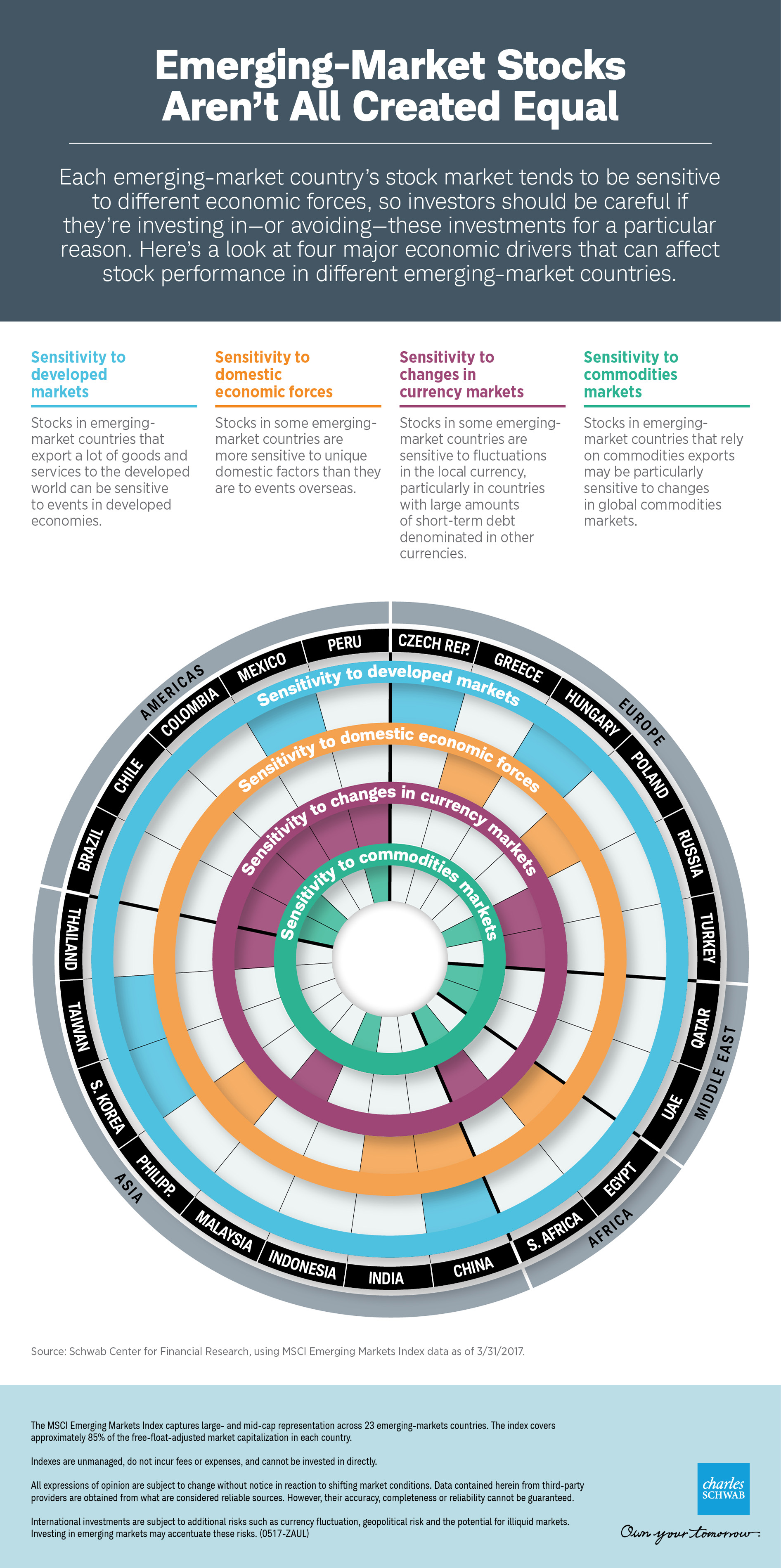
It is important to note however that not all emerging markets are driven by similar forces. While some may be dependent on commodity exports others may be more driven by the state of the domestic economy. So taking these factors into consideration when selecting destinations for emerging markets is critical. For example, Chile is highly dependent on copper (a volatile commodity) but Mexico’s economy is tied to the US economy. Moreover Mexico is not a commodity-driven economy. Its economy is focused mainly on manufacturing and tourism. Similarly the Asian countries of China and India do not depend on exports heavily. But instead their economies are dependent on domestic growth and other local factors.

The following neat infographic from Schwab identifies four economic factors that drive emerging markets:

Click to enlarge

Source: Emerging-Market Stocks Aren’t All Created Equal, Charles Schwab, May 24, 2017

Related ETFs:

  • iShares MSCI Emerging Markets ETF (EEM)
  • Vanguard MSCI Emerging Markets ETF (VWO)

Disclosure: No Positions


How to Use the Power of Compounding To Save For Retirement ?

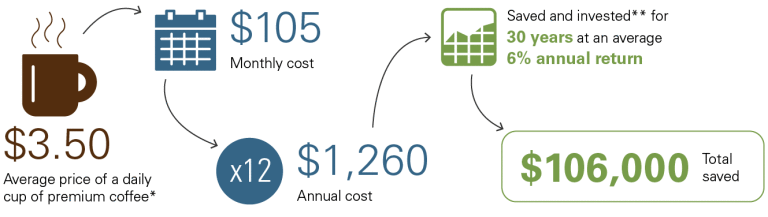
Compound interest is the eight wonder of the world. So said Albert Einstein. Saving for retirement is a struggle for many workers especially middle and poor-income American workers. However even saving a little everyday can help build a nice nest egg. The following example, shows the power of compounding returns by skipping coffee at expensive premium shops and saving that $3.50 each day.

The return below is based on investing that $3.50 each day for 30 years in a low-cost diversified Roth IRA earning 6% annual return according to an article by Fran Kinniry at Vanguard. After 30 years that account would have grown to $106,000. This is indeed a nice chunk of change to have in retirement.

Click to enlarge


He quotes an interesting tidbit about Warren Buffet’s similar line of thinking. From the article:

As a young man, Buffett wondered if he really wanted to spend $300,000 for a haircut.1 By getting his locks trimmed every five weeks instead of four, and spending $18 instead of $25, Buffett estimated he’d save an estimated $300,000 over his lifetime.

1 Alice Schroeder, 2008. The Snowball: Warren Buffett and the Business of Life. New York: Bantam Books.

Source: $106,000 for coffee? Let’s talk compounding by Fran Kinniry, Vanguard