REITs Investors To Benefit Big From New Tax Law

Investors in Real Estate Investment Trusts(REITs) are the big winners of new US tax laws. Currently dividends from REITs are taxed as ordinary income for US tax payers. This is substantially higher than taxes on qualified dividends at 10% for investments held for over one year. The ordinary income tax on REITs has also been a big disadvantage on investing in them compared to stocks in other industries. The new tax laws gives a big boost to investment in REITs.

Recently REITs have declined sharply due to rising interest rates and rising yields on treasuries. Since REITs are mostly held for their income, investors have turned bearish on the sectors. For example, Simon Property Group Inc(SPG) has seen its share price fall from over $220 back in July, 2016 to $159 recently. SPG and W.P. Carey Inc(WPC) have yields of 4.89% and 6.17% currently. Investors interested in this sector may want to consider adding some of the REITs especially those in the warehouse area in phases to profit from reduced taxes this year.

Below is a short excerpt from an article on the impact of new tax laws on REITs:

American citizens and corporations are projected to enjoy a net tax benefit of approximately $1.455 trillion over the next 10 years from the new tax law, but those benefits will not be evenly distributed among taxpayers. Still, real estate investment trusts and their investors are incontestable winners.

REITs are professional firms that purchase and operate income-generating properties with capital raised from their shareholders. They are attractive to investors who want the exposure to real estate but may not have the capital or knowledge to invest in properties directly.

Most REITs are structured as pass-through entities to avoid the double taxation of income, as they “pass through” at least 90 percent of the profit and losses to their investors. Investors receive a distribution from REITs either as ordinary income on a 1099-DIV form or as a return of capital. The latter provides tax deferral to investors since the return of capital is not taxed until the properties are sold with a profit. The 25 percent tax rate on the capital gains also could be lower than the income tax rate, which tops out at 37 percent under the old tax code.

The Tax Cuts and Jobs Act blessed REIT investors with a 20 percent tax reduction on the pass-through income received. Specifically, individual REIT investors who file jointly with taxable income less than $315,000, or file individually with income less than $157,000, may enjoy a 20 percent deduction on REIT dividends as qualified business income. REIT investors with higher taxable income — up to $415,000 jointly or $207,000 individually — also may enjoy a tax deduction on a reduced scale. REIT investors facing a high marginal income tax bracket are primary beneficiaries of the tax deduction.

The TCJA’s blessing even spills over to foreign REIT investors. Under the Foreign Investment in Real Property Tax Act, foreign REIT investors formerly were subject to a 35 percent withholding on REIT distributions. Under the new tax code, they are now subject to the corporate tax rate, which tops out at 21 percent.

Source:  REITs are the big winners from the new tax law, Accounting Today

For more details on the tax law changes visitors can check out the above linked article.

Disclosure: No Positions

Why Invest in International Small and Mid Cap Companies: Infographic

The small and mid cap universe of stocks is huge in the domestic market. For US investors, the international universe is much large with thousands of firms waiting to be discovered. To boost returns and potentially find multi-baggers investors can search for these firms in overseas markets. Some of the reasons for picking companies in this area are shown in the graphic below:

Click to enlarge

Source: Oppenheimer Funds

US Asset Class Returns by Year 1998 to 2017: Chart

Diversification is one of the most important strategies to follow when investing in equity markets. Putting all eggs in one basket is never a good idea. Many investors who piled into tech stocks during the dot-com era lost everything due to lack of diversification.

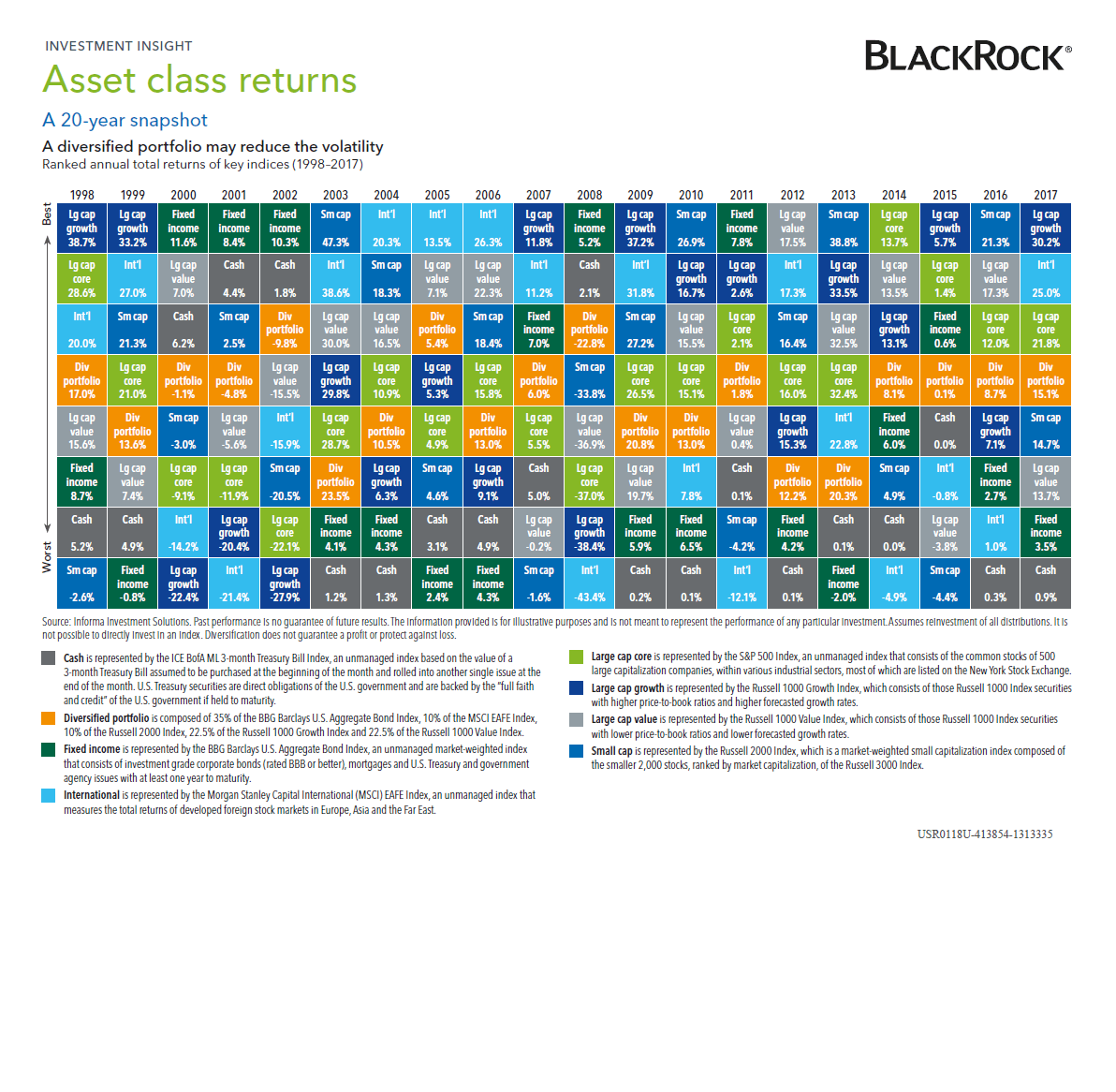
Diversification can take many forms including spreading one’s asset among various countries, regions, sectors, asset classes and asset types. The following chart shows the benefits of diversification based on US asset returns by year:

Click to enlarge

Source: Blackrock

In 2017, US large cap growth were the top performers with a return of 30.2% while fixed income was the second worst performer with a return of just 3.5%. International stocks earned the highest returns after US large cap growth at 25%. This shows the need for diversifying overseas.

Back in 2008, at the height of the Global Financial Crisis(GFC) US large cap growth and foreign stocks lost 38% and 43% respectively while fixed income yielded 5.2%.

So in a nutshell, investors need to allocate their portfolio among many asset classes. Simply owning only large caps or only fixed income is not a wise strategy.

Related ETFs:

  • SPDR S&P 500 ETF (SPY)
  • S&P MidCap 400 SPDR ETF (MDY)
  • SPDR Consumer Discretionary Select Sector SPDR Fund (XLY)
  • SPDR Consumer Staples Select Sector SPDR Fund (XLP)
  • SPDR Energy Select Sector SPDR Fund (XLE)
  • SPDR Financials Select Sector SPDR Fund (XLF)
  • iShares Dow Jones Select Dividend ETF (DVY)
  • SPDR S&P Dividend ETF (SDY)
  • Vanguard Dividend Appreciation ETF (VIG)

Disclosure: No Positions

The Top 10 Canadian Dividend Stocks

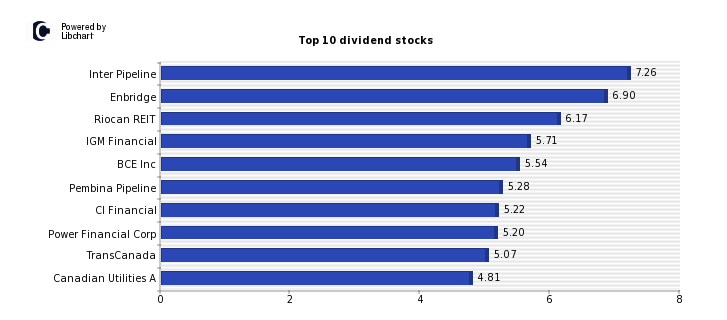
The top 10 dividend stocks of Canada are shown in the chart below:

Click to enlarge

Note: Data shown is as of April 20, 2018 and is based on the domestic market.

For US investors, Canada charges a lower withholding taxes on dividends for regular taxable accounts(except REITs).  There is no dividend withholding taxes for stocks held in qualified retirement accounts such as IRAs, 401-K, etc.

Source: Dividend Ranking

Disclosure: No Positions

A Timeline of Retail Bankruptcies From 2015 Thru March 2018: Infographics

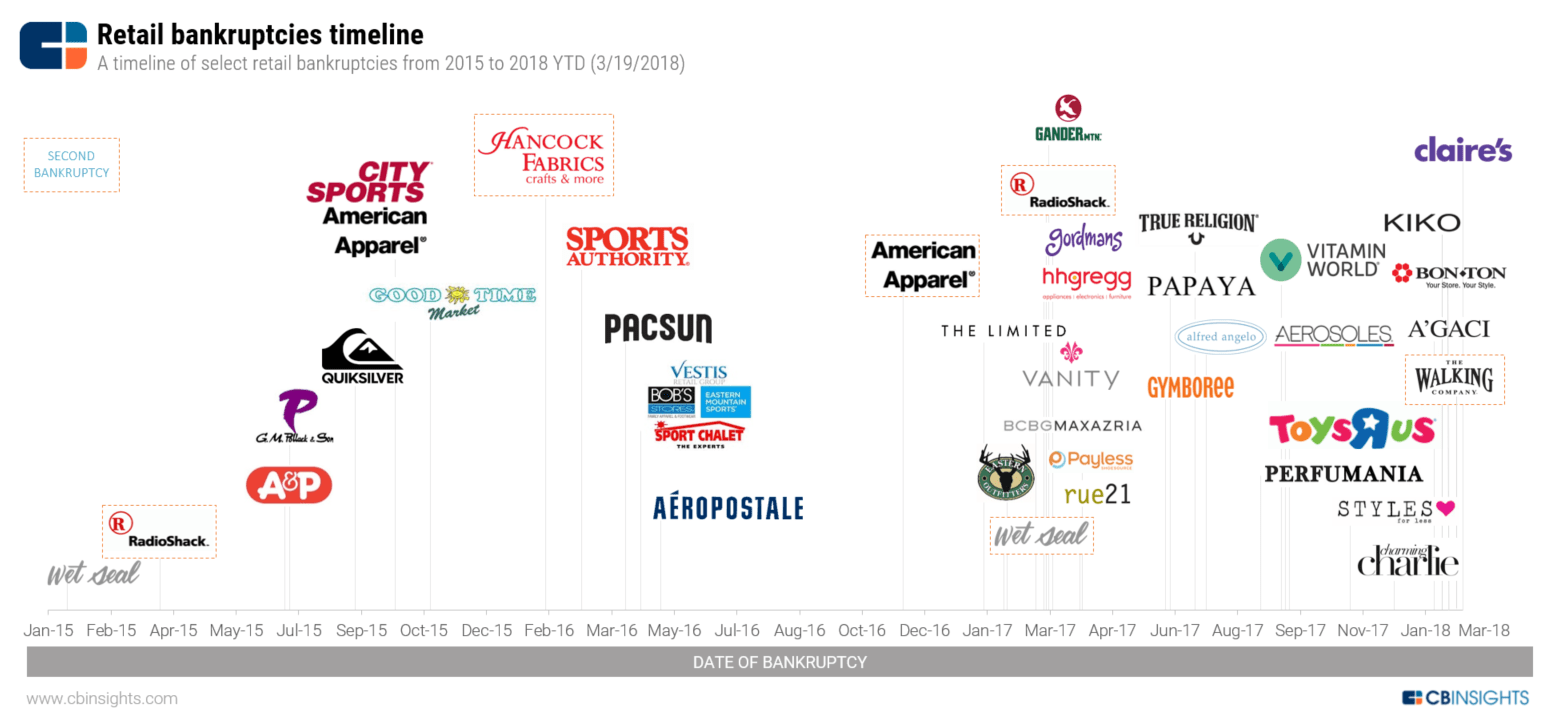
The retail industry is one of the worst performing industries in recent years. Hundreds of retail companies have gone bankrupt some almost overnight. A variety of factors are attributed to the retail apocalypse with Amazon being the prime reason. However blaming Amazon(AMZN) for all failures is an easy way out. Real reasons such as moronic business plans, management in-competencies, etc. are rarely mentioned.

The following is a neat infographic showing the timeline of recent retail bankruptcies:

Click to enlarge

Source: Here’s A List Of 40 Bankruptcies In The Retail Apocalypse And Why They Failed, CB Insights

Hat Tip: FT Alphaville