The S&P Biotechnology Select Industry Index Returns: Chart

The S&P Biotechnology Select Industry Index is one of the major indices that tracks the biotech sector. The index is up just 8% YTD while the NYSE Arca Biotechnology Index has shot up over 23%.

Click to enlarge
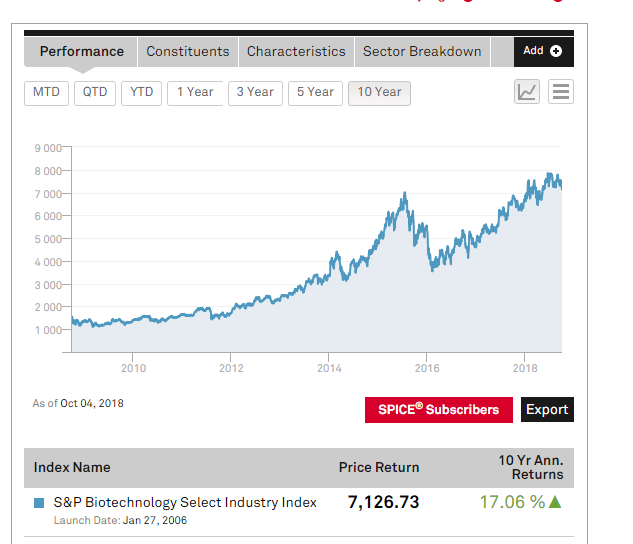
Source: S&P Indices

Overall Biotech stocks have performed so far well this year. Investors interested in the sector can check out the options available on the NASDAQ market.
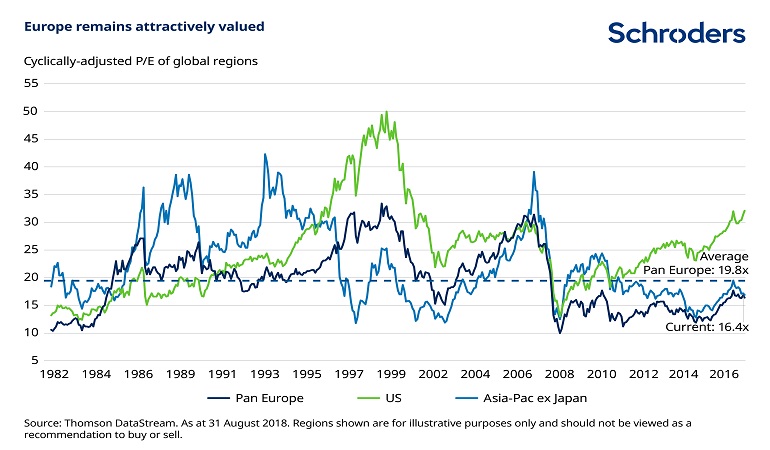
European Stocks Are Attractively Valued Now: Chart

European equities are attractive relative to their US peers based on cyclically-adjusted price-to-earnings ratio (CAPE) according to an article by Rory Bateman at Schroders. The following chart shows the comparison of valuations since 1982:

Click to enlarge

Source: Can European equities play catch-up in Q4?, Schroders

A short excerpt from the above article:

In summary, we are encouraged by the recent rotation in the market favouring more cyclical value stocks and moving away from expensive defensives.

The overall market valuation remains attractive with the cyclically-adjusted price-to-earnings ratio (CAPE) trading 20% below historical averages. The massive performance differential versus the US has recently begun to close and we expect this to continue.

Markets remain susceptible to volatile periods and we would suggest investors be opportunistic and take advantage of this volatility to buy assets that become mispriced.

Are Gold Mining Stocks Attractive Now?

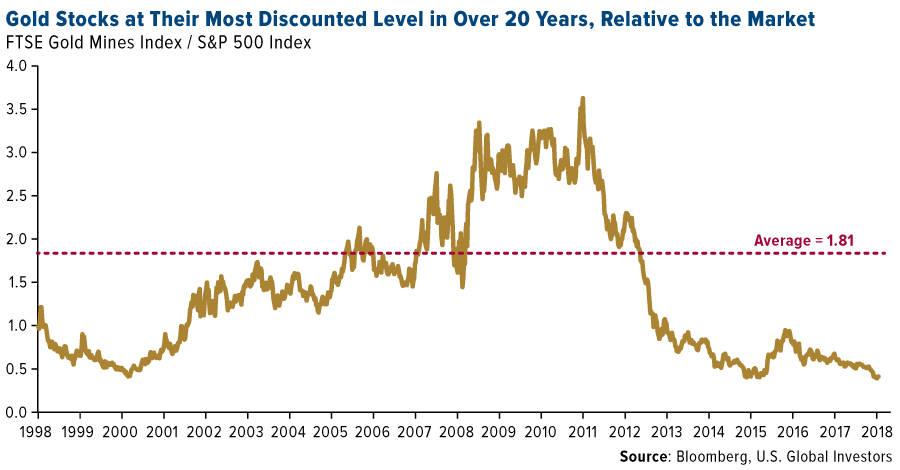
Gold prices continue to remain stagnant with December futures for the precious metal ending at $1,187.70 an ounce last Friday. The price struggles to maintain levels above $1,200 per ounce. However investors looking to gain from a rebound in gold prices may find gold miners attractive at current levels. In an article last week Frank Holmes of U.S. Global Investors noted that gold mining stocks are attractive relative the S&P 500.

From the article:

Get ready, gold bulls: The precious metal could be close to finding a bottom.

The price of gold fell back below $1,200 an ounce again this week as the U.S. dollar advanced following another federal funds rate hike. It’s now set to log its sixth straight month of declines, its longest losing streak since 1989.

That gold’s not trading below $1,150 is, I believe, remarkable. There’s a lot motivating the bears right now. Besides a stronger dollar and higher interest rate, stocks are still going strong, buoyed by record buybacks and massive inflows into passive investment products. In the week ended September 20, investors poured as much as $34.3 billion into ETFs, taking year-to-date inflows to nearly $215 billion, according to FactSet data.

This makes gold mining stocks look especially attractive by comparison. Relative to U.S. blue chips, the FTSE Gold Mines Index is now at its most discounted level in over 20 years.

Source: Gold’s Bottom Could Be Investors’ Lost Treasure, U.S. Global Investors

On a related note, last week NASDAQ-listed Randgold Resources(GOLD) announced plans to merge with NYSE-listed Barrick Gold Corp (ABX) to create the world’s largest gold mining company.

I am not a fan of gold mining stocks. However investors interested in gold miners can consider the stocks trading on the NASDAQ and NYSE for further research.

Related ETF:

  • SPDR Gold Trust ETF (GLD)

Disclosure: No Positions

A Review of Australia’s S&P/ASX 200 Index

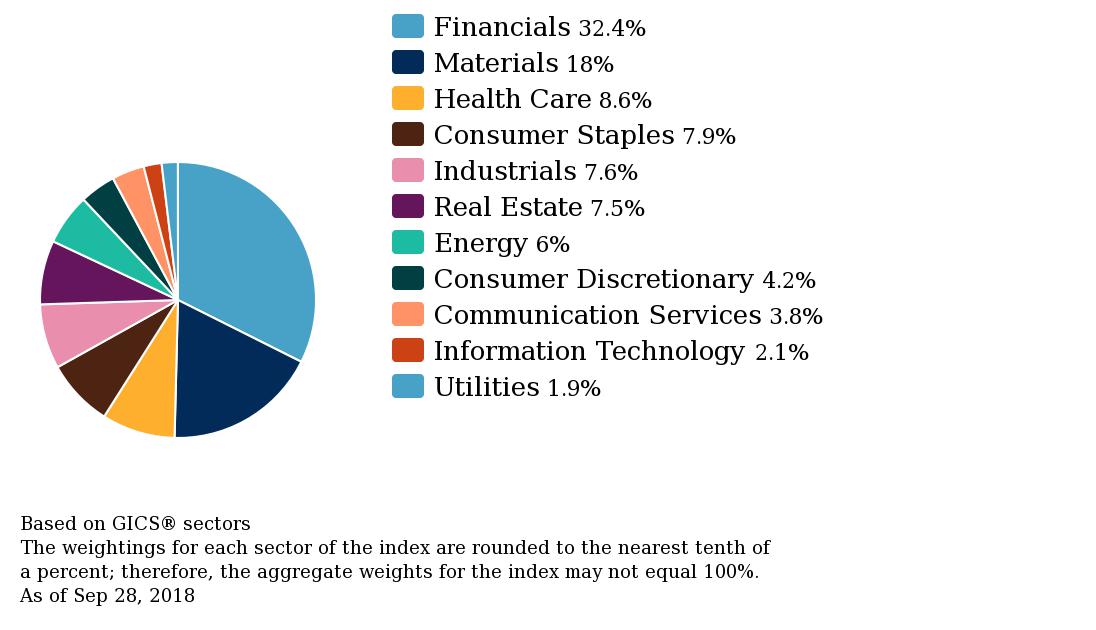
The S&P/ASX 200 Index is the benchmark index of the Australian equity market. The index is composed of the largest 200 companies listed on the ASX by float-adjusted market capitalization.

The composition of the Index is shown in the chart below:

Click to enlarge

Source: S&P Indices

Nearly one-third of the index is concentrated in financials with the materials sector accounting for 18%. Together these two sectors amount to over 50% of the index. Though Australia is a resource-based economy the financials play a major role than the resources sector.

The tech sector in Australia is tiny compared to the US. Hence the IT sector has an allocation of just over 2% in the index.

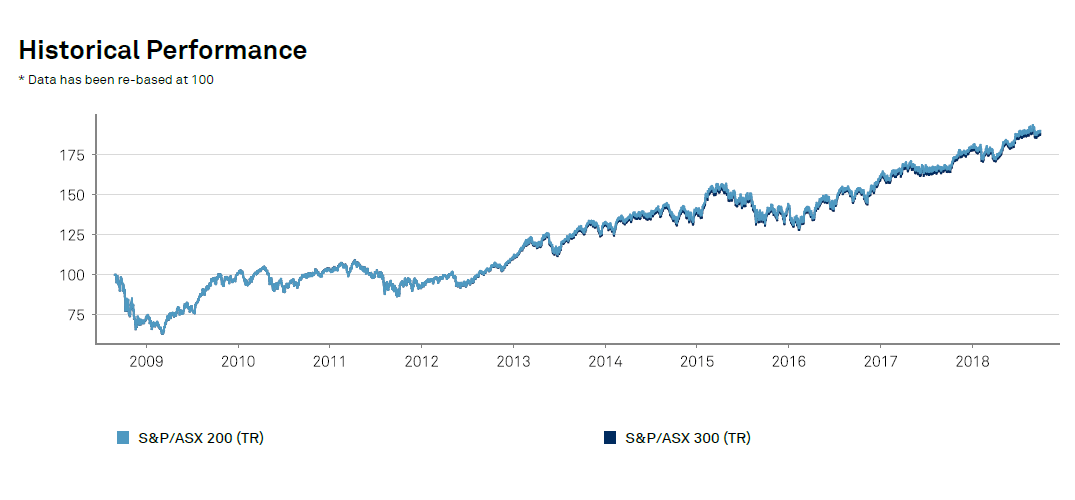
The long-term performance of the index in local currency is shown below:

Click to enlarge

The top 10 constituents in the index amount to over 45% of the index weightage. These 10 companies are listed below with their ticker on the US market and current dividend yield:

1.Company: Westpac Banking Corp (WBK)
Current Dividend Yield: 7.08%
Sector:Banking

2.Company: Australia and New Zealand Banking Group Ltd (ANZBY)
Current Dividend Yield: 8.96%
Sector:Banking

3.Company: National Australia Bank Ltd (NABZY)
Current Dividend Yield: 7.36%
Sector:Banking

4.Company:Commonwealth Bank of Australia (CMWAY)
Current Dividend Yield: 9.79%
Sector: Banking

5.Company: BHP Billiton Ltd (BHP)
Current Dividend Yield: 4.74%
Sector:Metals & Mining

6.Company: CSL Ltd (CSLLY)
Current Dividend Yield: 1.18%
Sector:Healthcare

7.Company: Wesfarmers(WFAFY)
Current Dividend Yield: 4.60%
Sector:Consumer Staples

8.Company: Macquarie Group(MQBKY)
Current Dividend Yield: No dividends paid
Sector:Financials

9.Company: Telstra Corp Ltd(TLSYY)
Current Dividend Yield: 7.13%
Sector:Telecom

10.Company: Woolworths Group Ltd
Sector:Consumer Staples
Woolworths does not trade on the US markets.

Note: Dividend yields noted above are as of Sept 28, 2018. Data is known to be accurate from sources used.Please use your own due diligence before making any investment decisions.

Download:

Disclosure: Long WBK and NABZY

Emerging Markets: Intra-Year Pullbacks and Yearly Returns 2004 Thru 2017

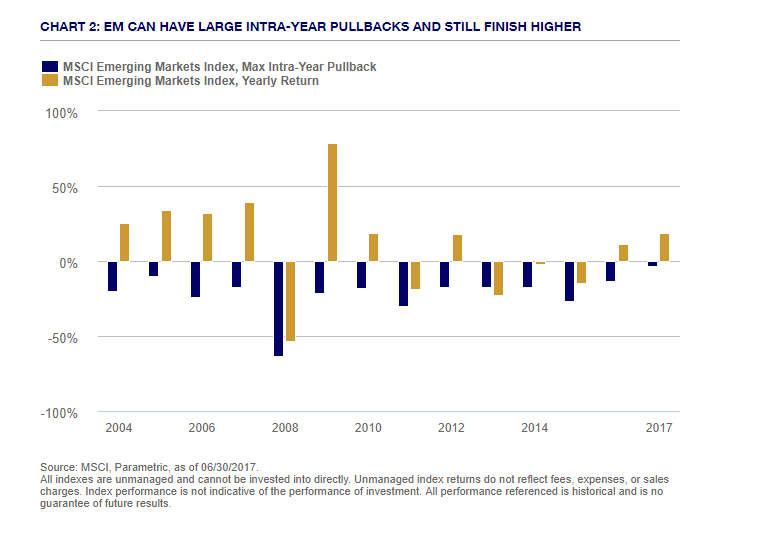
Emerging market equities are a volatile asset class. Though these stocks go through dramatic declines sometimes in a very short period of time, over the long run they offer above average returns. Investors who are able to wait out the downturns are rewarded for their patience.

The following chart shows how emerging markets can have big intra-year declines but still have positive annual returns:

Click to enlarge

Source: Who’s Afraid of an Emerging Markets Meltdown?, Thornburg Investment Management

From the above linked article:

While this has been painful for those invested in EM, the experience is not exactly unusual for the asset class. Over the last 15 years, the MSCI EM Index pulled back 15% or more 11 times, and it still finished the year higher six of those 11 times.

Related ETFs:

  • iShares MSCI Emerging Markets ETF (EEM)
  • Vanguard MSCI Emerging Markets ETF (VWO)

Disclosure: No Positions