US Equity Market Corrections and Bear Markets Since 1974

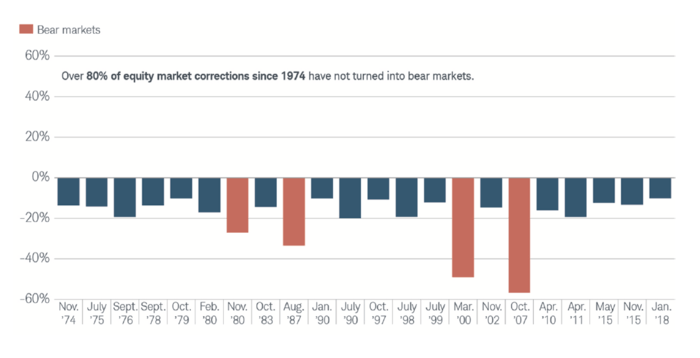
The US equity market may end the year with a loss barring any Santa Claus rally or a miracle. So investors may be wondering if this is the start of a bear market. Bear market is usually defined as a decline of 20% or more. According to an article at Schwab, very few of corrections in the market have turned into bear markets. In fact, since 1974 only 4 have turned into bear markets.

From the article:

Is it the start of a bear market?

Nobody can predict with any degree of certainty whether a correction will reverse or turn into a bear market. However, historically most corrections haven’t become bear markets (that is, periods when the market falls by 20% or more). There have been 22 market corrections since November 1974, and only four of them became bear markets (which began in 1980, 1987, 2000 and 2007).

Since 1974, only four market corrections have become bear markets

Source: Schwab Center for Financial Research with data provided by Morningstar, Inc. Each period listed represents the beginning month/year of either a market correction or a bear market. The general definition of a market correction is a market decline that is more than 10%, but less than 20%. A bear market is usually defined as a decline of 20% or greater. The market is represented by the S&P 500 index. Past performance is no guarantee of future results.
Source: Market Correction: What Does It Mean?, Schwab

Updates:

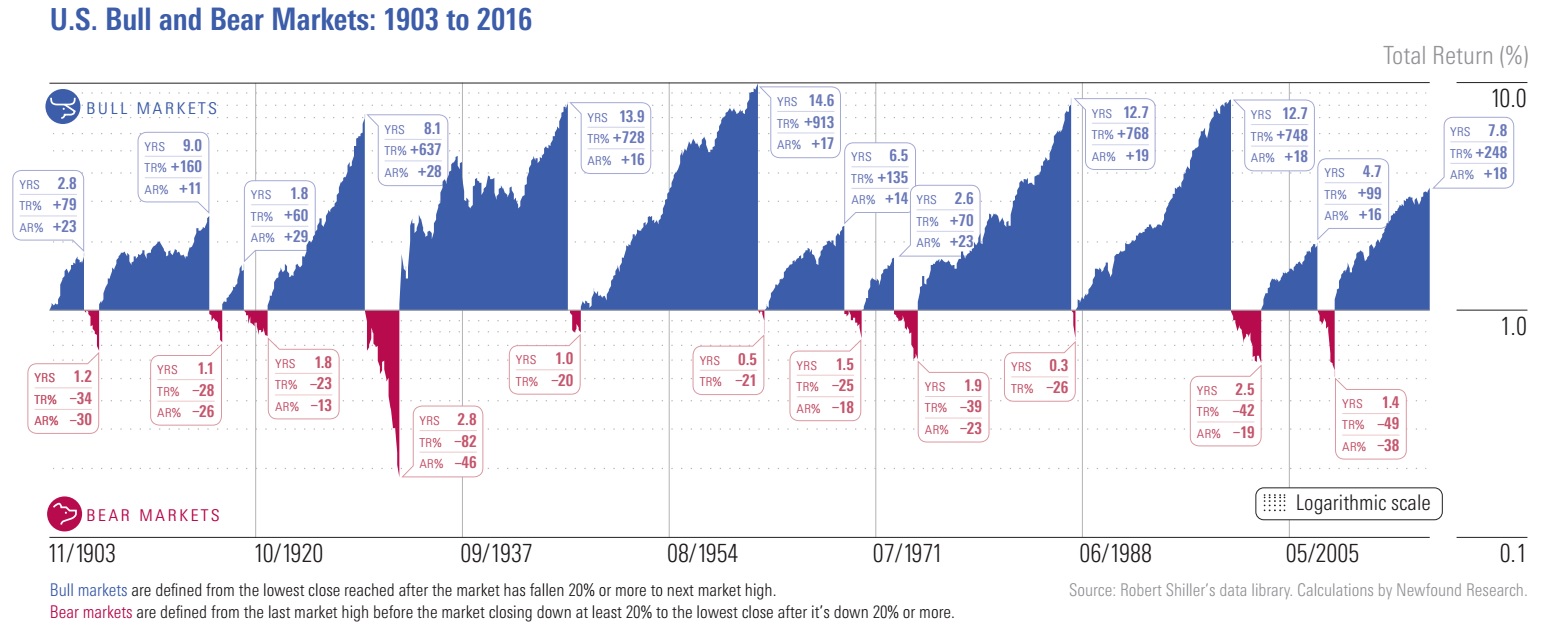
  1. US Bull and Bear Markets From 1903 To 2016:

Click to enlarge
Source: Skloff Financial Group

According to Morningstar, over the period from 1903 to 2016, there were 12 bull markets in the S&P 500. The average bull market lasted 8.1 years, with a total return of 387%. The average bear market lasted 1.5 years, with a total loss of 35%. Hence bear markets are shorter than bull markets on an average.

2. History of US Bull and Bear Markets:

Click to enlarge
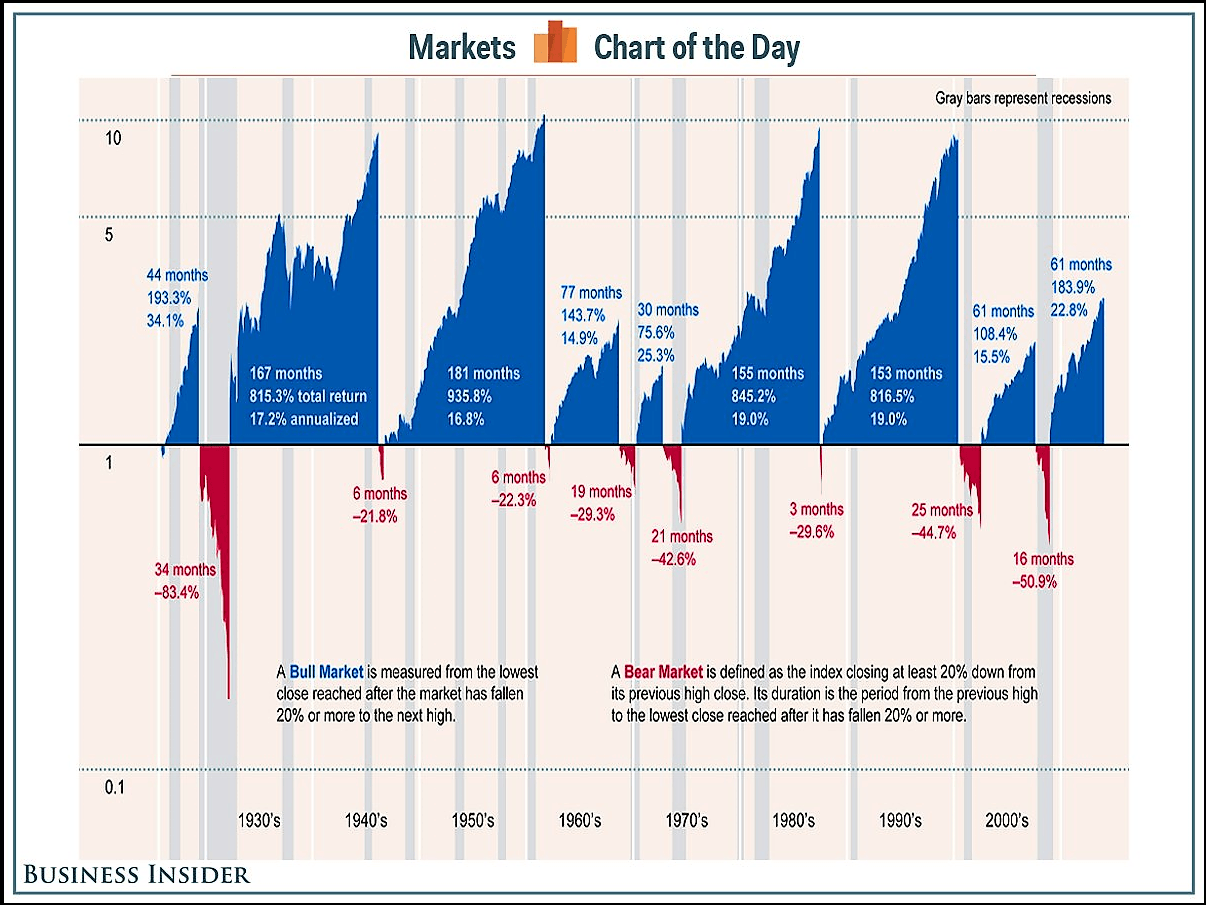
Source: Business Insider

3a. Length of Bull and bear Markets for the S&P 500 since 1927:

Click to enlarge
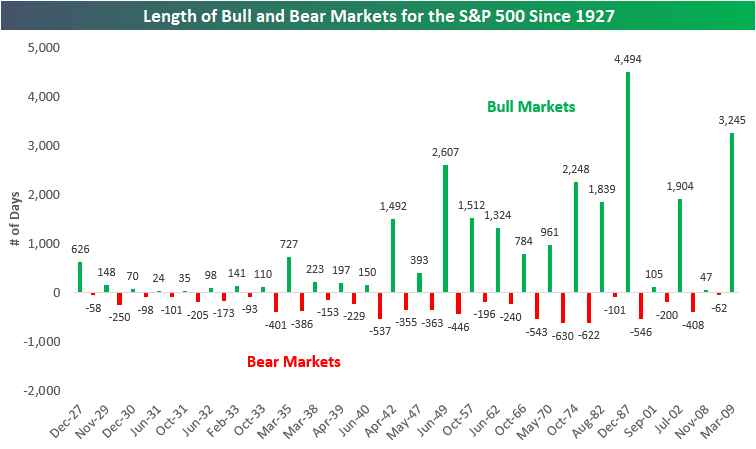
 

3b.US Bull and Bear Market Cycles post World War 2 based on S&P 500:
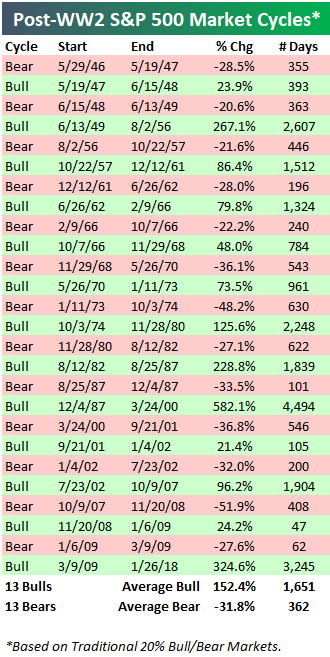
 

Source: Bespoke Investment Group

4.Dates of S&P 500 Bear Markets Since 1929:

Click to enlarge
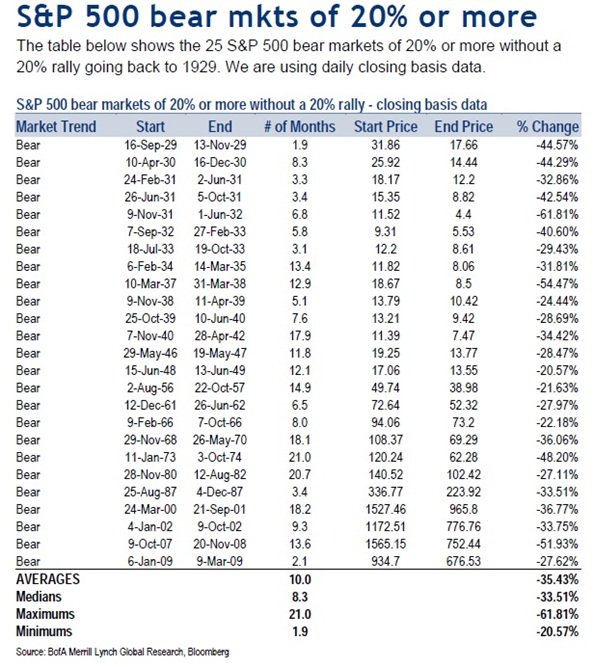
Source: Gold Eagle

Earlier Related Posts:

  1. Half of Global Stocks and S&P 500 Stocks Are Now in a Bear Market, Dec 19, 2018
  2. Stocks Deliver Strong Returns Following Bear Markets
  3. Average Annual U.S. Equity Returns Following Bear Markets: Chart
  4. On the Importance of Diversification During Bear Markets
  5. Total Returns During US Equity Secular Bull and Bear Markets Since 1877
  6. WSJ: Bear Markets are Remarkably Short – Length of Bear Markets Since 1920s 
  7. Bear Markets Are Always Followed By Positive Returns
  8. S&P 500: Bear and Bull Market Price Returns From 1966 To 2017
  9. Past Bull Markets Following Bear Markets: Chart
  10. Cyclical Bull Market in US Stocks Since World War II

Foreign Bear Markets:
  1. Bull and Bear Markets in Canada since 1957
  2. Bear Markets in Australian Stocks since 1900
  3. Duration of Bull and Bear Markets in Indian Stock Market

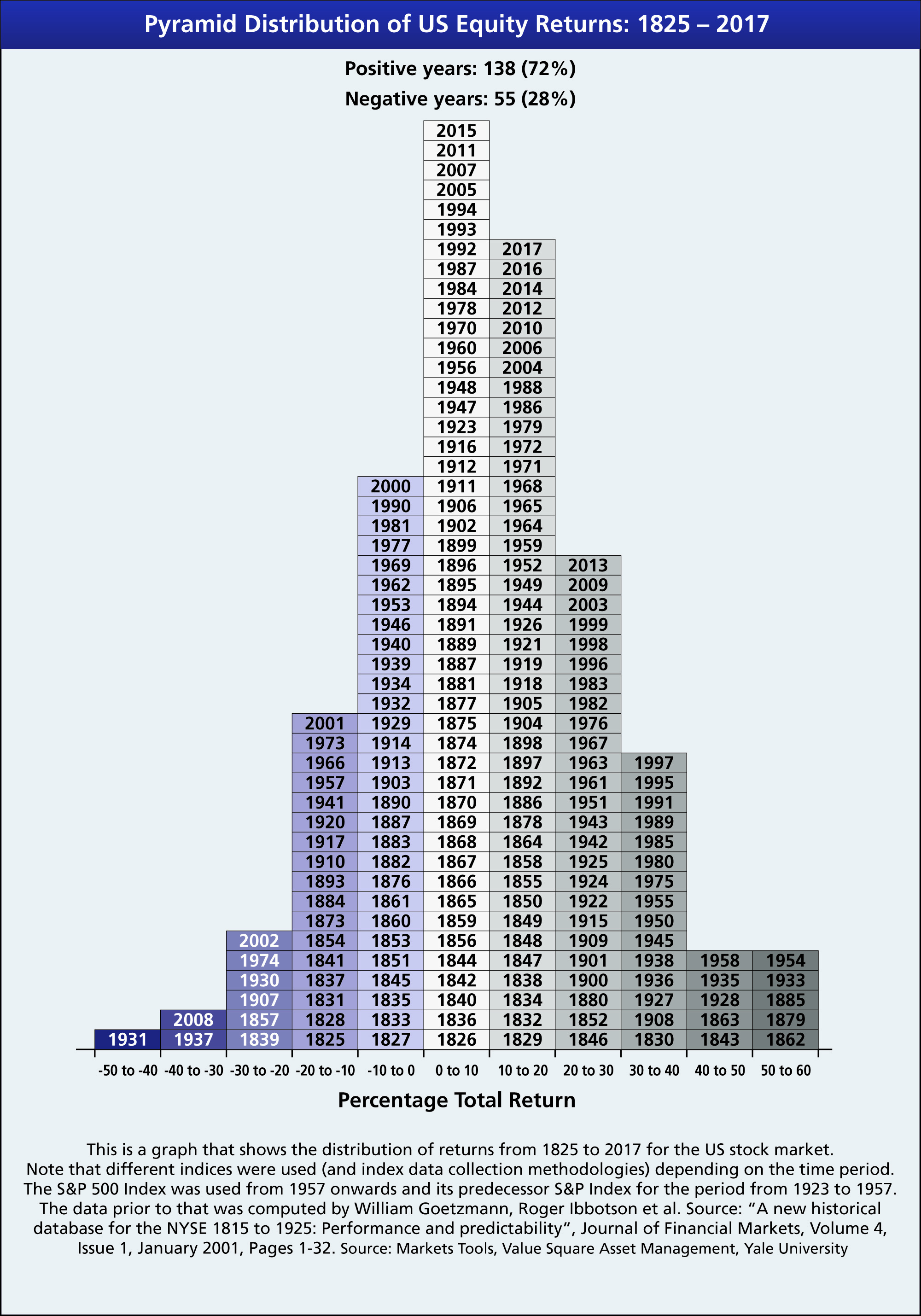
Pyramid Distribution of US Equity Returns 1825 to 2017

US markets are on track to end the year with negative returns. However over the long run, US equities have had more positive annual returns than negative returns.

The following chart shows the Distribution of US Equity Returns from 1825 to 2017:

Click to enlarge

Note: The returns shown above are Total Returns ( i.e. price appreciation + dividends)

Source:  Via Investment Office

Related ETF:

  • SPDR S&P 500 ETF (SPY)

Disclosure: No positions


Half of Global Stocks and S&P 500 Stocks Are Now in a Bear Market

Many of the major equity markets are in the negative territory year-to-date. The S&P 500 is down by 4.77% based on price alone. But more than half the stocks in the index are down by more than 20% according to a recent MarketWatch article. Similarly half of global stocks are represented in the MSCI World Index are also in a bear market noted a Socgen research report. Investors with cash deploy have definitely plenty of opportunities in the current market.

From an article at Money Observer quoting the Socgen report:

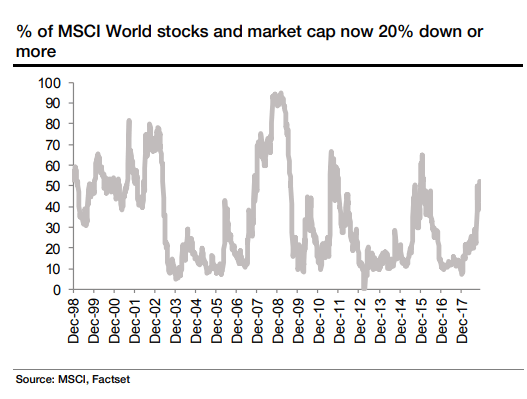
As the chart below from Societe Generale shows, 52% of companies included in the MSCI are now down by over 20% since their 52-week high. Essentially, half the companies on the index are now in a bear market. (Figures taken from a Societe Generale paper published on 10 December 2018.)

The 52% of companies in bear market territory do represent a smaller part of the overall index – in total they account for just 38% of the market cap of the MSCI World Index.

But that doesn’t mean that the broader index has performed well over the past year. As Societe Generale points out, the MSCI World Index is 12.6% down from its late January peak. At the same time, the index’s year-to-date total return is -4.9%, compared to its five-year annualised positive return of 5.7%.

Source: Chart that tells a story: half of global stocks are in a bear market, Money Observer

Below is an excerpt from the Marketwatch piece:

Even after the recent pain in the stock market, the S&P 500 Index is down only 3% in 2018 (excluding dividends). That’s not so bad when you consider the benchmark index rose 19% in 2017.

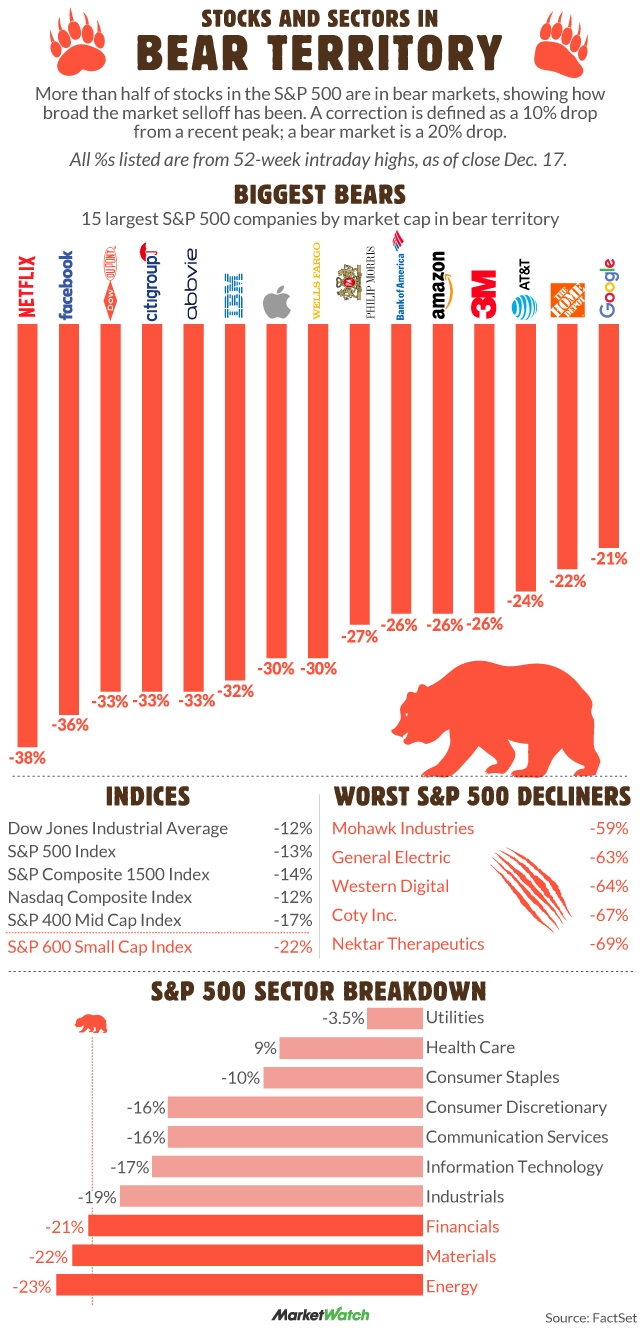
Still, more than half of the stocks in the index are in bear-market territory, showing how broad the decline has been.

A correction is typically defined as a 10% drop for a stock or an index from a recent peak, while a bear market is a 20%-plus decrease. Data supplied by FactSet show that 264 (53%) of S&P 500 SPX, +0.01%  companies are in bear markets.

Source: More than half of S&P 500 stocks are now in a bear market, Marketwatch

The following chart shows that all the 15 biggest companies by market cap in the S&P 500 are in a bear market:

Click to enlarge

Source: All the biggest stocks that are now in a bear market, in one chart, Marketwatch

Disclosure: No positions

Five Risks to Consider in Dividend Investing

Investing in dividend stocks is a popular strategy among many investors. Dividend stocks offer investors a decent dividend yield in addition to any potential gains from price appreciation. So investors tend to gain twice since not only they get paid dividends quarterly or yearly or twice yearly but also the price gains. Since dividends are paid straight out of profits and they are cash in investors’ pocket, dividend investing is a straight forward approach to investing in equities. Moreover income stocks provide a cushion during good times and bad times since the dividends keep coming. Despite all these advantages dividend investing, just like any other strategy, has many risks. Recently I came across an article at Money Observer by Robert Clough is an investment manager at Thesis Asset Management who discussed about five such risks.

1.Tax implications

Taxes are important factor to consider with dividend investing. For example, dividend yields in the US are low by global standards since dividends are taxed at a higher tax rate than capital gains. Hence this artificially forces companies to reinvest retained earnings for growth and investors are content with lower dividends since it reduces their tax hit.

Similarly US tax rates for dividends from REITs, bond ETFs, and other asset types are different. Hence investors need to be aware of them. Dividends paid out bond ETFs for instance are “Ordinary Dividends” which have higher tax rates than “Qualified Dividends” paid out by stocks that are held over 1 year.

Investing in foreign dividend stocks involves dividend withholding taxes by foreign states. These rates can be 0% to as high as over 35%. In many cases, US investors cannot recover these taxes and the withholding tax rates effectively reduce the net yield received by an investor.

2.Dividends can be erratic

Dividend payments are not guaranteed and can be cancelled or suspended or reduced at any time by a company. So investors should remember this fact and accordingly choose companies. Generally well-established companies with strong balance sheets tend to pay consistent dividends.

3.Correlation of dividends

Many companies in the same sector more or less have similar dividend yields. For instance, banks tend to have higher yields in the 2%+ range in the US. However simply investing in a bunch of banks to capture these juicy dividends is not a great idea. This is because during crises such as the Global Financial Crisis of 2008-09 banks suspended or reduced their dividends.

4.Mature companies

Mature companies may have higher dividend yields but they have lower growth for the obvious reason that they are mature. Unlike a young startup these firms may not have exponential growth. So investors loose out on capital appreciation though they earn high yields.

5.Erosion of capital

As discussed before, companies can reduce or cancel dividends. Reducing a dividend is much better than outright suspending of dividends. When a firm suspends dividend payments many institutional investors may be forced to sell the stock since the stock turns into a  non-dividend paying stock. They sell out the stock as their mandates may prohibit owing any stock that does not pay a dividend. Due to this selling prices may decline drastically in the market. A retail that sells during this time for whatever reason will sell at huge loss.

Source: Five risks to check: investing for dividends, Money Observer

Knowledge is Power: Small Habits, Emerging Market Drivers, German Energy Transition Edition

The S&P is down by 2.75% YTD. US bank stocks declined even more and are getting close to bear market territory. The crash in tech stocks especially the FAANGs is not surprising. Developed European markets are in the negative YTD as well with Germany’s DAX off by 16%. Among the Latin American markets, Mexico is down due to the election of AMLO while Brazil is up with the election of “Trump of the Tropics” Jair Bolsonaro. With this year almost looking a down year for the US markets, investors are looking forward to 2019, although that is promising to be a great year for equities either.

The following are some interesting reads that you can check out:

Sagrada Familia, Barcelona