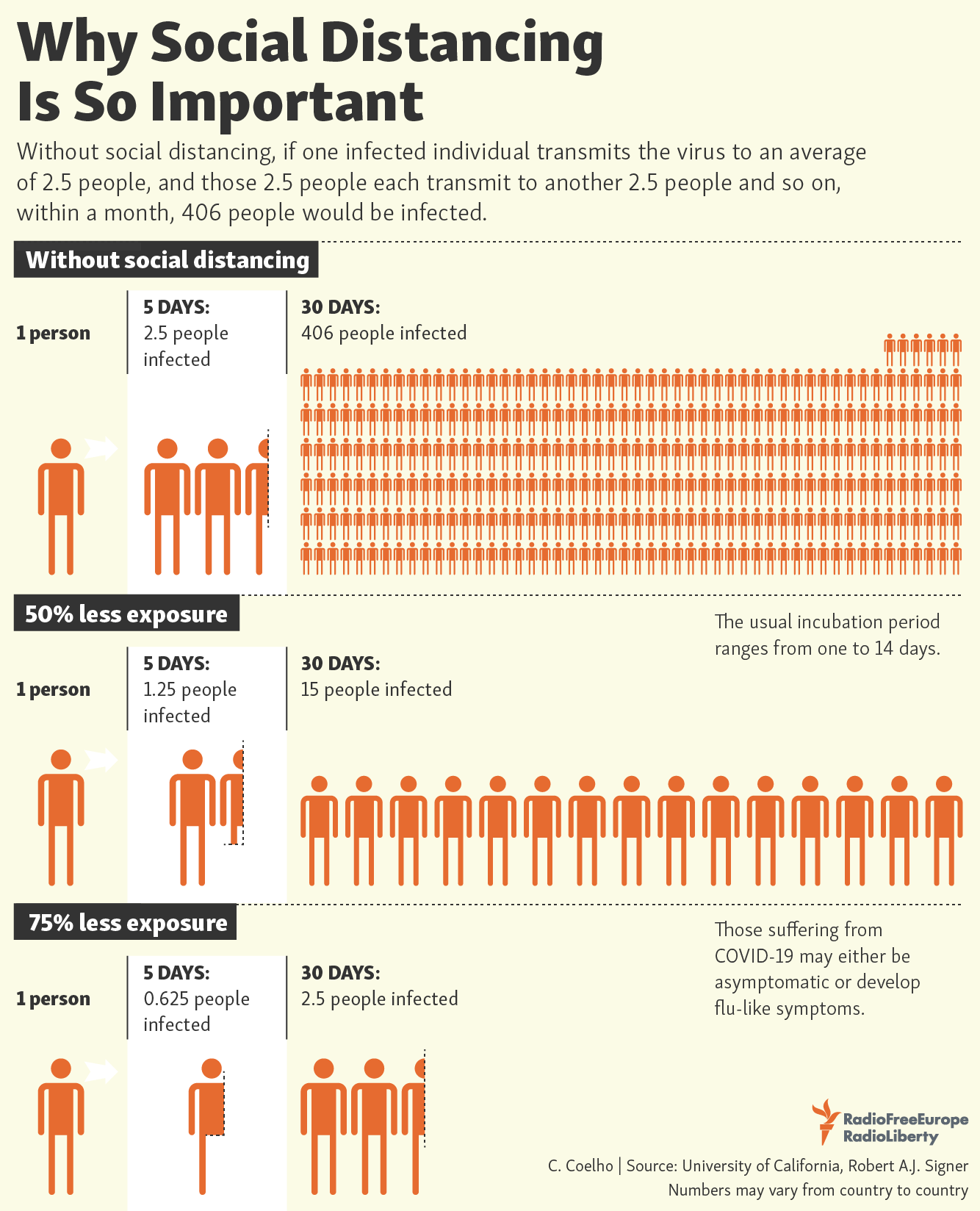
How To Make Your Own Hand Sanitizer: Infographic

Hand Sanitizer is one of the items that is out of stock in most stores these days in the US. Despite increase in production, it is becoming hard to find it. When it is available, stores have started to ration them at one per order. For many weeks now, stories have been floating around the internet that some folks are making their own. So how do you make your own hand sanitizer? The below graphic provides the answer:

Click to enlarge

Source: RFE/RL
Fascinating Guardian Article on The Epic Failure of the US Against Coronavius

In a democratic country it is often said you get the leaders that the people vote for. In this context the US is no different than any other democrazy. The US failed miserably in in its response against COVID-19 by political dithering and drama. In some ways the virus also exposes the weaknesses of the current political and healthcare structure and its total disarray. Far from being able to manage a crisis intelligently and smartly like one would expect from a powerful rich country, it acted like a banana republic with no leadership or control except a few leading to the current chaos and disaster. Indeed future historians will wonder on how the great country in the world was brought to its knees by a tiny virus.

The Guardian published an excellent article yesterday analyzing the response of the US and South Korea against the virus. From the piece:

When the definitive history of the coronavirus pandemic is written, the date 20 January 2020 is certain to feature prominently. It was on that day that a 35-year-old man in Washington state, recently returned from visiting family in Wuhan in China, became the first person in the US to be diagnosed with the virus

On the very same day, 5,000 miles away in Asia, the first confirmed case of Covid-19 was reported in South Korea. The confluence was striking, but there the similarities ended.

In the two months since that fateful day, the responses to coronavirus displayed by the US and South Korea have been polar opposites.

One country acted swiftly and aggressively to detect and isolate the virus, and by doing so has largely contained the crisis. The other country dithered and procrastinated, became mired in chaos and confusion, was distracted by the individual whims of its leader, and is now confronted by a health emergency of daunting proportions.

Within a week of its first confirmed case, South Korea’s disease control agency had summoned 20 private companies to the medical equivalent of a war-planning summit and told them to develop a test for the virus at lightning speed. A week after that, the first diagnostic test was approved and went into battle, identifying infected individuals who could then be quarantined to halt the advance of the disease.

Some 357,896 tests later, the country has more or less won the coronavirus war. On Friday only 91 new cases were reported in a country of more than 50 million.

The US response tells a different story. Two days after the first diagnosis in Washington state, Donald Trump went on air on CNBC and bragged: “We have it totally under control. It’s one person coming from China. It’s going to be just fine.”

Source: The missing six weeks: how Trump failed the biggest test of his life, The Guardian

The complete article is worth a read.

Comparing Canada Stock Market’s COVID-19 Crash To Past Routs

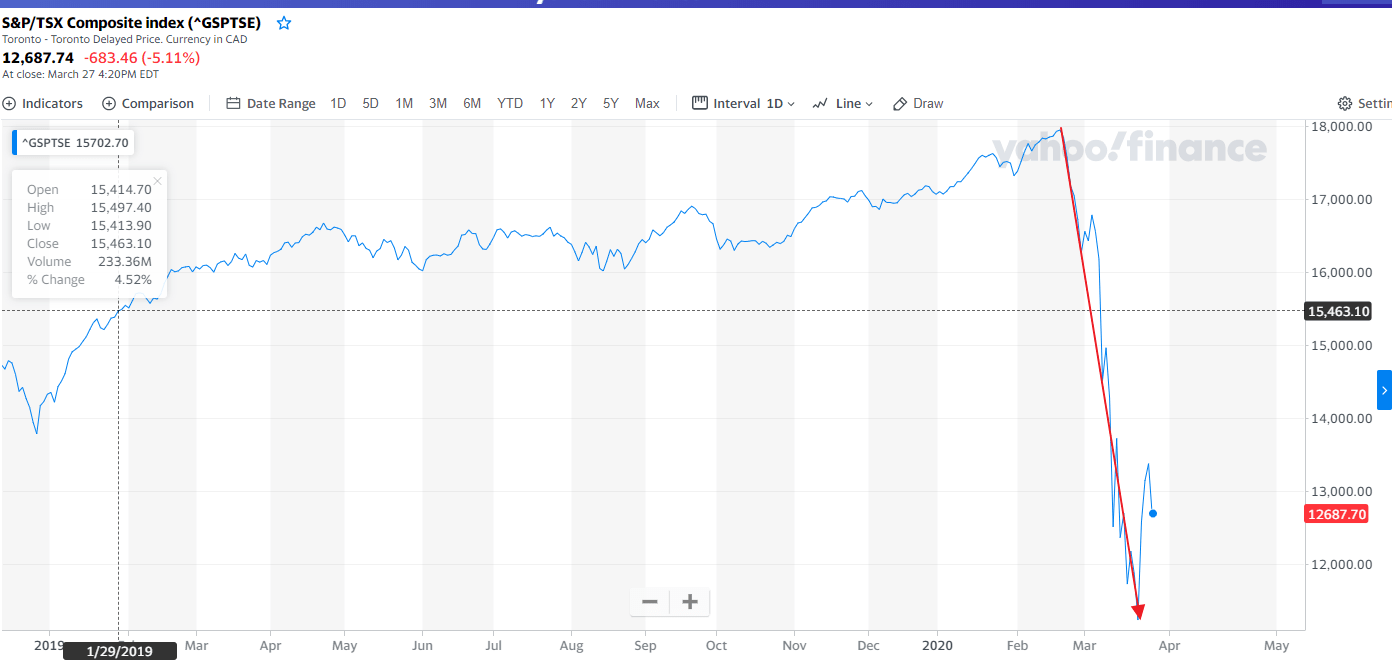
The S&P/TSX Composite Index is down about 26% year-to-date. However it was down much before the 19% jump in the index in 3 days last week. The index reach a peak of 17,970 in Feb. Then it plunged dramatically in just a few weeks all the way to 11,172. This was the worst sharp decline in Canadian stocks ever according to an article in MaClean’s. The chart below the recent collapse in the TSX index:

Click to enlarge

Source: Yahoo Finance

Below is an excerpt from the MaClean’s piece:

Simply put, we’ve never seen anything like this before.

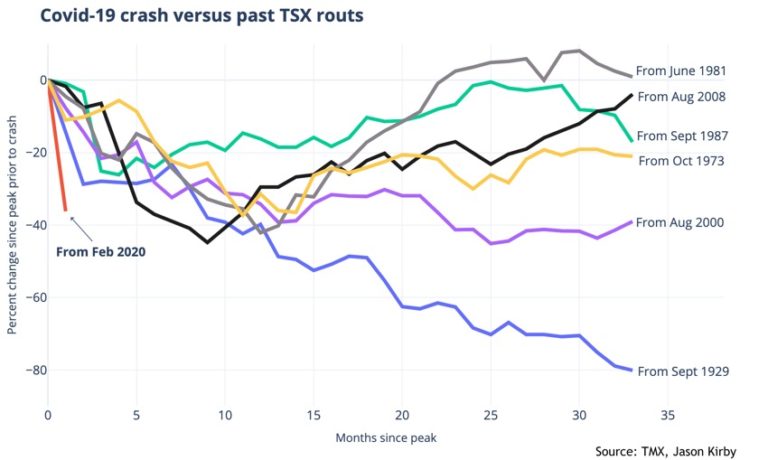
The chart uses monthly data for the Toronto Stock Exchange going back to the 1920s, and looks how how stocks performed relative to the peak prior to each crash. In additional to the current sharp downturn, illustrated in red, the other market crises included are the 2008 Great Recession, the collapse of the dot-com bubble, Black Monday in 1987, the 1981 recession, the oil shock of 1973 and the 1929 stock market crash. The chart covers 33 months, which was how long it took for Canadian stock prices to reach their lowest point after the 1929 crash.

As the chart shows, no crash has been as sharp and as deep as what we’re seeing now. To date more than $1 trillion has been wiped out from Canadian stocks as the S&P/TSX Composite Index tumbled by one-third since Feb 20. Circuit breakers put in place to calm panicked investors by halting trading when markets drop precipitously have triggered multiple times, yet markets have continued to fall. Even dramatic rate cuts by central banks, including the Bank of Canada, have failed.

Source: Canada’s stock market collapse is like nothing we’ve ever seen before, MaClean’s

Note: The above chart is before the 19% jump in the last week. 

The TSX is dominated by oil, natural resources and financial sectors. As these sectors declined heavily in the past weeks the benchmark fell as well.

Related ETFs:

  • The iShares MSCI Canada ETF (EWC)

Disclosure: No Positions