Two Ways to Invest in Chile

Chile is one of the few emerging market countries that is holding up well this year. The Bank of New York Mellon Chile ADR Index is up 9.05% year-to-date. Though the economy of Chile is heavily dependent on export of commodities such as Copper, in recent years the economy has become more diversified. The domestic economy is strong due to various policies implemented by the government.While there are a few Chilean stocks trading as ADRs in the US, the easiest way to invest in Chile is via the iShares MSCI Chile Investable Market Index ETF(ECH) and the closed-ended fund The Chile Fund(CH). These two funds give broad exposure to many Chilean stocks.

1. iShares MSCI Chile Investable Market Index ETF(ECH):

Launched in 2007, this ETF has about $150M in assets. The current yield is 1.96% and the expense ratio is 0.63%. Year-to-date the fund is up 12.34%. Since inception the fund is down 24.80%.

One of the pros of this fund is that it has only 9% of the assets invested in financials. Energy, Utilities and Industrials account for a major portion of the portfolio.

2. The Chile Fund (CH)

Currently CH is trading at a discount of 14%. The fund has an asset of base of $106M and the yield is 1.53%.

The fund made a return of 49.58% in 2007 when the Chilean stocks were hot due to the commodities boom. In 2008, it gave back all the returns from 2007 and ended the year with a loss of almost 52%. Year-to-date the fund is up about 12%. Similar to the ETF, the assets of the fund are widely allocated among various stocks in different sectors.

Both the closed-end fund and the ETF are smart options get exposure to Chilean stocks. However CH will be much more volatile than the ETF in these turbulent times since it is a closed-ended fund.

Back in January Marketwatch has an article titled Looking for defensive exposure? Try Chilean stocks. In this piece, Geoffrey Dennis, Latin America strategist at Citigroup said “Chile always outperforms in down markets. There’s always been a substantial pool of domestic liquidity and that’s been a stabilizing force in the market.”

Knowledge is Power: Tax Haven Edition

1.On Thursday, it was Liechtenstein and Andorra. On Friday, Austria, Luxembourg and Switzerland likewise decided to change their banking laws to allow for more cross-border cooperation. The days of European tax havens are numbered. Tax Havens Give In to EU Pressure

2. Major Vienna banks wanted to capture the Eastern European market and benefit from its growth. Now they are waking up to the hangover caused by what could end up being a series of bad loans. The government, while trying to reassure the banks, is also seeking international assistance. By Rüdiger Falksohn and Walter Mayr Austria Feels Pinch of Eastern European Downturn

3.Within US policy circles, the rapid rise of China as a major force in the global economy is provoking a reconsideration of whether free trade is still in the US national interest. Trade wars can lead to shooting wars – By Henry C K Liu

4.Juha Pikkarainen has been out of work since Stora Enso Oyj shuttered the world’s northernmost pulp mill last year in Finnish Lapland, heralding the end of an era. Ghost Towns Dot Finland as Forestry Collapse Threatens GrowthBy Kati Pohjanpalo and Diana ben-Aaron

5.Two German institutes are forecasting that the economic downturn will be worse than previously thought as the government confirms that Germany’s industrial production was down sharply in January. Germany Hasn’t Hit Bottom Yet, Economists Say

6.Fiscal stimulus and interest rate cuts are sowing the seeds of recovery, but the private sector has to respond to make it sustainable, says Frederic Neumann, senior Asia economist at HSBC Global Research. Asia’s response to export shock is encouraging

7.People trying to cope with less as global economy shrinks for first time since WWII.
Crisis Takes a Mounting Toll on Developing Countries

8. Earlier today the Census Bureau reported that both imports and exports continued to decline in January. But February is looking even worse. Last week China reported exports had collapsed in February. And from the Journal of Commerce Online today: St. Petersburg TEU Traffic Plunges LA Port Import Traffic Collapses in February

9.The Baltic Dry Index (BDI) is a measure of what it costs to ship raw materials—like iron ore, steel, cement, coal and so on—around the world. The Baltic Dry Index is compiled daily by The Baltic Exchange. To compile the index, members of the Baltic Exchange call dry bulk shippers around the world to see what their prices are for 22 different shipping routes around the globe. Understanding the Baltic Dry Index

10. Diverson:

The Guinness Book has recently acknowledged that the biggest swimming pool in the world is located in Chile. It is 115 feet deep, 1000 yards long and 20 acres – the perfect place to do laps in because the 66 mil of gallons of water prove to be more than enough. The saltwater pool contains 250,000 cubic metres of water and is navigable in small boats.

Largest Pool

San Alfonso del Mar Resort, Chile

Source: Travel Guide

New Car Sales Rebound in Germany by 21.5% in February

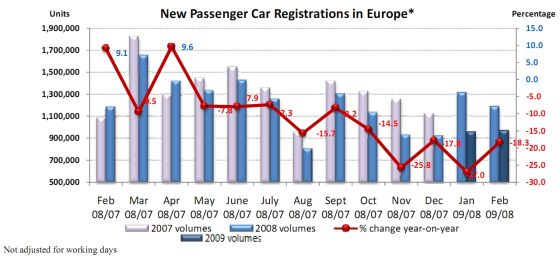
The European Automobile Manufacturers’ Association released the new car registrations report for February. New car registrations was up by 21.5% in Germany compared to February last year.

When car sales declined in most European countries how did Germany record high growth?

Car sales increased in Germany last month due to an innovative incentive program launched by the government. Under this program, the government offered 2,500 Euros for car owners to get rid of their older cars and buy a new replacement. This cash bonus to scrap old cars encouraged German consumers to buy 277,740 new cars last month. However exports declined in the same period. Overall the incentive program was a success in Germany. France and Italy implemented similar programs but they were not as successful as in Germany.

As a whole, new car registrations in Europe was down by 18.3% in February compared to the same month last year.

Chart (click to enlarge) :

Car Registrations Europe

Source: ACEA

Major markets such as the UK, Spain and Italy continued to post decreases in sales. All the East European countries except Poland had negative growth with Latvia recoding the highest decline at 76%.

Since the cash for scrap bonus program worked well in Germany, should the US government launch such a program?. With billions in bailout funds handed to the big three car makers one would assume that this type of innovative ideas can be easily implemented here as well.

Top Banks of India 2009

Last month, Dun & Bradstreet, the world’s leading provider of global business information announced the top banks in India in a publication titled “India’s Top Banks 2009”.

The Top Banks of India 2009 based on the performance in year 2008 are:

[TABLE=144]

Source: Dun&Bradstreet

Most of the above banks do not trade in the US markets. ICICI Bank Limited is listed on the NYSE with ticker IBN. State Bank of India, India’s largest state owned bank does not trade in the US. The other Indian bank, HDFC Bank Ltd (HDB) did not win a award.

Related:

India’s Best Banks 2009 

The 10 Most Profitable Banks in India 

The Top 10 Banks in India Based on Assets

The following are the India-specific ETFs:

1.WisdomTree India Earnings Fund (EPI)

2.PowerShares India Portfolio (PIN)

3.iPath MSCI India Index (INP)

The Top Five European ETFs

The ETF industry continued to grow last year in Europe despite the credit crunch. Assets Under Management (AUM) grew by 6.49% from the start of the year. In 2008, the widely watched European Blue Chips Index DJ Euro Stoxx 50 dropped by 44.37%. By the end of the year, there were 1,553 ETFs listed in European Exchanges.About 67% of all ETF assets in Europe were invested in equity ETFs.

Of the hundreds of ETFs available, the following are the top five ETFs in Europe as of 2008 end based on assets held:

[TABLE=143]

Source: ETF Industry-Europe Market Review 2008 from Lyxor Asset Management (a division of Societe Generale, France)

The number two ETF EONIA fom db-xtackers is a money-market funds cash ETF. The top ETF is the Lyxor ETF DJ Euro STOXX 50 from Lyxor with over 5.14 B EUR in assets. As of today March 11,2009 the AUM has shrunk to 4.075 B EUR. The Euro Stoxx 50 Index based ETFs occupy two spots in the list above. This is because this index gives easy exposure to the top 50 blue chip companies in the Euro Zone (excl. UK).

US-based investors can invest in the DJ Euro Stoxx Index via the SPDR DJ Euro Stoxx50 ETF (FEZ) from State Street Global Advisors. The expense ratio is 0.29% and the total net assets is $96M. The current dividend yield is 7.38% though that may fall since the index has many financials such as ING (ING) which may cut dividends. However about 80% of the portfolio is in non-financial sectors where dividends are relatively safer. France and Germany account for 70% of the portfolio.