The Ten Best Performing European ADRs Year-To-Date

Here are the top 10 best performing ADRs year-to-date (approx. % change)

1. Gentium – GENT – 169%
2. Mechtel Steel – MTL – 165%
3.Wimm-Bill-Dann Foods – WBD – 108%
4.Vimpel Communications – VIP – 88%
5. Acergy – ACGY – 87%
6. Aixtron – AIXG – 74%
7. ASM International – ASMI – 73%
8. Credit Suisse – CS – 61%
9. Mobile Telesystems – MBT – 59%
10. Flamel Technologies – FLML – 56%

US Housing Slowdown May Bottom Out This Year

The collapse in the US housing sector may stabilize and bottom out this year based on some of the data presented below. Sub-prime and Alta-A mortgages have been some of the worst loans that have hit lenders in recent months. However there have been reports of even prime mortgages including jumbo mortgages going bad due to rising unemployment, fall in income and other factors.

Sub-prime and Alt-A mortgages issuance grew rapidly from 2003 thru June 2007. The peak year was in 2005 when nearly two million such loans were originated as the data shows below. The sub-prime mortgages nearly doubled from nearly 1.1 million in 2003 to 1.9 million in 2005. Alt-A mortgages grew even at a higher rate from 304,000 in 2003 to 1.1 million in 2005.

Number of Sub-Prime and Alt-A Mortgage Originations by Year:

[TABLE=152]

Chart-Total-Subprime-Loans-By-year

Source: Federal Reserve Board Calculations based on data from First American Loan Performance
Note: Data used is for 30-year,first-lien mortgages only

The fall in the number of subprime mortgages from 2005 is due to the rise in mortgage rates and the slowing down of house price appreciation. In total about 9.6 subprime and Alt-A mortgages were originated in under 5 years. In 2007, lenders abruptly stopped approving heavily such loans after June and in 2008 they stopped completely.

The majority of the subprime loans were in a few states that included OH,MI and IN in the midwest and CA,AZ,FL and NV as the chart shows below:

Subprime-loan-by-states

One reason that the housing crash may bottom out this year is because by mid-2009, rate resets for these loans will decline substantially. Many of the sub-prime loans have already had their rates reset in 2008. This is identified by the shaded region in the chart below.

Subprime-rate-resets-by-year

According to a simulation run by Shane M. Sherlund in the paper titled The Past, Present, and Future of Subprime Mortgages,Federal Reserve Board, Washington, D.C.,  in the worst-case scenario sub-prime mortgage defaults would peak in mid to late 2008 and 2009 for sub-prime fixed rate mortgages.

Worst-Case-Subprime-Loan-Defaults

I shall post more updates on the housing sector and its impact on the economy as I do more research into this complex issue. Feel free to leave your thoughts in the comments section.

Canadian Economy To Rebound in 2010

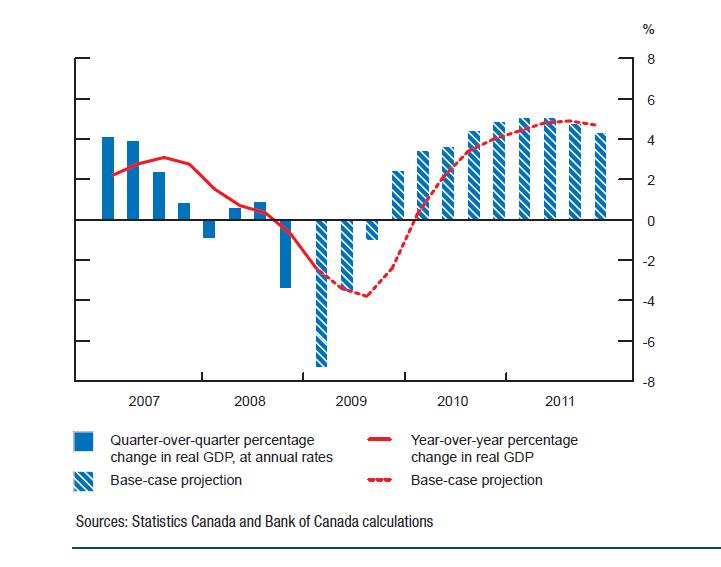
The latest Monetary Policy Report from the Bank of Canada states that the Canadian economy is projected to grow in 2010.The real GDP is projected to grow by 2.5% in 2010 and 4.7% in 2011.This year though the GDP will fall by 3.0%.

Some of the key point from the report are:

  • Recession in Canada will be deeper than expected due to the intense and synchronized global recession
  • Core Inflation will diminish this year but gradually increase and reach 2% in 2011
  • Progress on measures to restore normal flow of credit have been slow in the US
  • Slowdown in the US housing and auto sectors magnified the weakness in the Canadian economy as exports fell sharply
  • Sales of new autos and homes in the US are projected to rebound in the second half of 2009
  • The strength of balance sheets of banks,corporations and households in Canada have helped to make the financial system fare better than other countries in this global crisis
  • Economic conditions deteriorated further in 1Q,2009 with exports in the forest products, automotive and materials sectors posting more declines
  • Due to weak domestic demand import volumes will drop sharply in 2009
  • Economic recovery in Canada will be much more rapid than in USA since Canadian households are in a much better position financially
  • Housing market correction in Canada is expected to be much less severe than in the US

Chart – Growth in Real GDP Expected to Rebound in 2010
Canada-GDP-Growth

Source: Bank of Canada

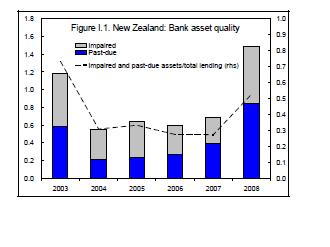
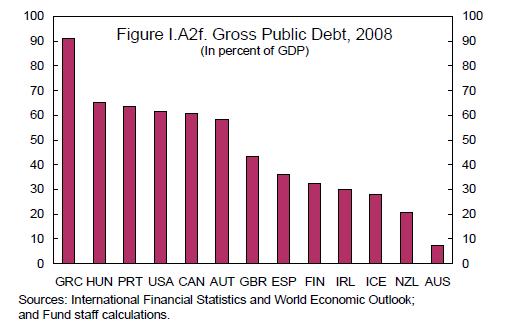
Chart: New Zealand Banks Asset Quality and Public Debt

The following are two charts showing New Zealand banks’ Asset quality and the ratio of  public debt as a percentage of GDP. The big 4 banks delinquent by 90 days loans is less than 0.5% of total loans. New Zealand has a very low outstanding public debt of about 20% of GDP.

New Zealand Banks Asset Quality

New Zealand Banks Asset Quality

New Zealand Public DebtNew Zealand Public Debt

Source: New Zealand – Selected Issues, IMF, May 2009