Building America With Obama Bonds Signals Losing Appeal of Municipal Debt
Credit Card Chargeoffs vs Exhaustion Rate
‘It’s Still too Early for Economic Euphoria’
Beijing’s facade of resilience

“Despite the apparent strength of the banking system, the ratio of private sector credit to GDP is still low by international standards (see Chart 3). Some of the restrictions on the banking system, and the incentives for banks to hold government bonds rather than make loans, have stifled lending. Consequently, the average ratio of loans to deposits in the Indian banking system is much lower than in most other countries.”
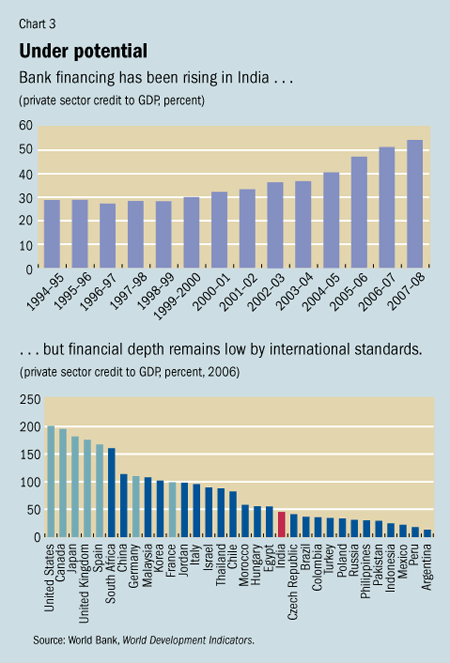
Source: Next Generation Financial Reforms for India , Finance and Development Magazine -September 2008, IMF
In the residential real estate market, foreclosure activity continues to be a major drag though it decreased in May relative to April. Last year a record 3.1 million filings were made. RealtyTrac predicts this year a total of 4 million foreclosures.Businessweek predicts the housing market to recover sometime in 2012.
The Commercial Real Estate (CRE) market is also continuing to deteriorate. As companies go bankrupt additional CRE space would flood the market. A few firms such as Circuit City, Linens ‘N Things and mall operator General Growth Properties have filed for bankruptcy. While some are predicting a big crash in the CRE market I think it is unlikely to cause a severe economic strain like the one caused by the collapse in the residential market. This is because CRE is not as large as the residential market as shown in the graph below.
Composition of Total Mortgages Outstanding in the U.S.:

Source:Â L.217 Total Mortgages, Flow of Funds Accounts of the United States report, 1Q-2009
Residential real estate accounts for the largest amount of mortgages outstanding. From $6.2 Trillion in 2002, it has risen to $11.9T (annualized rate) in first quarter 2009. CRE accounts for 2.5T in 1Q, 2009. To put these numbers in perspective, the U.S. GDP is about $14.3 T. The residential mortgage amounts outstanding increased year-over-year till the housing boom ended in 2007. Farm forms a minor portion of the total real estate market. In 1Q, 2009 farm mortgages outstanding accounted for only $111B at an annualized rate.The total mortgage amounts owed exceeds the total GDP of the country.
The personal savings rate in the USA started to increase since last year when the economy crumbled. Traditionally Americans save less than people in other countries. Europeans, Asians and others are high savers. But in the past how much did Americans save each year? Has the savings rate been always too low? In order to order these questions I analyzed data from the Bureau of Economic Analysis. The following is a brief summary of this research.The chart below shows the historical trend of personal savings rate against personal disposable income since 1929.

The following chart shows the savings rate as a percentage of personal disposable income from 1929 thru 2008:

Source: Table 2.1. Personal Income and Its Disposition,NIPA Tables, BEA
From 1941 to 1945 during war time the personal savings rate increased significantly reaching 20.4% in 1945.However from the 1980s it started heading down and stayed at a healthy 7.7% in 1992. Since then it continued to get worse. By 2005 it went under 1% to just 0.4%. This is interesting since even during the bubble ear of the late 90s Americans saved anywhere from 2 to 5%. From a low of 0.6% in 2007, the savings rate shot up to 1.8% in 2008 as more of their disposable income than on consumption of goods and services.
If the economy does not improve, savings rate may continue to increase and possibly reach high single digits like it did up until the late 80s. But savers have very few incentives to save as the interest rate on any savings account is at very low levels. The following best interest rates from Bankrate.com shows the horrendous rates offered now:
1 Year Certificate of Deposit (CD) – 1.97%
5 Year Certificate of Deposit (CD) – 3.07%
6 Months Certificate of Deposit (CD) – 1.43%
In addition, some large commercial banks pay 0.01% interest on savings accounts. Some investors are keeping their funds in CDs or money market accounts now in order to protect the principal instead of investing them in the markets. Hence the personal savings rate may be slightly skewed. Overall the growth in personal savings rate is a positive for the long-term. But I would argue that the current savings rate needs to increase substantially before we can say that we are saving too much and that high savings is actually hurting the economy.
The Banker Magazine has released a preview of its “The Banker Top 1000 World Banks” list. The banks in the list are ranked based on their Tier 1 capital ratio. According to the magazine, “Tier 1 capital is the most relevant measurement of bank strength”.
The Top Five Strongest Banks for 2009 are:
[TABLE=161]
The top ranked bank in the world is JPMorgan Chase (JPM). In my recent article titled A Review of Tier 1 Capital Ratios of Large US Banks, JPMorgan Chase had a Tier 1 ratio of 11.30%. The second ranked bank is Bank of America (BAC) and the third place went to Citigroup (C). Hence all the top 3 positions to U.S.-based banks.
The fourth and fifth positions went Royal Bank of Scotland (RBS) and HSBC (HBC). HSBC was ranked number one last year. Unlike the other four banks in the top five, HSBC did not receive any government aid.
Japan’s Mitsubishi UFJ took the seventh position. The magazine said China’s ICBC was the most profitable bank with earnings of $21.3 billion last year.
Posted below is a video from The Banker magazine discussing the Top 1000 banks list for 2009:
