Ten of the Largest and Most Liquid Chinese Stocks

To identify the most liquid Chinese stocks traded in the Hong Kong Exchange we can use the iShares FTSE/Xinhua China 25. This tracks the FTSE/Xinhua China 25 index and offers exposure to 25 of the largest and most liquid Chinese stocks. The index is market capitalization index subject to a 10% weighting cap.

The Top 10 Holdings in iShares FTSE/Xinhua China 25 are:

China Construction Bank (OTC: CICHF.pk)
China Mobile Ltd (CHL)
Ind & Comm Bk Of China
China Life Insurance Co (LFC)
Bank Of China Ltd (OTC: BACHY.pk)
CNOOC Ltd (CEO)
China Merchants Bank (OTC: CIHKF.pk)
Bank Of Communications Co
China Shenhua Energy Co
BOC Hong Kong Holdings Ltd

Note: Data as of June 30, 2009

Based in Hong Kong, China Mobile Ltd (CHL) has a huge subscriber base. At the end of May this yea, the company had 488M subscribers. The current dividend yield is 3.7% and the average annual earnings growth is about 22%. The beta is 0.9.

China Life Insurance Co (LFC) offers individual life insurance, group life insurance, accident insurance and health insurance product. Total policies in effect as of December 31,2008 was 102M. The beta is 1.4 and last year’s total revenue was about $27B.

CNOOC Ltd (CEO) is China’s largest offshore oil producer. CNOOC said yesterday “revenue for the third quarter fell 23% from a year earlier as lower realized oil prices offset higher output. The company said in a filing to the Hong Kong Stock Exchange Thursday revenue during the quarter totaled 23.8 billion yuan ($3.5 billion). It said output was equal to 647,382 barrels of oil or equivalent, a drop of 18.4% from a year earlier, while average realized prices throughout the quarter was $67.83 per barrel, a drop of 36.6% on year.”

Interactive Map: China’s Oil Empire
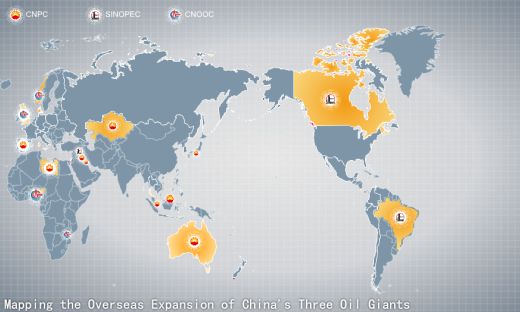
China-Oil-Map-Empire

Source: China’s Economic Observer

Click on the map to see China’s big oil companies’ (CNOOC, CNPC, and Sinopec) interests across the globe.

Ten Foreign Stocks by Largest Market Capitalization

I ran the stock screener for foreign stocks traded in the NYSE with the following conditions:

Market Cap = $100B+

Dividend Yield = 3% or more

The search resulted in the following 10 ADRs:

1. Royal Dutch Shell plc ( RDS.A)

2. China Mobile Ltd. (CHL)

3. BP plc (BP)

4. TOTAL S.A. (TOT)

5. Telefonica S.A. (TEF)

6. Banco Santander, S.A. (STD)

7. Vodafone Group Plc (VOD)

8. Novartis AG (NVS)

9. GlaxoSmithKline plc (GSK)

10. Sanofi-Aventis SA (SNY)

Oil giants Royal Dutch Shell plc ( RDS.A), BP plc (BP) and TOTAL S.A. (TOT) have diversified global operations. With the price oil rising near $80, this sector is getting the attention of investors. Yesterday BP reported strong earnings. Total and Shell may follow suit as well.

Telecom providers China Mobile Ltd. (CHL), Telefonica S.A. (TEF) and Vodafone Group Plc (VOD) all have excellent franshises. For example, UK-based Vodafone has established its brand in many emerging markets and continues to increase subscribers.

Spanish bank Banco Santander, S.A. (STD) is the lone bank in the above list. Despite sluggish domestic housing market, Santander is well positioned for growth due its huge presence in overseas markets such as Latin America.

Drug majors Novartis AG (NVS), GlaxoSmithKline plc (GSK) and Sanofi-Aventis SA (SNY) manufacture many preventive vaccines, medicines and consumer health-care products. These drug makers have diversified businesses and their stocks are good picks for all market conditions. Last year all three had revenues exceeding $40B. GlaxoSmithKline plc is especially well known in developing countries. Some of the top brands of GlaxoSmithKline include Ribena, Horlicks, Aquafresh, Panadol and Tums. GSK website states “Every minute…more than 1,100 prescriptions are written for GSK products.”

SITE OUTAGE !!!

Hello Visitors

My site www.topforeignstocks.com has been hit with a malware problem today. Because of this Google Search Engine has marked all pages as “This site may harm your computer” warning.

I am working hard with my ISP to get this issue fixed asap. Should be cleaned up by tomorrow and regular posting will resume tomorrow as well.

Meanwhile we are working on adding more content to this site. You can also checkout my other sites at:

http://www.globaleconstats.com

http://adruniverse.blogspot.com 

Thanks for your understanding & patience !!!!!!

-David

Will Emerging Markets Continue to Outperform Developed Markets?

Emerging markets have strongly outperformed developed markets this year. The equity market indices of countries like China, India, Brazil, etc. are up significantly over markets in Europe, Japan and North America. Over the last 10 years, the US and Japanese equity markets were essentially flat to down. Emerging market indices have grown many times in the same period.

An IMF study in published in the World Economic Outlook, September 2003 mentioned that the GDP per capita of a country is positively correlated to the change in the size of the working ppopulation. Based on this theory, developed countries  are projected to have lower growth which in turn will lead to lower equity returns. One of the reasons for the low growth in developed countries is that the ratio of dependents will rise dramatically in the coming years due to declining population growth and increasing life expectancy, In the US, the era of strong participation in the workforce by the baby boomers is over. While in Europe population decline is an issue, in the U.S. the decline will not be big due problem to immigration and high fertility rates. Unlike the developed world, labor force in emerging countries are growing. By 2050 India, China and Brazil are projected to have the largest working population in the world.

In the U.S. as baby boomers retire they would liquidate their stocks, bonds and other assets leading to a fall in prices. In emerging markets the working population is expected to increase higher than the general population growth. With high savings rates, prudent investment policies,  emerging market equities may easily beat developed market equities in the future also.

The U6 unemployment rate is over 16% in the USA. Millions of unemployed workers are unable to find well-paying jobs. Compared to this, emerging markets like India are attracting large foreign direct investments  as per a research report by Morgan Stanley, This is leading to more job opportunities in many sectors. In addition to manufacturing, many emerging countries are developing their knowledge-based sectors such as bio-technology, drug industry, mathematical analytical systems, etc. All these activities will help emerging markets beat developed markets over the next decade and beyond.

Related ETFs:

The iShares MSCI Emerging Markets Index Fund (EEM)

The iShares FTSE/Xinhua China 25 Index Fund  (FXI)

The iShares Brazil Index Fund  (EWZ)