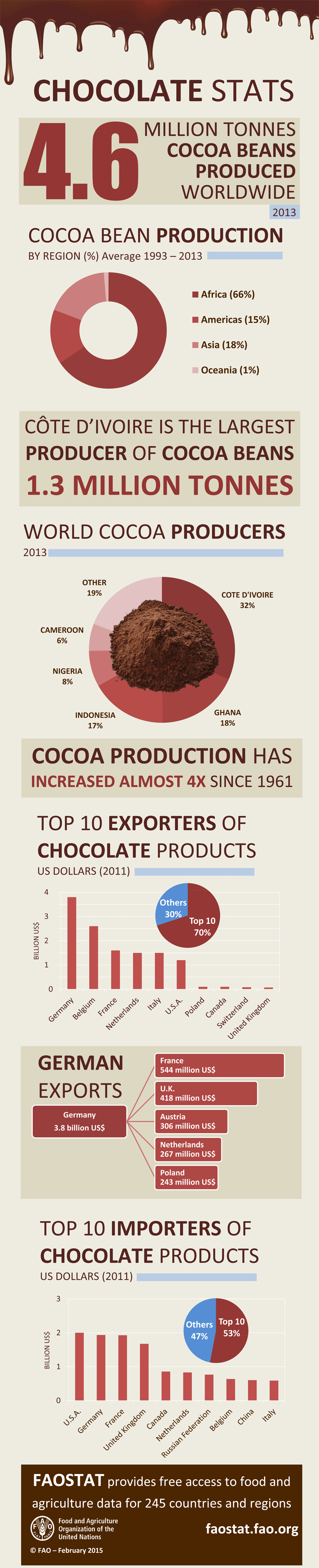
Infographic showing the world’s top producers of cocoa and the top importers and exporters of chocolate products.Africa accounts for more than half of the world’s cocoa production.
Click to enlarge
Source: FAO
Infographic showing the world’s top producers of cocoa and the top importers and exporters of chocolate products.Africa accounts for more than half of the world’s cocoa production.
Click to enlarge
Source: FAO
The US Dollar is one of the seven reserve currencies in the world. Unlike in the past, the dollar today is not backed not anything but the full faith and trust of the U.S. government. Essentially the dollar and other reserve currencies are just a pieces of paper similar to other currencies like the Ukraine Hryvnia, Botswana Pula, Croatian Kuna, Swailiand Lilangeni, Bhutan Ngultrum, etc. However the dollar and other reserve currencies are valued more in the global market.
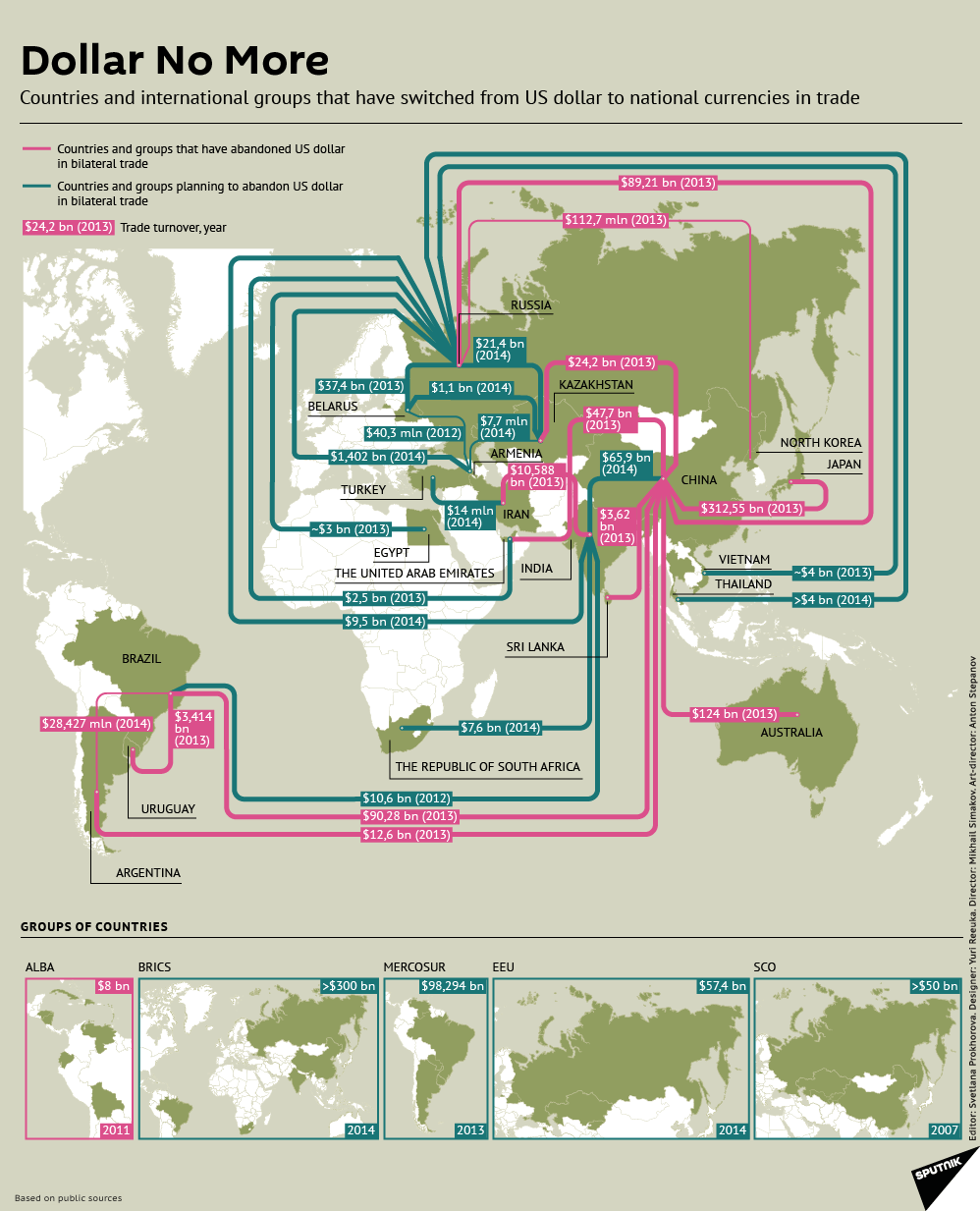
The majority of the world’s currency reserves are held in US dollars and is the preferred currency in global trade.However the dominance of the dollar in trade may be in decline as countries and international groups are switching from dollar to national currencies in trade.
The following infographic offers interesting insights on the ongoing evolution of trade in currencies other than the dollar:
Click to enlarge
Source: Sputniknews
India’s benchmark Sensex is flat so far this year as of May 15th. The MSCI India Index is up by just 0.37% based on US dollar terms.
India was one of the top performing markets in 2014 but that is not the case this year. For example, among emerging markets, China’s Shanghai Composite has shot up by 33.2% and Brazil Bovespa is up by 14.5 % year-to-date (YTD).
From an investment standpoint, investors may be wondering if Indian stocks are cheap now since the equity markets of China and Brazil and even Russia have grown substantially higher relative to India (YTD). The answer is not easy to figure out. Adrian Lim, Senior Investment Manager of Aberdeen Asset Management noted in an interview last month that valuations are Indian equities are reaching historic highs.
From the report:
Click to enlarge
How have Indian equities performed this year?
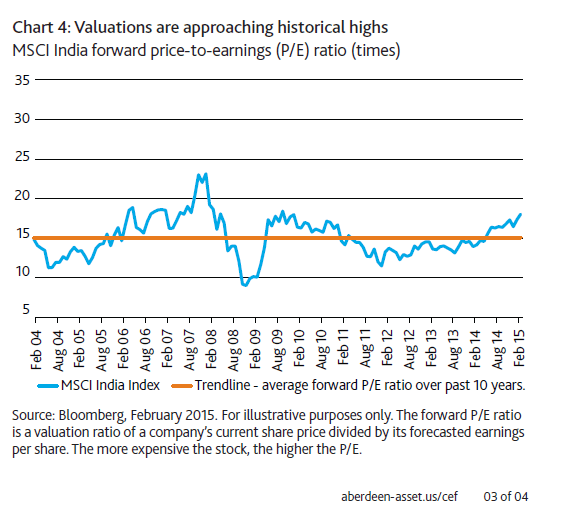
Cheaper energy prices, lower inflation, and the steady pace of economic reforms, have been good for share prices. The MSCI India index is up 10.3% in the year to date (as at 27 March in local currency terms). As a result, Indian equities are trading near their historical highs, at 19.0 times FY2015 earnings. We’ll need to see further signs of economic growth to support better margins and earnings.
Source: Aberdeen Indian Equities, April 2015
The above chart shows that forward P/E ratio is reaching historic levels reached during late 2007-08 before the global financial crisis. So based on this factor, Indian stocks are not cheap now.
However there are many other factors that can be used to calculate equity valuations. Based on other factors such as the Market Cap to GDP, Indian stocks are not in a bubble according to a recent article in The Hindu Business Line. This valuation metric is a favorite of Warren Buffet. In a 2001 Fortune interview he stated “it is probably the best single measure of where valuations stand at any given moment.”
From the Business Line article:
Valuation provides comfort
The Nifty was trading at a price to earnings (PE) multiple (trailing 12 months) of 22 towards the end of April this year. This is higher than the five-year average PE multiple of around 19 but much below the peak valuations hit before the 2008 and 2000 peaks.
Before the market sold off in 2008, the Nifty was trading at a much higher multiple of 27.6 times. In February 2000, before the dotcom bubble burst, the Nifty was trading at a multiple of 28.4 times.
The estimated forward PE multiple for the Nifty for FY16, at around 15.5 times, too lends comfort.
If we measure Nifty’s valuation on the price to book ratio, it was available at 3.5 times book value towards the end of this April. The ratio has not changed much since the end of December 2012 when the Nifty was trading at 3.13 times its book value; despite the 38 per cent rally in the index since then. It implies that the growth in India Inc’s net assets has kept pace with the increase in stock price over the last two years.
On a price-to-book metric too, the Nifty has not reached peak valuation yet. In December 2007, this ratio was 6.4 and in February 2000, it was 5.1.
Market capitalisation to GDP ratio is another metric that can be used to judge if the market has turned expensive. A ratio of around 1 implies that the market is rightly valued whereas a value below 1 signals room for growth. Currently, the market cap to GDP ratio is 0.87, which signals absence of a bubble.
According to the World Bank, India’s market cap to GDP was 1.47 in 2007, when the bull market was at its fiercest. That was a clear sign of an overheated market, waiting to fall. In 1999, this ratio was just 0.39, probably due to fewer stocks in the listed universe at that point. This number is, therefore, not comparable.
Source: End of bull run? by Lokehswarri, The Hindu Business Line
The Nifty is the other benchmark index for Indian equity market created by the National Stock Exchange of India.
In summary, Indian equities can be considered as fairly valued now. Unless economic reforms are implemented faster and corporate profits increase from the current tepid levels, stocks may find it harder to climb higher from current levels.
Twelve Indian firms trade on the US markets as ADRs. According to an article in the latest edition of Bloomberg BusinessWeek, foreign investors are flocking to HDFC Bank(HDB), one of India’s largest private sector banks. From the article:
It’s hard to overstate just how much global investors are captivated by HDFC Bank Ltd., India’s biggest lender by market value.
Not only does the stock trade at the highest valuation among the world’s largest banks, but international funds are so bullish that they’re willing to pay a record 20 percent premium over HDFC’s local stock price to get their hands on the limited number of shares available to foreigners. Brokerage analysts, meanwhile, have more buy ratings on the company than at any other time in 14 years.
Source: World’s Most Expensive Bank Is a 20%-a-Year Growth Machine, Bloomberg Business
You may also want to read the “Reform is the only answer to India’s growth-inflation problem” piece by Shumita Sharma Deveshwar of Trusted Sources published ealier this month on FT beyondbrics blog.
ETFs: The Complete List of India ETFs and ETNs Trading on the US Markets
Disclosure: No Positions
Singapore is a tiny country compared to the U.S. While the U.S. has a population of over 318 million, Singapore’s population is just 5.5 million.In terms of land sizes, the two countries are not even comparable since Singapore is a city state where one can travel from one end to the other in just half hour by car.
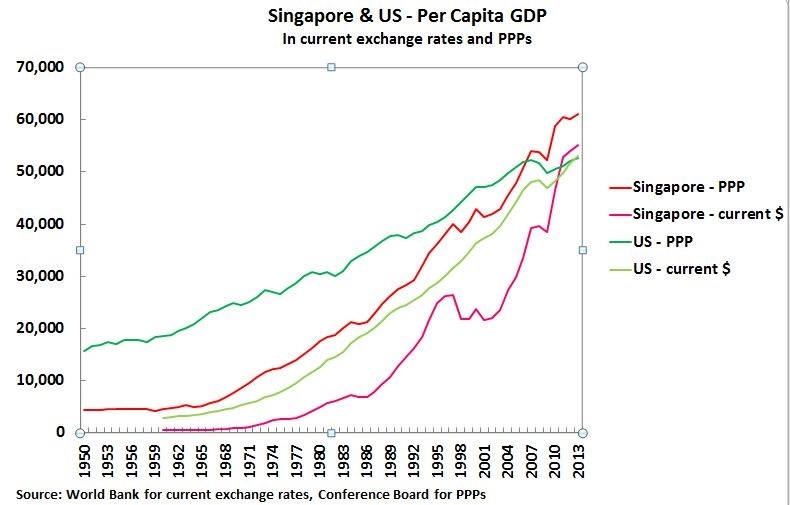
The GDP of Singapore was $307.0 Billion in 2014. The U.S. is one of the largest economies in the world with a GDP in excess of $17.0 Trillion in 2014. The GDP per capita figure is interesting to compare between the two countries. The U.S. GDP per capita was only $54,800 while the figure for Singapore was $81,300 in 2014.
According to an article by John Ross of Renmin University of China, Singapore’s GDP per capita in 2013 was 104% of that the U.S. calculated at current exchange rates.
The chart below shows the comparison of GDP per capita between the U.S.:
Click to enlarge
The author quoted a couple of research papers noting that the economic growth of Singapore came not from productivity but from investment and labor capital accumulation.
From the article:
Singapore was a classic example of the success of an “open economy:” Singapore’s total trade is indeed considerably higher than its GDP. This is, of course, in line with the ideas behind China’s “opening up” policy. But every study shows that Singapore’s domestic development was based overwhelmingly on the huge accumulation of capital and labor, with only a tiny contribution coming from productivity growth (technically known as Total Factor Productivity, or TFP).
This reality was first noted in the 1990s by the United Kingdom-based economist Alwyn Young. His finding was used by U.S. economist Paul Krugman in a famous 1994 paper entitled “The Myth of Asia’s Miracle” to predict Asia’s coming economic failure. Krugman argued that successful economic growth should be based on productivity development, not on accumulation of capital and labor. But, of course, it was Krugman who was proved wrong as Singapore’s per capita GDP overtook even that of the U.S.
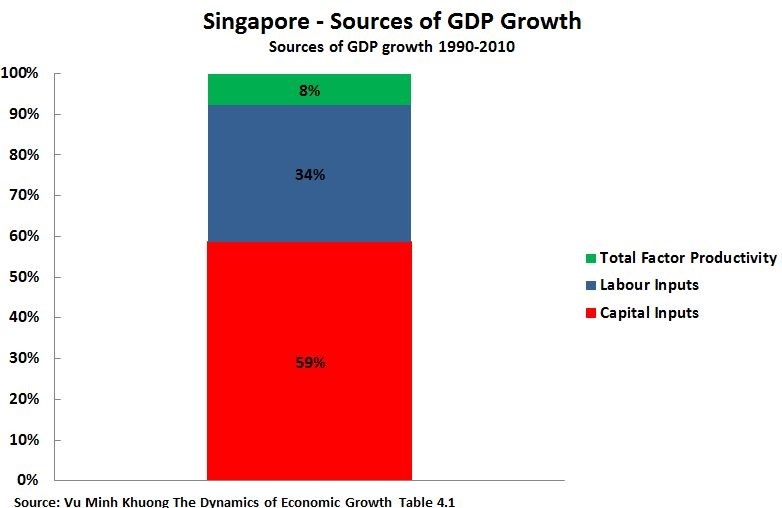
Young’s finding has since been replicated by every major study of Singapore since. The latest, by Vu Minh Khuong of the Lee Kuan Yew School of Public Policy at the National University of Singapore, is summarized in Figure 2 below. This study found that 59 percent of Singapore’s economic growth came from capital investment, 34 percent from growth of labor inputs, and only 8 percent from productivity (TFP) increases.
In short, every study has found that Singapore’s achievement of the highest level of economic development in Asia – a higher level of per capita GDP than the U.S. – was based on massive accumulation first of capital and then of labor, with productivity growth playing a tiny, almost non-existent, role.
The contribution of productivity to economic growth is much higher in the U.S. and other developed countries. So Mr.Ross concluded that basically Singapore’s economic growth is based on quantity rather than quality.
Sources:
How Singapore achieved a higher per capita GDP than the US, John Ross, Renmin University of China
The World Factbook, CIA
Source: FE Trustnet