Thoughts on Jack Bogle’s Views on Foreign Stocks

Mr.Jack Bogle, founder of The Vanguard Group is not a fan of foreign stocks. He basically states that Americans need not own foreign stocks since one gain exposure to overseas markets by simply staying with US firms. Jack gave an interview Bloomberg in 2014 and I wrote an article about that.

I admire Mr.Jack for helping millions of investors saving billions with his index investing approach. However I do not agree with his views on international stocks. In a recent interview with MarketWatch he shared the same views he held back in 2014 on foreign stocks. From the interview:

On the index he would pick if he was starting the first index fund again:

Bogle: I would choose the Standard & Poor’s 500 Stock Index SPX, -0.09%  for the same reasons I picked it in the first place all those years ago. The reality is that it’s weighted by the market capitalization of each stock, so if a big stock goes up in value, you don’t have to buy any more, it goes up in value by the exact same amount in the fund. It is a very low-transaction costs investment. It’s the best index around.

On people who would criticize that choice because the S&P 500 is a U.S. stock index:

Bogle: I’m out on kind of a limb on this, but I realize — and everyone else should know — that in the S&P 500, almost half of the revenues and half of the earnings of those 500 corporations come from outside the U.S. It is an international portfolio, it just doesn’t have a stock price that floats in the international market.

So I am happy to have a totally U.S. portfolio, and that is what I happen to do myself.

I can’t tell you it’s right. I can’t say that international won’t do better in the future, because it has done so much worse in the past since I first made this statement back in ’93. … You don’t need to use international, however, and if you do, keep it below 20% of your portfolio.

Source: Opinion: Jack Bogle tells you the secret to becoming a winning investor, MarketWatch, Dec 21, 2016

Listed below are five reasons why investors should own foreign stocks. And depending on one’s individual circumstances, allocating more than 20% of one’s portfolio to overseas markets is also smart.

  1. No one market is the top performer every year consistently. For example, the US may be the top performing market one year but the next year it can end up with average returns.
  2. Many foreign markets have dividend yields that are much higher than the pathetic 2% yield of the S&P 500. For instance, UK’s FTSE 100 yield is about 4%. Similarly Australia, New Zealand have yields that are far higher than that of US firms.
  3. The US is a world-class leader in certain sectors but not all sectors. For instance, in technology American firms put the rest of the world’s firms to dust. Though there are a few European tech pioneers, majority of the top tech firms like Amazon(AMZN), Facebook(FB), Netflix(NFLX), Alphabet (GOOG),etc. are US companies. No other country can match the US in the high-tech field. But there are other industries where the US lags other countries. In the chemical industry, Germany firms such as BASF AG(BASFY) top global rankings. Similarly in consumer products European firms like Unilever(UN) and Nestle(NSRGY) beat their US rivals. So in order to profit from the world leaders in sectors, investors should cast their net far and wide.
  4. In banking, the US is not the best always. The recent Global Financial Crisis(GFC) proved that the seemingly stable US banks were nothing more sand castles. Compared to many US banks, the banking industry in countries like Canada and Australia are far superior and banks in those countries were mostly unscathed during the awful crisis of 2008-09. So an investor that was stuck with purely US bank stocks would have lost or under-performed than an investor owing Canadian and Aussie banks.
  5. Though Mr.Jack points out that more 50% of revenues of S&P 500 firms come from abroad and that gives international exposure to US investors, simply owning S&P 500 firms is not a great way to access foreign markets. While there are many reasons for this, one reason is that American firms may earn a lot from foreign markets but that does not necessarily they will share the gains with investors. For instance, large-cap US firms are known for their obsession with stock buybacks to boost share prices and acquisitions. Many studies have proven that buybacks do not benefit ordinary shareholders as much as say higher dividend payouts. By investing directly in foreign companies, an investor avoids the wasteful and outlandish behavior of large US corporations with their profits.

Related ETFs:

  • iShares MSCI Canada Index (EWC)
  • iShares MSCI Australia Index (EWA)
  • Global-X Norway ETF (NORW)
  • iShares MSCI United Kingdom Index (EWU)

Disclosure: No Positions
The Stock Market Participation Rate is Very Low in Germany

Stock market participation varies across countries. In some countries such as the US the participation rate is high while in others such as frontier countries the rate is very low.

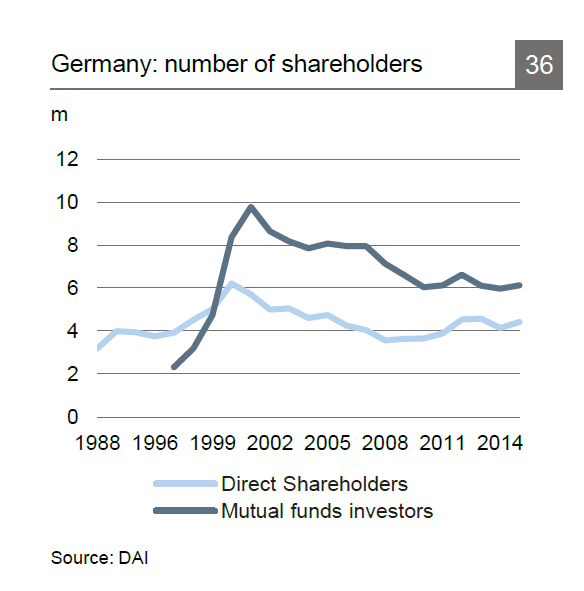
Among developed countries, Germany has one of the lowest stock market participation rates. According to a recent article, just over 9 million of Germans owned stocks either directly or indirectly thru mutual funds. This figure is very low when we consider the population of the country which stands at over 81 million. In comparison, more than 50% of all Americans own stocks. Currently the US population is over 318 million. So that is about 159 million.

The graph below shows the total number of shareholders in Germany since 1988:

Source: Beacon of stability: The foundations of Germany’s success, Deutsche Bank Research

Very few Germans invest in the stock market because they have a high aversion to risk. Americans on the other hand are extreme risk-takers. In addition to the high equity market participation rate, the high popularity and growth of casinos, lotteries, sports betting, bingo games, etc. confirm the risk-taking culture prevalent in the U.S.

From a recent article at DW:

The reasons for Germans’ chronically low market participation are manifold, says Gerrit Fey, the director of capital market policy at DAI.

In addition to tax rules that could be seen as disincentivizing investing, historically, Germany has always had a more or less functional pension system.

“We are not taught that building our own fortunes will allow us to enjoy some extra income later in life,” Fey told DW. “You have these ingrained behavioral patterns in Germany that show a large aversion to risk.”

Some of the reluctance to buy equity also comes from memories of past stumbles that refuse to fade. In 2001, it was the bursting of the dot-com bubble; in 2003, the implosion of the Neuer Markt, a technology index on the German stock market styled after the NASDAQ.

There were also a number of high-profile IPOs that went awry. In 1996, for instance, the German government privatized Deutsche Telekom and had to raffle off shares because demand was so high. Many people saw Telekom as a sure-fire way to make some money – until the share price tanked and dragged Germans’ confidence down with it.

The fact that the Telekom debacle still stings betrays another idiosyncrasy of Germans’ trading habits. Generally speaking, Germans tend to have a shrewd sense of when to sell, Fey says. But their problem is not always knowing when to buy back in.

Source: Why are Germans afraid of the stock market?, DW

Takeaway:

Just because not many Germans trust stocks, does not mean foreign investors must be wary of German stocks. In fact, as the economic powerhouse of Europe, Germany is home to world-class firms and by investing in stocks investors have the opportunity to profit from their success. In certain sectors such as chemicals, engineering, automobiles, etc. German companies top other European countries and the world.

Also checkout:

Comparing The Valuation Of British Stock Market Sectors

The FTSE 100 is up just over 12% year-to-date. The index has outperformed the other major indices of developed Europe such as the CAC-40, DAX and IBEX. This is because the FTSE 100 is heavily concentrated with mining and oil and gas firms and the companies in the index are more dependent on foreign markets than the domestic market for revenues.

So from an investment perspective for 2017, which sectors of the British equity market are cheap now?

Before we get to the answers, lets review some of the key points on British stocks from an article published by Schroders:

  • In October, 2016 the FTSE reached a record high of 7,129.83. In February when markets worldwide were shaky the index dropped below 5,600.
  • Currently the dividend yield on the FTSE is about 4%. This is much higher than what investors can get with UK gilts(government bonds) and bank savings accounts. So investors looking for income and beat inflation which is around 1.2% can consider investing in stocks.
  • However the dividend cover – a measure of the ability of a company to pay dividends from cash generated – has declined dramatically since 2006. But a recovery in the British and global economy should improve companies’ earnings leading to a rise in dividend cover.
  • The FTSE 100 currently has a P/E ratio of 16.8 compared with a long-term average of 14.9. So British stocks are not cheap. Based on the tangible book value though stocks look attractive. This figure stands at  3.43 compared to a historical average of 3.76.

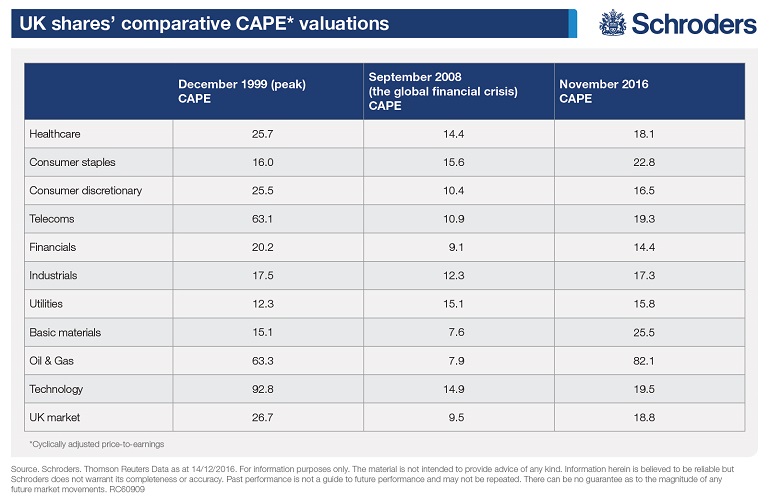
Some sectors of the market looks cheap relative to historical ratios. The following table shows the cyclically adjusted price-to-earnings (CAPE) ratios of different sectors:

Click to enlarge

Source: What next for the FTSE 100? by David Brett, Schroders

Some of the British stocks trading on the NYSE that investors can consider for further research are: Vodafone Group PLC (VOD), British American Tobacco PLC (BTI), AstraZeneca PLC (AZN), Diageo PLC (DEO), National Grid PLC (NGG), BP PLC (BP) and Royal Dutch Shell PLC (RDS.A). Investors may want to avoid British banks now.

Also checkout:

Disclosure: No Positions

How Closely is the Canadian Economy Linked to the U.S. Economy?

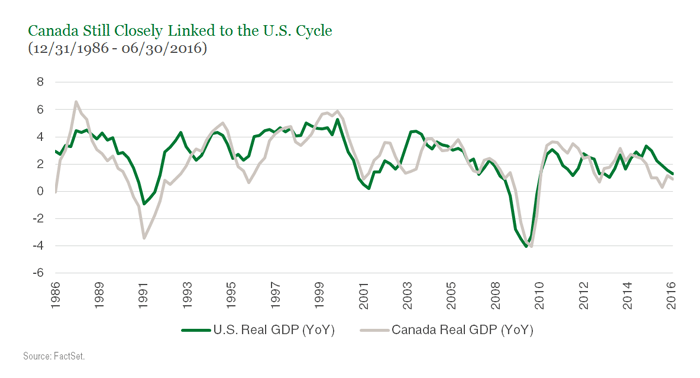
The economy of Canada is highly linked to the US economy. In fact, when the US economy is in expansion mode Canada does better and vice versa

Click to enlarge


In terms of size, Canada’s population is about the size of California and its GDP is about the size of the GDP of Texas. The US GDP is about twelve times the size of Canada’s GDP.

Source: Country in Focus: Canada, Manning & Napier

Knowledge is Power: Globalisation, Car Habbit, Emerging Markets Edition

Other Interesting links from bookmarks:

  1. Railroad Stocks 2015: Guide to Rail Stocks & Investments
  2. Travelling on the Trans-Siberian in style: wi-fi, gyms, libraries, restaurant carriages, children’s playrooms – even arrange for your own carriage to be attached to the train
  3. The Art of Doing Nothing
  4. Deducting a Loss in an IRA « The Investment Conversation
  5. REITs Review: Looking Beyond the Price Tag – Context | AB
  6. Is It Too Late to Catch the Emerging-Market Rally? – Context | AB
  7. Why are so many active funds underperforming? – Citywire Money
  8. FTSE 100 Index – Wikipedia
  9. America’s road trip: will the US ever kick the car habit? | Cities | The Guardian
  10. Why Aren’t Americans Getting Raises? Blame the Monopsony – WSJ
  11. With Trump, no hope for change – Livemint
  12. Taking aim at the establishment: Why some of Europe’s top leaders are walking dead – World – CBC News
  13. Fines Alone Won’t Deter Corporate Crime – Bloomberg View
  14. My journeys in Trumpland | US news | The Guardian
  15. US elections: How slogans can make or break a candidate – Livemint
  16. Kenneth R. French – Data Library
  17. Solving Canada’s Innovation Problem · thewalrus.ca
  18. How many US manufacturing jobs were lost to globalisation? | FT Alphaville
  19. ‘Democracy was hijacked. It got a bad name’: the death of the post-Soviet dream | World news | The Guardian
  20. BBC – Autos – Inside the world’s longest rail tunnel
  21. Five things that could turn a good stock into a great stock | Financial Post
  22. Why globalisation, as we know it, is dead | Business Line
  23. Why Many Young Russians See a Hero in Putin
  24. Justin Trudeau: ‘Globalisation isn’t working for ordinary people’ | World news | The Guardian
  25. 16 Best Foreign Movies on Netflix Ranked and Reviewed
  26. Comparing Health Systems – UK NHS Performance | The Nuffield Trust
  27. A public option for banking | Al Jazeera America
  28. Germany axed tuition fees – but is it working out? | World news | The Guardian
  29. The Brazilian Doctors Who Sounded the Alarm on Zika and Microcephaly – WSJ
  30. Health Care’s Continental Divide – Bloomberg View
  31. After Living in Norway, America Feels Backward. Here’s Why. – BillMoyers.com


Thyssenkrupp Headquarters, Essen, Germany