Auto Workers in Mexico Earn Less Than Those in China

In an article last last year I discussed the average hourly wage rate for auto workers in select countries. I wrote “Mexicans working at the auto factories get between $1 an hour to $ 3 an hour. Mexico’s minimum wage is 73 pesos or $4 a day. Hence auto workers earn much more than the prevailing minimum wage. Despite this Mexican workers are far cheaper since in all the developed countries hourly wages run into double digits. Mexico has many advantages for auto manufacturing due to many factors including the cheap labor, railroad and road transportation links and close proximity to the US.”
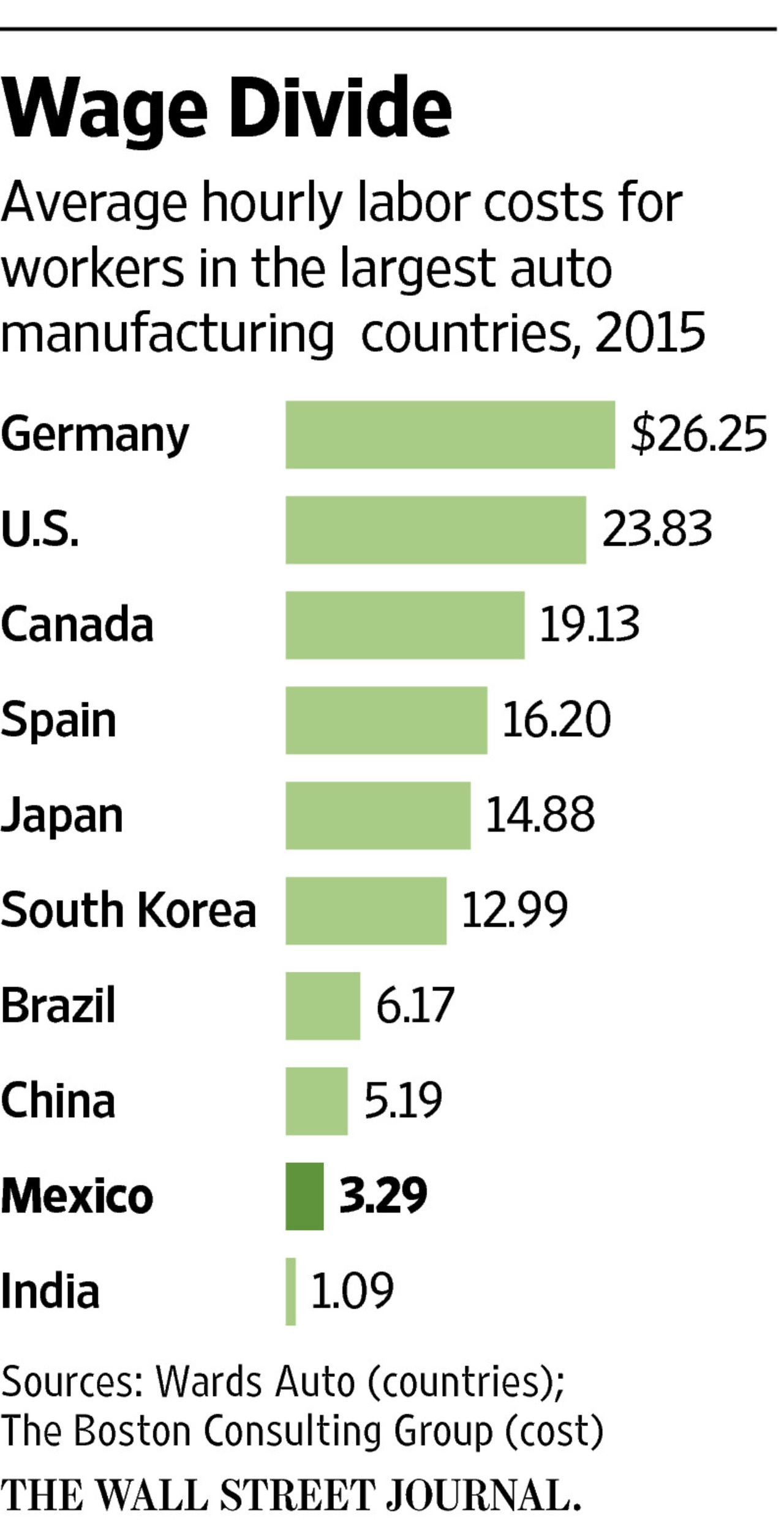
Source: It’s Getting Harder and More Expensive to Make Cars in Mexico, WSJ, Aug 14, 2016

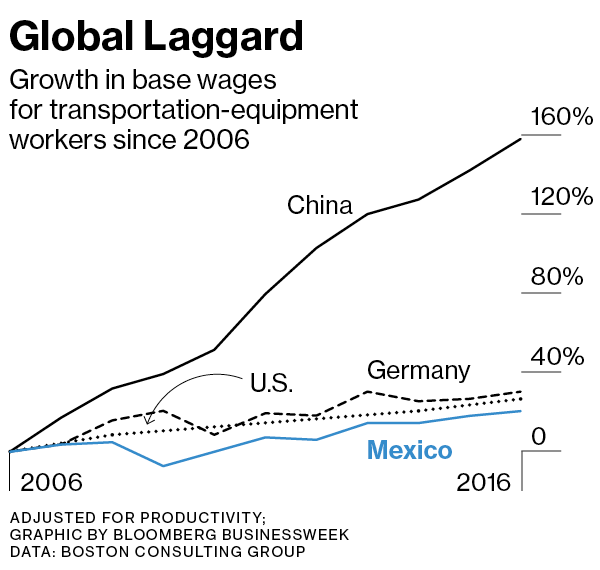
Bloomberg published an interesting piece last week discussed why Mexican auto workers’ age is very low and why it is not increasing. It seems like powerful unions and politicians that run the country basically sell out auto workers behind their backs. From the article:

At a ceremony at Mexico’s Los Pinos presidential residence in July 2014, BMW Chief Executive Officer Harald Krüger pledged to spend $1 billion to build a factory in the northern state of San Luis Potosí that will employ 1,500 workers. To mark the occasion, he presented President Enrique Peña Nieto with a model of a silver BMW race car.

The German automaker had unwrapped its own gift two days earlier, a labor contract signed by a representative from the state chapter of the Confederación de Trabajadores de México (CTM), the country’s largest union confederation, and notarized by a Labor Ministry official. The document, which Bloomberg reviewed, sets a starting wage of about $1.10 per hour and a top wage of $2.53 for assembly-line workers. The starting rate is only a bit more than half the $2.04 an hour that is the average at Mexican auto plants, says Alex Covarrubias, a lecturer at the University of Sonora in Hermosillo.

The paperwork was filed two years before BMW broke ground on the new plant, which will turn out $45,000 3 Series sedans. When workers begin to stream into the factory sometime next year, there’s a good chance most won’t know they belong to a union.

So-called protection contracts— agreements negotiated between a company and a union that doesn’t legitimately represent workers—are illegal in the U.S. and Germany. But Lance Compa, a senior lecturer at Cornell’s School of Industrial and Labor Relations, says they’re standard operating procedure in Mexico, where deals are cut factory by factory rather than collectively across a company or industry. Experts say this is a primary reason that wages in the auto sector have stagnated in recent years, despite a fresh wave of investments by foreign carmakers, most recently by German and Japanese manufacturers. Mexico’s union bosses and politicians are more interested in keeping corporations happy than in raising the living standards of workers, Covarrubias argues. “Protection contracts are a way to keep wages artificially low,” he says.
 

SourceHow Mexico’s Unions Sell Out Autoworkers, Bloomberg, May 5, 2017

The entire Bloomberg article is worth a read.

Related:
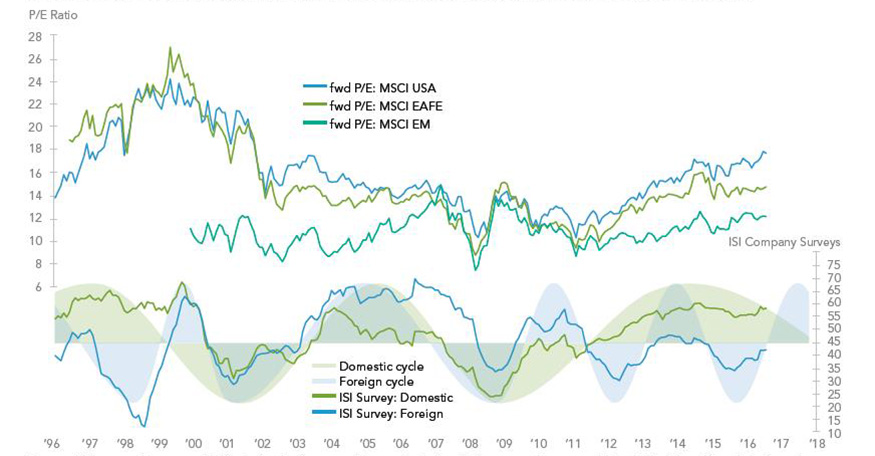
Valuation Ratio: US vs. International Developed and Emerging Market Stocks

U.S. stocks have outperformed international stocks in the past few years. Foreign stocks look attractive at current levels while their American peers look expensive. According to an article by Jurrien Timmer at Fidelity, since the Global Financial Crisis peak in March 2007 thru April 2017 the S&P 500 has returned 282% in total returns compared to 136% and 130% for international developed and emerging market stocks.

Most recently the MSCI US Index had a forward  P/E ratio of 17.7 while the MSCI EAFE Index (for international developed market) and MSCI EM Index had ratios of 14.8 and 12.2.  So investors looking to diversify their holdings may want to consider adding high-quality foreign stocks in a phased manner.

Click to enlarge


Source: Stock market check-in: Good and not-as-good news, Fidelity

Coal Jobs Compared to Jobs in Other Industries: Chart

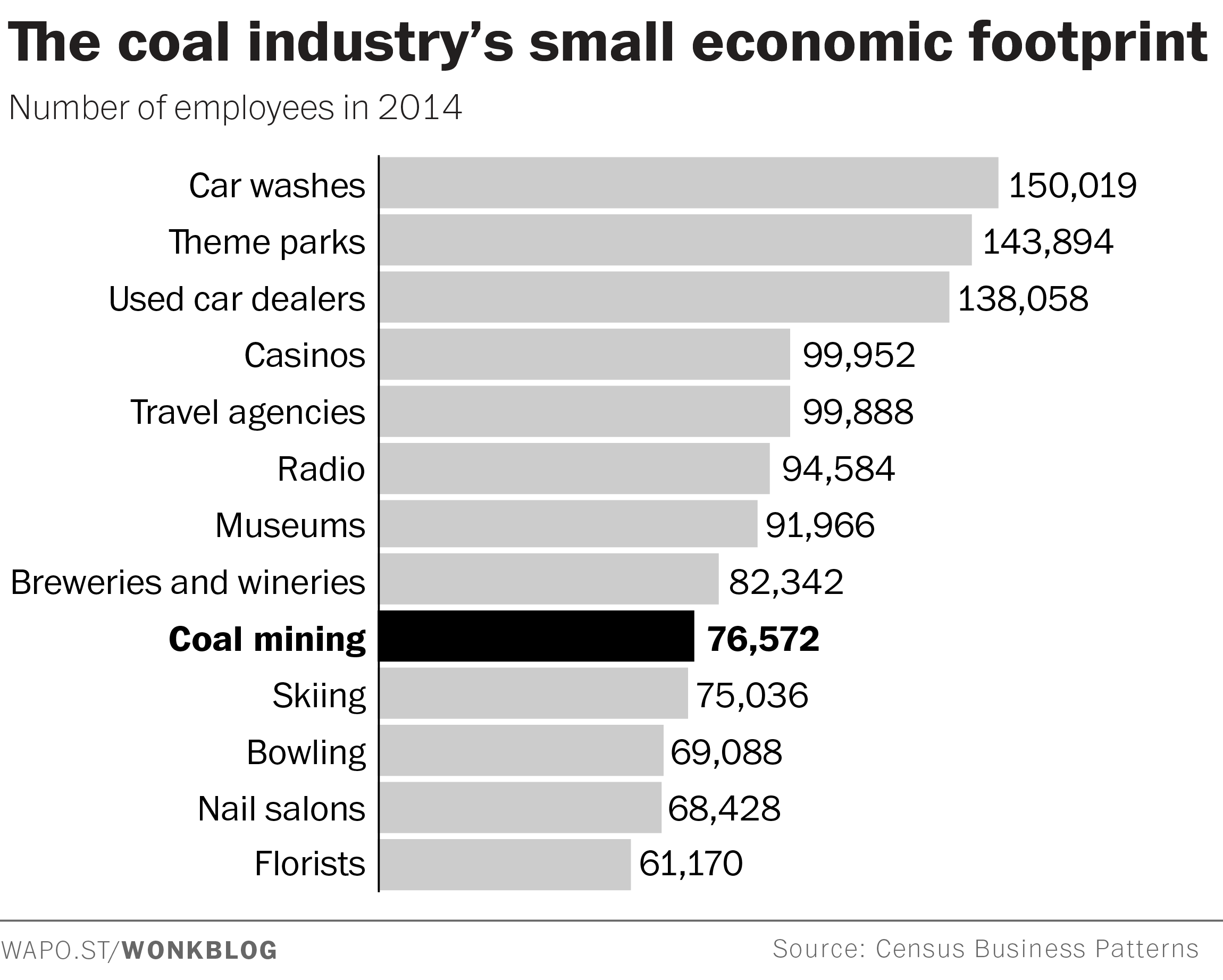
The number of workers employed in coal mining industry is less than the number of workers in than many other industries. For example, museums employed 91,966 compared to just 76,572 workers in the coal industry according an article I came across in The Washington Post. The 76K figure is not coal miners only but also includes office workers, sales people and others in the coal mining industry.


Click to enlarge


SourceThe entire coal industry employs fewer people than Arby’s, Washington Post

Related:

A Look At Leading Blue-Chip Companies From The Eurozone

The Top 50 blue-chip companies in the Eurozone are represented in the Euro Stoxx 50 Index. The Eurozone countries covered by this index are Austria, Belgium, Finland, France, Germany, Ireland, Italy, Luxembourg, the Netherlands, Portugal and Spain. For investors looking to gain exposure to developed Europe this index offers an excellent starting point for identifying potential investment opportunities.

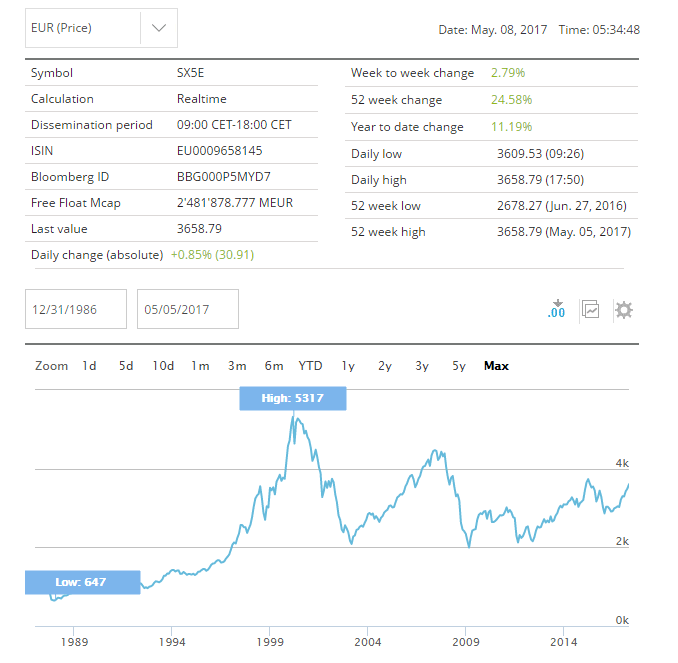
The Euro Stoxx Index is still below the long-term peak as shown in the chart below:

Click to enlarge

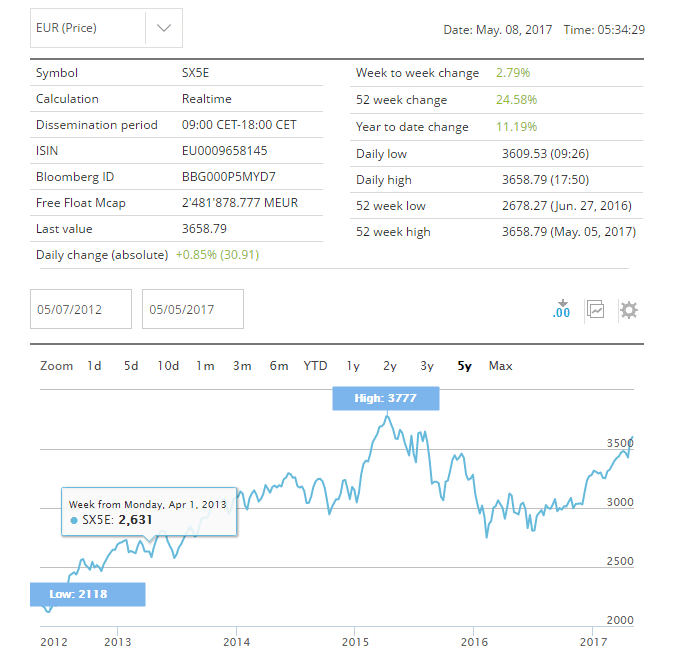
The following chart shows 5-Year performance of the index :

Note: Returns shown are for Euro-denominated price returns.

Source: Euro Stoxx

Ten stocks from the index are listed below with their current dividend yields for further research:

1.Company: Total SA (TOT)
Current Dividend Yield: 5.03%
Sector:Oil, Gas & Consumable Fuels
Country: France

2.Company: BASF SE (BASFY)
Current Dividend Yield: 3.21%
Sector: Chemicals
Country: Germany

3.Company: Siemens AG (SIEGY)
Current Dividend Yield: 2.64%
Sector:Industrial Conglomerates
Country: Germany

4.Company: Sanofi (SNY)
Current Dividend Yield: 3.21%
Sector: Pharmaceuticals
Country: France

5.Company: Banco Santander SA (SAN)
Current Dividend Yield: 3.41%
Sector: Commercial Banks
Country: Spain

6.Company: Unilever NV(UN)
Current Dividend Yield: 2.71%
Sector: Food Products
Country: The Netherlands

7.Company: Anheuser-Busch InBev SA/NV (BUD)
Current Dividend Yield: 3.17%
Sector: Beverages
Country: Belgium

8.Company: Allianz SE (AZSEY)
Current Dividend Yield: 4.16%
Sector:Insurance
Country: Germany

9.Company: Adidas AG (ADDYY)
Current Dividend Yield: 1.06%
Sector: Sportswear
Country: Germany

10.Company: Eni SpA (E)
Current Dividend :
Sector:Oil, Gas & Consumable Fuels
Country:Italy

Note: Dividend yields noted above are as of May 5, 2017. Data is known to be accurate from sources used.Please use your own due diligence before making any investment decisions.

Another simple way to gain exposure to the Eurozone blue-chips is via the SPDR® EURO STOXX 50® ETF (FEZ). Currently the fund has an asset base of over $3.4 billion and the expense ratio is 0.29%.

Disclosure: Long SAN

French Stocks in Focus

The French election is currently under-way. Tomorrow global investors may react based on the outcome of this divisive election. For US investors, only 11 French companies now trade on the organized exchanges. However those willing to go to the OTC markets have an additional 102 companies to choose from.

Among the major firms trading on the NYSE are Sanofi(SNY), Orange(ORAN) and oil major Total(TOT). Go to The full of French ADRs on the exchanges for all the stocks.

Many of the other top companies trade on the OTC market. Some of the options to consider include: Air Liquide(AIQUY), Arkema(ARKAY), AXA(AXAHY), BNP Paribas(BNPQY), Societe Generale(SCGLY), Danone(DANOY),Electricite de France(ECIFY) and Valeo(VLEEY). The complete list of stocks on the OTC market can he found here.

Related:

Disclosure: Long AXAHY