The Benefits of Cloud Computing

The benefits of Cloud computing cannot be under estimated. The biggest player in this new technology is the e-commerce giant Amazon(AMZN). Amazon Web Services(AWS) generated over $12.0 in  revenue in 2016. Other companies such as Microsoft(MSFT), Alphabet(GOOG) are also growing their cloud offerings.

The following chart shows some of the benefits of cloud computing over traditional IT:

Click to enlarge
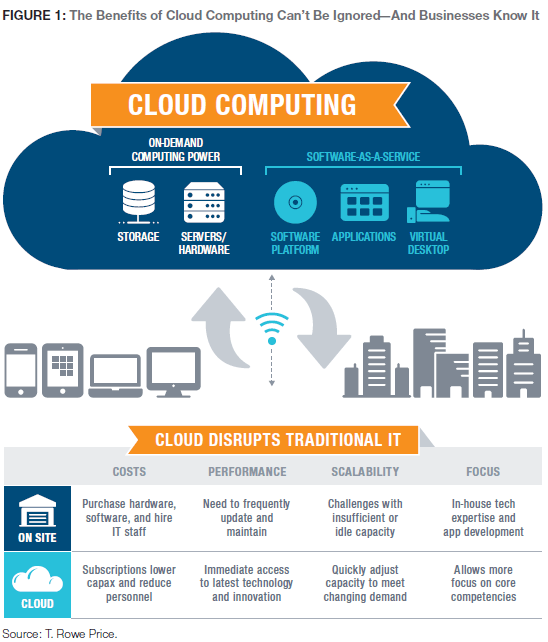
 

Source: Global Technology – Cloud Computing: In Early Stages and Spreading Globally by Paul Greene, T.Rowe Price

Disclosure: No Positions
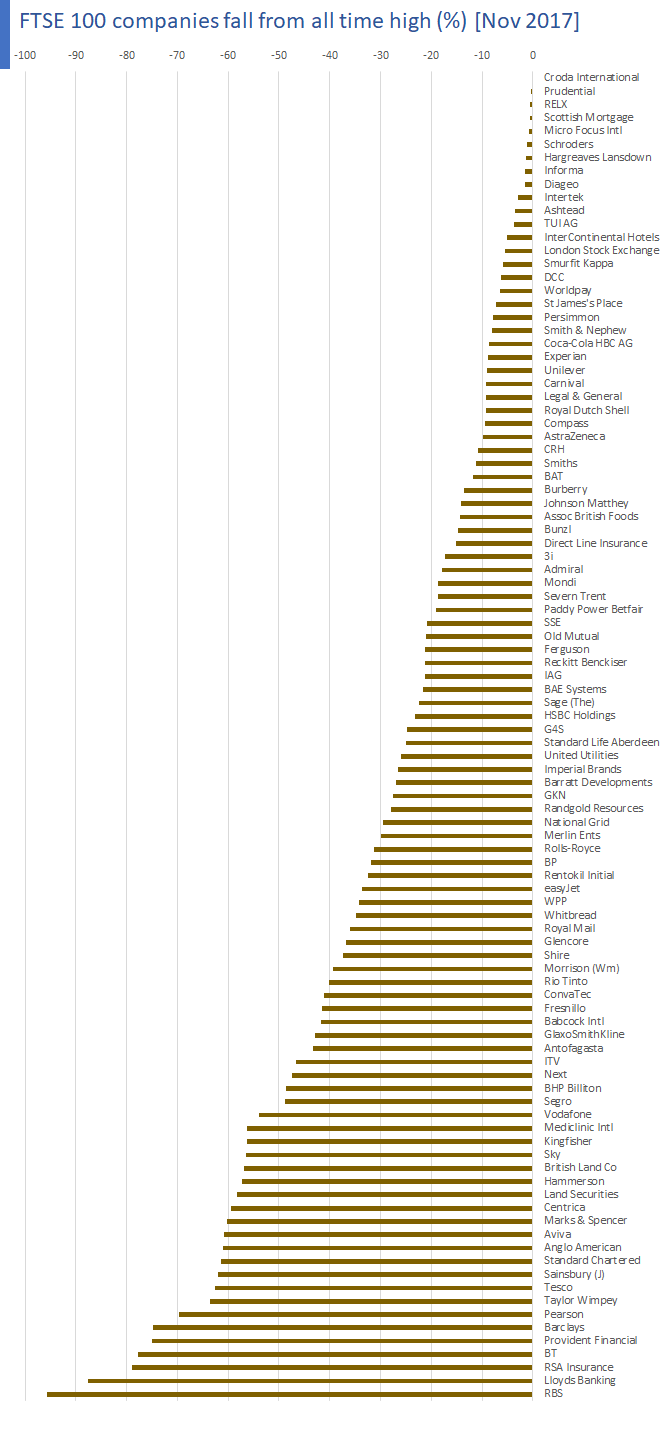
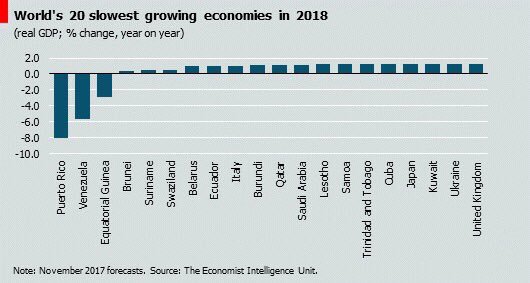
How Far Have FTSE 100 Index Stocks Fallen From Their All-Time Highs?

Many of the companies in the FTSE 100 index are still down from their all their highs reached before the Global Financial Crisis(GFC) of 2006-07. Despite the index reaching all high records recently these companies’ stocks are languishing. Some of them may never recover their previous highs in our life times. This is especially true with banking stocks. Unlike the US, where swift measures such as the TARP have made most of the surviving banks strong and growing, the UK failed to take meaningful actions due to political and regulatory paralysis. As are result the top British banks have lost their glory.

Investors in banking stocks have seen most of their investment wiped out due to the collapse in share prices and the lack of strong recovery/ The following chart shows the fall in percentage from their all-time highs for FTSE 100 Index companies:

Click to enlarge

Note: Data shown above is based on local currency and as of Nov 19, 2017

Source: Stock Market Almanac

A few observations:

  • Royal Bank of Scotland Group PLC (RBS) is still down 96% from its all-time highs. This bank should drop the “Royal” from its name and simply go with Bank of Scotland or BS for short.
  • Another former hi-flier Lloyds Banking Group PLC (LYG) is off more than 75% from all-time highs. Instead of having a horse on its logo, it should revamp the logo and change it to a goat or sheep or a donkey. Or maybe change its name altogether to something else.
  • Firms like Diageo PLC (DEO), British American Tobacco PLC (BTI), Unilever PLC (UL), etc. have performed well and are closer to their all-time highs than the awful banks.

Disclosure: No positions

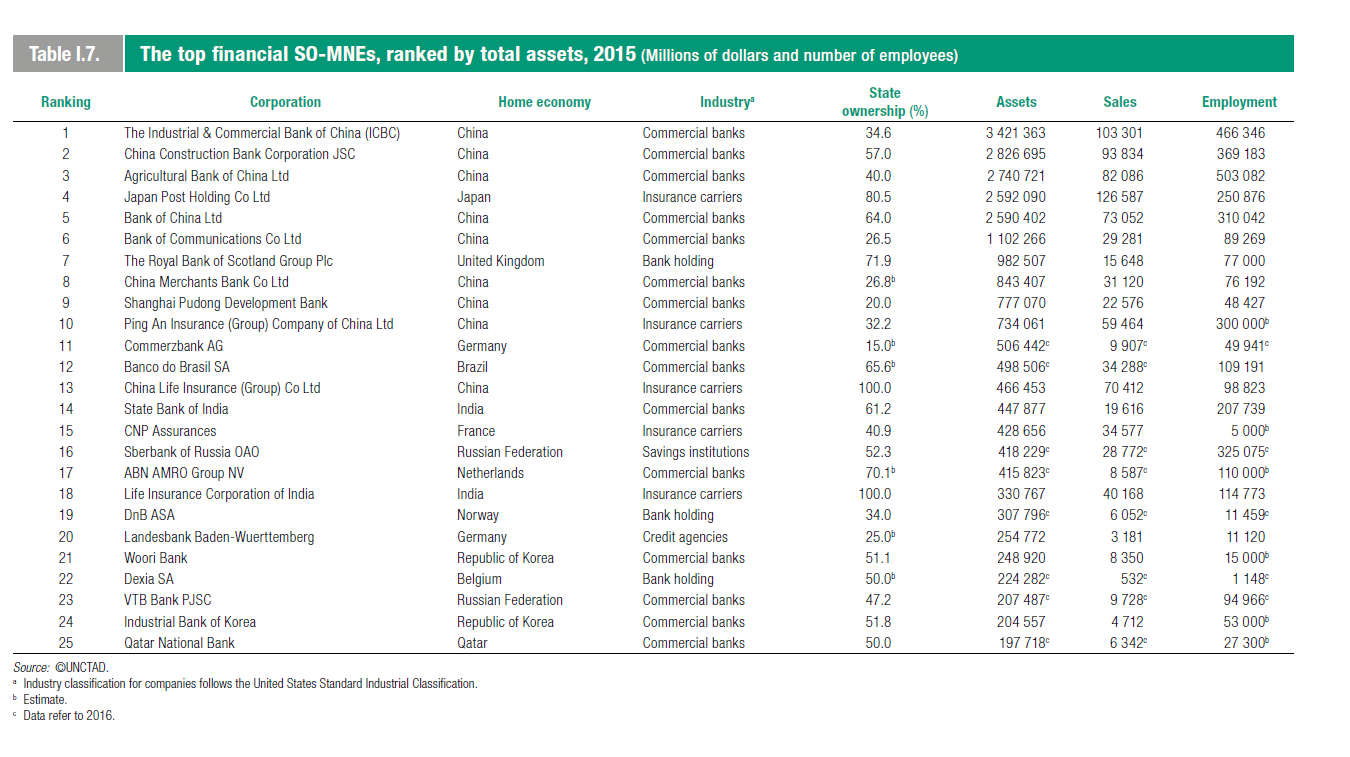
The Top 25 Financial State-Owned Multi-National Companies 2017

The Top 25 Financial State-Owned Multinational Corporations (MNCs) ranked by Foreign Assets as of 2015 are listed in the table below:

Click to enlarge

Source: World Investment Report 2017, UNCTAD

The Royal Bank of Scotland(RBS) is majority(72%) owned by the British state. The state is the largest shareholder in many of the top banks in emerging markets such as Brazil, China and India.

Related:

Disclosure: No Positions

Honda vs. Tesla: A Brief Review

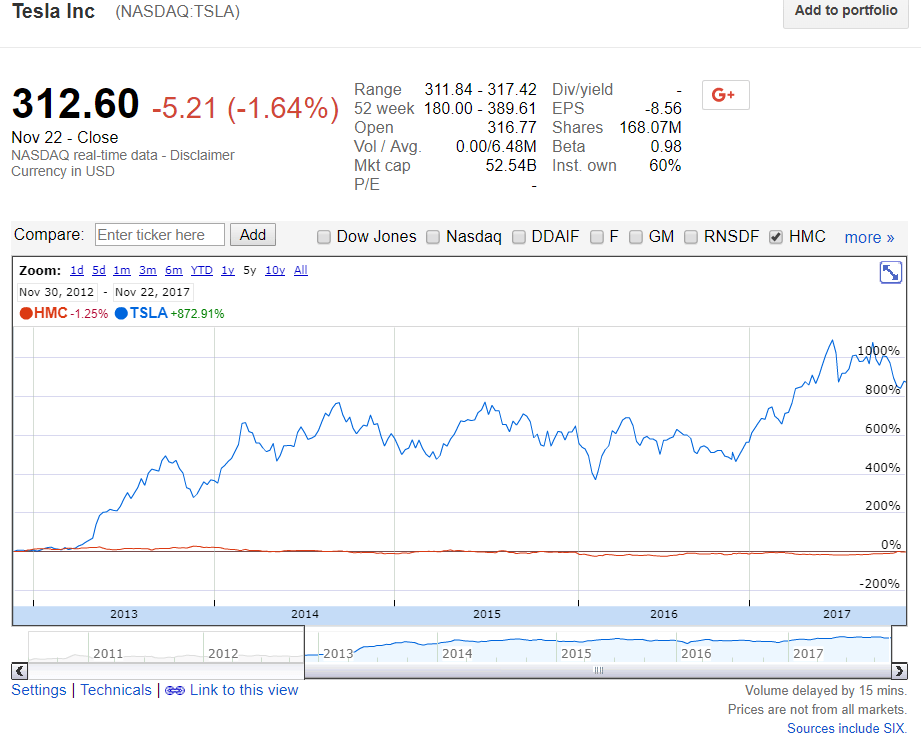
Electric automaker Tesla(TSLA) has become one of the most valuable auto companies the world. Investors are highly attracted to the company’s stock for its growth potential. In this post, let’s take a quick look at how Tesla compares with the Japanese auto giant Honda.

Equity investors in Tesla have enjoyed phenomenal gains. The firm’s stock is up 43% year-to-date compared with just 13% for Honda Motor Co. Ltd(HMC). In the past five years, TSLA has shot up an astonishing 873% while HMC is basically flat as shown in the chart below:

Click to enlarge

Source: Google Finance

In the past 10 years, TSLA has soared 1,528%. However it should be noted that Tesla is a highly volatile stock.Even a small negative news has a substantial adverse on the stock price.

Ben Preston of Allan Gray published an article titled “Finding value in an over-valued world”. From the piece:

Honda vs Tesla

Graph 1 compares the market capitalisation and revenue of Honda and Tesla. It is remarkable that investors have allowed themselves to be so convinced of Tesla’s future success that they are now saying Tesla is worth more than the whole of Honda, even though Honda has 10 times the revenue. Bear in mind that in a decade of existence, Tesla has never been profitable. And, in the last four decades, Honda has never been unprofitable.

It is important to acknowledge that Honda’s earnings have historically been cyclical. The company experienced a big decline in earnings from the mid-80s to the mid-90s, and again in the global financial crisis. But even during those periods, Honda’s shares have only rarely – and only very briefly – traded for less than tangible net asset value. On average, its shares have traded at a 50% premium to net asset value, but today investors can buy them at a 10% discount. In the context of a stock market that looks quite expensive overall, Orbis believes that Honda shares look like pretty good value.

Source:Finding value in an over-valued world, Allan Gray

Obviously Tesla is a high growth company and Honda is a stable well-established slow grower. Clearly investors are willing to pay a premium for fast growing firms even of they are not profitable.

Disclosure: No Positions