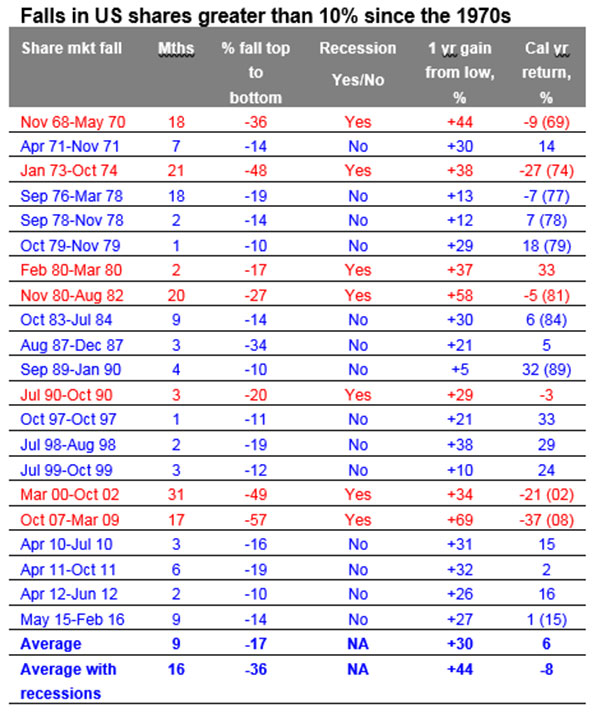
The US equity markets had one of the steepest falls yesterday. The market became volatile last week and culminated yesterday with the sharpest drop yet in recent years. The Dow fell over 1,100 points with a loss of 4.6%. S&P 500 also fell in tandem.
In the past months, stocks made one record after another. Fads like bitcoin, cannabis stocks, dot con 2.0 internet stocks, etc. became the latest craze that lured everyone from millennials to mom-and-pop investors. However while the economy in general started growing, earnings of American firms were not increasing exponentially other than a handful of firms. In addition, valuations of stocks became stretched. Currently the S&P 500 has a P/E of 24.74 well above the mean of around 15. Overall a combination of factors including the ones mentioned above and others such as complacency, too much money chasing few stocks, euphoria, etc. are leading to the decline in equity prices.
Today I came across post by Duncan Lamont at Schroders discussing the factors behind the returns of major equity markets and the implications for future growth. From the article:
When we look back over the past three years, investors have earned remarkably similar returns in local currency terms in very different parts of the world.
UK, eurozone, Japanese and emerging market equities have all returned close to 9.5% a year1. The US, as is well known, has been the outlier and star performer, delivering closer to 11.5% a year.
However, when we look behind the numbers at what has been driving that performance, we find an altogether different and more diverse set of circumstances. The chart below decomposes returns over the 2015-2017 period into their key components:
- Income (blue bar) – dividends2
- Earnings (green bar) – how fast have companies grown their earnings?
- Valuations (red bar) – how has price/earnings multiple changed? Does the market now value companies more or less, for a given level of earnings
The sum of these components approximates the return on the stockmarket, which is shown with a black diamond.
Past performance is not a guide to future performance and may not be repeated.
Three key features stand out:
- US returns have been driven predominantly by increasing valuations. Earnings growth has been next to nothing.
- Japanese and eurozone equities have been powered by a combination of strong earnings growth and dividends. The market has failed to reflect these better fundamentals in valuations, which have stagnated.
- UK equities have had a rollercoaster ride. The decline in commodity prices contributed to a collapse in earnings over the past three years, given the market has a large allocation to this sector. However, investors have been prepared to value companies higher relative to those depressed earnings, which has softened the blow. One explanation for this is that investors have priced in a sustained recovery in commodity prices.
When we look at 2017 in isolation we find a different set of drivers. Synchronised and strong earnings growth everywhere has been the main engine of returns in all markets.

1. Emerging market equities represent a basket of different currencies. Local currency for emerging markets has been taken to be USD.
2. Technically, the income return has been calculated as the difference between the change in the share price and the total return earned on an investment.
Source: What has driven stockmarket returns and what will drive them in future?, Schroders
Earlier:
As stocks continue to take investors on a wild ride like a roller coaster, here are a few thoughts to remember:
- Keep calm and carry on.
- Do not get scared by headlines.
- It is wise not to sell out in panic.
- If further declines occur take advantage and deploy cash into high-quality stocks.
- Never stop automatic dividend reinvestments when markets decline.
- Keep an eye on the markets with a focus on some stocks in the watchlist for potential buying opportunities.
- Time in the markets is more important for success than timing the markets. So avoid trying to predict the direction of the market.
Sometimes the best way to win in the markets is to do nothing. Yesterday’s volatile day is one such day where staying put is better for the long-run than panicking.